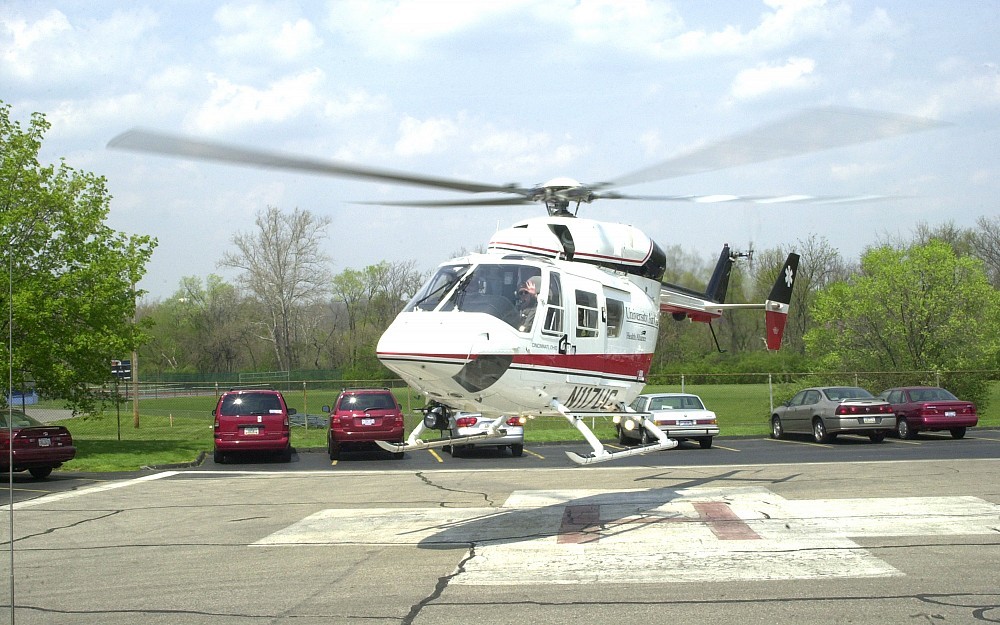
Even With Helicopter EMS, Hospital Transfer Can Delay Treatment for Heart Attacks

CINCINNATIHelicopter emergency medical services can be a life saver for patients needing immediate care. But, according to a UC-led study, the process of activating them often delays treatment beyond recommended times.
The study, published online ahead of print in Annals of Emergency Medicine, was led by assistant professor Jason McMullan, MD. In a multicenter, retrospective chart review, McMullan found that a majority of STEMI heart attack patients transferred by a hospital-based helicopter emergency medical service (HEMS) in 2007 did not receive treatment within the time period recommended by national physician groups.
For patients with a ST-elevation myocardial infarction (STEMI), a type of heart caused by a sudden, total blockage of a coronary artery, the American Heart Association and American College of Cardiologists have set a goal of 30 minutes to open the artery if a clot-busting drug is given (a treatment known as fibrinolysis) or 90 minutes if a stent is to be placed in the artery (percutaneous coronary intervention, or PCI). The length of time from the patients arrival at the emergency department to treatment by PCI is commonly referred to as "door to balloon time.
"The goal of treating patients suffering heart attacks is to open a clogged cardiac artery as soon as possible, says McMullan. "While all emergency departments have access to fibrinolysis, not every hospital is capable of PCI. As a result, many people are transferred to a PCI hospital to receive a stent and a helicopter is frequently used to make that transfer as fast as possible.
With the chart review, researchers aimed to estimate the proportion of STEMI patients transported by a hospital-based helicopter who met those national goals.
McMullan reviewed the charts of 179 subjects, flown by UC Healths helicopter emergency medical service, Air Care, from 16 referring to six receiving hospitals in Greater Cincinnati. He found that, of those patients transferred for PCI, only 3 percent received treatment within the 90-minute goal, and more than half were treated after two hours.
"Our results suggest that, when inter-hospital transfers are required, significant delays are introduced, even when a helicopter is used, says McMullan. "A tremendous amount of time is lost in trying to contact a cardiologist to accept the patient, which, during the time period studied, had to be done before Air Care could be called. We recommend that in these situations, hospitals without a PCI capability consider early fibrinolytic therapy.
The study found only one in five patients was treated with fibrinolytic therapy prior to transfer to a hospital with PCI capability. Of those, fewer than half were treated within the 30-minute goal.
Authors point towards delays in the process of activating HEMS that can contribute to delays in treatment.
"The take-home point of our findings is certainly not that helicopter EMS doesnt help STEMI heart attack patients; on the contrary, HEMS undoubtedly saves many lives in getting suburban and rural STEMI patients to cardiac catheterization labs for PCI as rapidly as possible, says Air Care medical director and paper co-author William Hinckley, MD. "Rather, the point is that calling the helicopter is not like saying, Beam me up, Scotty on Star Trek. Its fast, but its not instantaneous.
They recommend that hospitals consider strategies to reduce the time required for transfers, possibly by creating a streamlined system in which an emergency medicine physician is able to call for both helicopter transport and cardiologist approval with a single phone call or by allowing non-physician personnel to request a transfer.
Hinckley says other strategies could include enabling rural EMS squads to activate Air Care from the field. Based on the research, he says Air Care is working with physician partners at referring and receiving hospitals to implement such new protocols and decrease the time from diagnosis to treatment for STEMI patients.
Co-authors are Jared Bentley, Todd Davis, MD, Gregory Fermann, MD, Matthew Gunderman, Kimberly Ward Hart, William Knight, MD, Christopher Lindsell, PhD, April Shackleford, MD, and W. Brian Gibler, MD.
UC Health comprises more than 650 physicians, a 650-bed tertiary care hospital (University Hospital), West Chester Hospital, a short-stay surgical hospital and medical building on the West Chester medical campus, and 30 practice sites around the Tristate region. At UC Health University Hospital, the average door to balloon time (for patients entering the hospital through the emergency department) is 67 minutes.

Once landed, Air Care & Mobile Care's flight crew take patients directly to University Hospital's critical care pavilion.
Tags
Related Stories
UC radiation oncologist speaks with Local 12 news about clinical trial for head and neck cancer treatment
August 10, 2026

Dr. Sara Medek, a UC radiation oncology professor, speaks with Local 12 news about a new clinical trial aimed at reducing radiation in certain areas while still treating cancer effectively but with fewer painful side effects.
Cancer Center director charts future based on collaboration, AI
August 10, 2026

David Gius, MD, PhD, was featured in a Cincinnati Business Courier article and The Cancer Letter’s “The Directors" podcast discussing his priorities and goals as he recently took the helm as director of the University of Cincinnati Cancer Center.
Bidirectional link between oral, kidney health calls for patient education, access
August 4, 2026

Despite growing awareness of the connection between oral health and chronic health conditions, patient awareness and access to dental care remain limited, according to University of Cincinnati experts who recently spoke with Healio | Nephrology News & Issues.