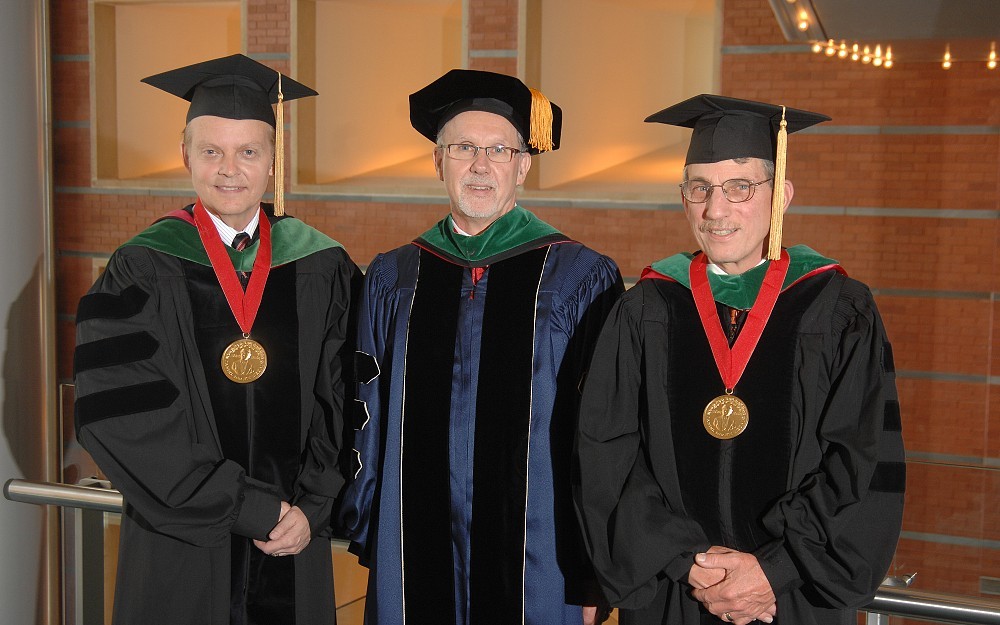
College of Medicine Awards Top Honor

CINCINNATIThe University of Cincinnati (UC) College of Medicine has named Richard Becker, MD, and James Heubi, MD, winners of the 2011 Daniel Drake Medal.
The Daniel Drake Medal was established in 1985 as the college celebrated the 200th anniversary of the birth of its founder, pioneering physician Daniel Drake. The award is given annually to honor distinguished living faculty and alumni.
"The annual Drake awards are a time when we at the College of Medicine can reflect on the contributions made by our outstanding faculty and alumni, says Andrew Filak, MD, interim dean of the College of Medicine and vice president for health affairs. "Drs. Becker and Heubi serve as great examples of the caliber of both the doctors we train and our faculty.
About Richard Becker, MD
Becker is professor of medicine at Duke University School of Medicine. He is co-director for the Duke Comprehensive Center for Hemostasis and Thrombosis, director of the Cardiovascular Thrombosis Center, Duke Clinical Research Institute (DCRI), and director of the Duke Health Systems Cardiogenetics Thrombosis Clinic.
He completed undergraduate, graduate and medical degrees at the University of Cincinnati; an internal medicine internship, residency, chief residency and a hematology/coagulation fellowship at the Cleveland Clinic Foundation; and a cardiology fellowship at the University of Massachusetts.
"I am deeply humbled by the award which bears the name of Daniel Drake and moreover, recognition by my peers and colleagues at the University of Cincinnati College of Medicine, said Becker in a statement submitted for the 2011 awards program. "Success in medicine, as in life, does not occur in isolation, but through support, nurturing, inspiration, mentorship and guidance.
About James Heubi, MD
Heubi has been on the faculty of UC for 32 years and professor of pediatrics since 1989. More recently he has been program director for the General Clinical Research Center (GCRC) from 1988 to 2010, associate dean for clinical and translational research since 2002, associate chair for clinical investigation in the department of pediatrics since 2006 and co-director of the Center for Clinical and Translational Science and Training since 2005.
Heubi graduated from Indiana University School of Medicine in 1973 and received the Marcus Ravdin Award for highest scholastic achievement. He completed his pediatric training at James Whitcomb Riley Hospital for Children in Indianapolis and fellowship training in pediatrics and gastroenterology, hepatology and nutrition at Cincinnati Childrens Hospital Medical Center.
"Over the years, I have been in admiration of all the outstanding faculty and alumni who have received this award because of their outstanding achievements and service to the College of Medicine, said Heubi in a statement submitted for the 2011 awards program. "I have had the privilege to have known one half of the recipients since the award was created in 1985 and I am honored to be included in their company.

2011 Daniel Drake Medal winner Richard Becker, MD

2011 Daniel Drake Medal winner James Heubi, MD
Related Stories
UC radiation oncologist speaks with Local 12 news about clinical trial for head and neck cancer treatment
August 10, 2026

Dr. Sara Medek, a UC radiation oncology professor, speaks with Local 12 news about a new clinical trial aimed at reducing radiation in certain areas while still treating cancer effectively but with fewer painful side effects.
Cancer Center director charts future based on collaboration, AI
August 10, 2026

David Gius, MD, PhD, was featured in a Cincinnati Business Courier article and The Cancer Letter’s “The Directors" podcast discussing his priorities and goals as he recently took the helm as director of the University of Cincinnati Cancer Center.
UC graduates cross finish line at commencement
August 7, 2026
The University of Cincinnati recognized 2,125 graduates in two ceremonies at summer commencement Friday on campus at Fifth Third Arena.