UC Researcher to Study Implementation of Electronic Health Records

CincinnatiA researcher in the University of Cincinnati (UC) Department of Emergency Medicine has received a two-year, $150,000 fellowship award from the Emergency Medicine Foundation to study the implementation of electronic health records in a suburban emergency department (ED).
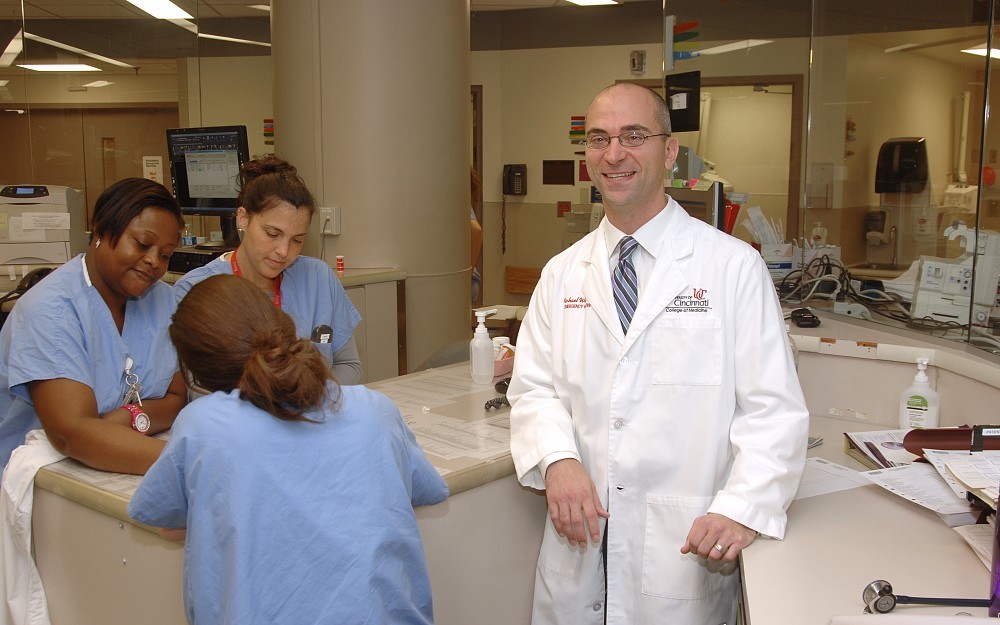
The award will support the work of Michael Ward, MD, MBA, an assistant professor at the College of Medicine. Ward has spent the past year focusing on simulation modeling in operations research, working with Sean Collins, MD, associate professor of emergency medicine, Craig Froehle, PhD, associate professor of operations management at the UC College of Business, and Christopher Lindsell, PhD, vice chair of research in emergency medicine.
In addition to being an emergency medicine physician at UC Health University Hospital, Ward also is pursuing a Master of Science in Quantitative Analysis (MSQA) in UC's Department of Operations and Business Analytics (OBA).
Specifically, his grant will fund the study of the operational effects of electronic health records in emergency departments, using discrete-event simulation to model how implementation strategies can be improved.
Wards latest research focuses on evaluating the operational disruption to an emergency department undergoing electronic health record (EHR) implementation.
"The claim is that these systems make everything better, faster and more efficient, he says, "yet many centers have to add staff and increase workloads during the weeks and months following their EHR implementation.
The study has two aims: first, to quantify the operational disruption of EHRs and second, to use simulation modeling to evaluate how to maximize efficiency during implementation.
Ward says this type of work wouldnt be possible without simulation modelingan operations research method that enables him to use existing data to predict how one or several changes can affect a complex system like an emergency department.
"In a regular clinical trial, you take one tiny little piece and change thatpatients get drug A or drug B, he says. "But when it comes to any sort of large-scale operation, there are so many factors involved that its tough to say that one variable really made a difference.
"For example, we see 80 to 90,000 patients in the UC Health University Hospital emergency department per year. But the number of patients in the department changes depending on the time of day, season or year. You take the department at 12:15 p.m. on a Monday and 12:15 p.m. on a Tuesday and it could be completely different.
With simulation modeling, Ward says he can use probability to simulate a system based on existing data.
"So you have a model that reasonably well approximates reality, he says. "Once you have that, you can start exploring it and running experiments over and over. There are many different ways in which you can start to evaluate the model you have, to give an estimate of what effect a change would have.
In his position as an operations research fellow, Ward has also studied the cost-effectiveness and accuracy of using different tests to diagnose pulmonary embolisms in the ED, decision making in subarachnoid hemorrhage and admission strategies for chest pain patients.
"With this kind of research, you can gain information that a trial never would be able to get or would be prohibitively expensive to study, he says. "It allows investigators to ask questions without actually running a trialand it becomes a very cost-effective way of studying complex systems.
Related Stories
UC expert weighs in on current MASH treatment approaches
June 5, 2026

As MedCentral recently reported, pending broader pharmacologic approvals for metabolic dysfunction-associated steatohepatitis (MASH), lifestyle modifications remain the go-to intervention.
At least two weather patterns increase headaches, UC study suggests
June 4, 2026
University of Cincinnati physicians and collaborators identified two specific weather patterns that increase headache and migraine risk and found the preventive medication fremanezumab (Ajovy) can reduce weather‑associated headaches. The findings will be presented at the American Headache Society Annual Scientific Meeting in Orlando.
UC researcher secures $3.3M grant to study microplastics’ impact on heart
June 2, 2026
The National Institute of Environmental Health Sciences awarded a $3.3M grant to University of Cincinnati researcher Hong‑Sheng Wang, PhD, to study how microplastics and nanoplastics affect cardiovascular health.