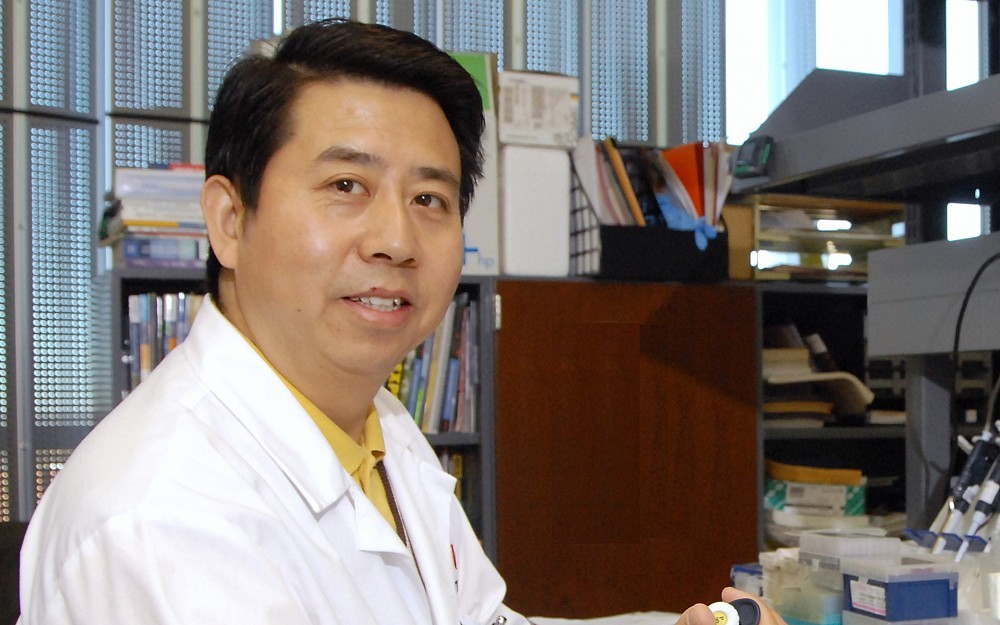
Researcher Awarded Grant to Find Stem Cell Treatments for Dry Eye

To anyone who suffers from chronic dry eye, Hongshan Liu, MD, PhD, assistant professor of research in the department of ophthalmology, could one day have a permanent solution.
Liu was recently awarded a 2011 Fight for Sight Grant-in-Aid award. The $20,000 award will be used to study the cause of dry eye and potential treatment using mesenchymal stem cellscells that can transform into various cell types in the bodytaken from the umbilical cord.
Fight for Sight is a nonprofit organization that provides pilot funding to researchers in support of finding cures and treatments for eye conditions.
Grants-in-Aid funding is typically awarded to junior faculty members who are developing their independent scientific skills.
"Im honored to receive this award, Liu says. "This money will help in furthering my basic research, hopefully resulting in solutions to a common ophthalmological issue.
Liu says dry eye is when the quality and quantity of tears are decreased.
"In the U.S., dry eye is the second most common problem of patients seeking eye care; it affects 10 percent of the population between the ages of 30 and 60 and 15 percent of the population 65 years and older, he adds.
Dry eye is characterized by simple eye irritation symptoms: Pain, light sensitivity, gritty sensation, a feeling of something foreign in the eye, itching, redness or blurred vision.
"Dry eye impacts quality of life and the ability to perform daily activities such as reading, using a computer and driving due to decreased visual functions, says Liu, adding that not much is known about this common condition.
"Current scientific evidence shows that dry eye is an inflammatory disease of the eyes surface and that this persistent inflammatory response leads to dysfunction of certain secretory glands, he continues. "Increased production and activation of pro-inflammatory cell-signaling proteins (interleukin-1â) play a crucial role in the formation of dry eye and is an inducer of inflammation, stimulating the production of other pro-inflammatory proteins.
With this knowledge, Liu hopes to find ways to suppress the overproduction of interleukin-1â in animal models using stem cells and find more effective remedies for dry eye.
"So far, there is a lack of treatment for dry eye, and patients affected by this condition must frequently use eye drops or artificial tears to relieve dryness on the eyes surface, he says. "So far, my data has shown that mesenchymal stem cells from a human umbilical cord were capable of suppressing inflammatory and immune responses, activated by overproduction of certain cells or proteins. For example, the transplantation of these cells significantly suppressed the inflammatory response in treating acid burns in models.
"In my study, I hope not only to find out more about the development of dry eye and the specific proteins involved in the development, but also I am planning to treat the dry eye in models with mesenchymal stem cell transplantation, to hopefully reverse disease development.
Liu says this study could lead to more and better treatments for patients with this condition.
"This research will eventually be tested in clinical trials, but the hope is that, eventually, it will benefit millions who suffer from dry eye worldwide, he says.
Tags
Related Stories
UC radiation oncologist speaks with Local 12 news about clinical trial for head and neck cancer treatment
August 10, 2026

Dr. Sara Medek, a UC radiation oncology professor, speaks with Local 12 news about a new clinical trial aimed at reducing radiation in certain areas while still treating cancer effectively but with fewer painful side effects.
Cancer Center director charts future based on collaboration, AI
August 10, 2026

David Gius, MD, PhD, was featured in a Cincinnati Business Courier article and The Cancer Letter’s “The Directors" podcast discussing his priorities and goals as he recently took the helm as director of the University of Cincinnati Cancer Center.
Bidirectional link between oral, kidney health calls for patient education, access
August 4, 2026

Despite growing awareness of the connection between oral health and chronic health conditions, patient awareness and access to dental care remain limited, according to University of Cincinnati experts who recently spoke with Healio | Nephrology News & Issues.