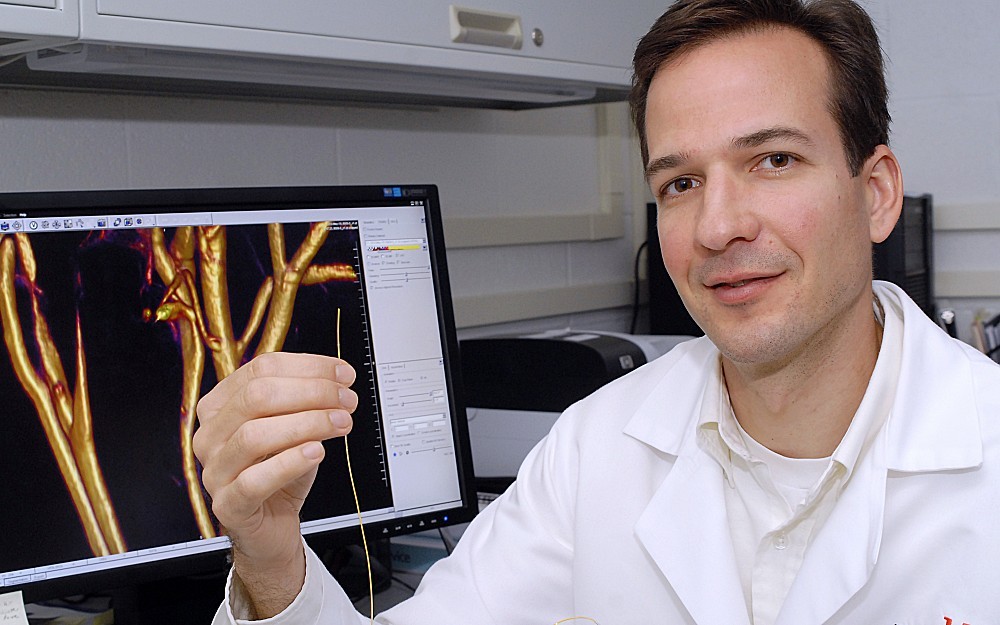
Focus on Science With David Manka, PhD

Focus On highlights faculty, staff, students and researchers at the UC Academic Health Center. To suggest someone to be featured, please email uchealthnews@uc.edu.
David Manka, PhD, is a research assistant professor in the division of cardiovascular diseases. He is an expert vascular biologist and developed the some of the first models of arterial injury in mice still used today today as a PhD student at the University of Virginia.
How long have you been with UC?
"I came in 2004, after a postdoctoral fellowship at the Flanders Interuniversity Institute of Biotechnology (VIB) in Leuven, Belgium.
What is your current research focus?
"I study the basic mechanisms of vascular disease. Lately, have focused on how the fat that surrounds the outside of arteries (perivascular fat) causes disease on the inside of the vessel.
How soon do you expect your findings to impact patient care?
"We are currently focusing on a number of genes that may be accounting for the detrimental effects of the perivascular fat on the adjacent artery. We have some very promising preliminary data in mice that may translate in a few years to the clinic. At this time, however, it is premature to make predictions.
What do you like to do in your spare time?
"I love playing soccer, traveling and spending time with my three young children."
Tags
Related Stories
On-site training in Speech & Hearing Clinic sets UC’s programs apart
August 27, 2026
At the University of Cincinnati’s Speech & Hearing Clinic, Doctor of Audiology and Speech-Language Pathology graduate students gain real-world experience while providing free speech and hearing services to the community.
Funding expands UC research into weight gain side effects of bipolar medication
August 26, 2026
University of Cincinnati researchers have been approved for funding by the Patient-Centered Outcomes Research Institute (PCORI) to expand the implementation of healthy lifestyle interventions and metformin prescription to help manage weight gain in overweight or obese youth taking second-generation antipsychotic medications.
One in four NFL players had CTE at death
August 25, 2026

Forbes cites research on concussions and football helmets by the University of Cincinnati in a report that found one in four NFL players had brain damage at death.