Transplanted Kidney, Patient Still Going Strong after 38 Years

Clark Beck didnt have fond memories of his time at the University of Cincinnati. While working toward a degree in mechanical engineering in the early 1950s, he was poor, frequently ill, andas the only African-American student in his classfelt isolated from his classmates.
"I hated going to class, because when it would get quiet, everybody could hear my stomach growling, he say. "But I didnt dare miss a lecture, because I had to study all by myself.
His first semester at UC, Beck contracted strep throat. Without treatment, the infection spread through his body. It would eventually lead to chronic glomerulonephritis, in which internal kidney structures become inflamed and slowly fail. The condition used to be the primary cause of kidney failure, before infections were caught quickly with antibiotics.
Beck didnt know his kidney was gradually losing function. He just knew he was constantly sickthrough college and during his years as an engineer at Wright-Patterson Air Force Base.
In 1971, as Beck was returning from a business trip, his kidney finally failed. He spent three days in intensive care at Miami Valley Hospital in Dayton and was placed on the transplant waiting list. He continued working at Wright-Patterson, scheduling dialysis treatments at hospitals across the country during his trips to aircraft companies.
"I look back on it now and it seems like a hard time, he says, now 82 years old and living in Dayton, OH. "But it didnt seem so thenit was survival. You do what you have to.
On Oct. 29, 1972, Beck returned to University Hospital, then Cincinnati General Hospital, where a kidney had become available for him. J. Wesley Alexander, MD, founder of Cincinnatis first transplant surgery program, performed the surgery.
"The team informed me there was only a 50 percent chance the kidney would work as long as six months, says Beck. "They asked if I wanted them to proceed. Im glad I said yes.
Alexander had performed the hospitals first kidney transplant in 1967, just five years beforehand. At the time, UC was one of a few centers in the country manufacturing its own anti-rejection medication, anti-lymphocyte globulin.
"We made it here ourselves because you couldn't buy it at the time, says Alexander, now an emeritus professor. "Now all these things are commercially available. There must be two to three dozens of approved drugs for transplantation.
"But at the time, there were just two drugs used consistently, prednisone and azathioprine, and anti-lymphocyte globulin was only used by the centers that could make it themselves. We derived it from goats, because we didnt have access to a horse farm.
Beck remembers the medication, toomostly from enduring the painful injections of it for months following his surgery. But with "those terrible shots, as he calls them, his new kidney functioned.
It continues to last, for 38 years now. Meanwhile, his memories of UC improved.
"The best things in my life, Ive done since receiving the transplant, says Beck.
That includes teaching engineering and serving as assistant dean of engineering at Wright State University for 11 years. Beck also started a program there to prepare and encourage women and minority high school students to earn a bachelors degree in the STEM fields.
Even through treatments for colon, prostate and skin cancer, Becks kidney has functioned. Though retired, he continues to work, serving on the UC Foundation Board of Trustees and other education and nonprofit boards.
"Clark is a really remarkable success story," says Alexander. "Every year that goes along, our long-term results are improving in kidney transplantation. But he's really one of the lucky patients that got in on the ground floor and had very good results."
This fall, Beck will help his grandson move into his dorm for his sophomore year at UC, where hes on track to graduate exactly 60 years after his grandfather did.
"Im very grateful to the University of Cincinnati, he says. "I had great hardship my first year here
and I felt bitter about UC when I graduated. But when I got the transplant here, which saved my life, I changed my attitude. Ive been very active with UC since. Its my school now.

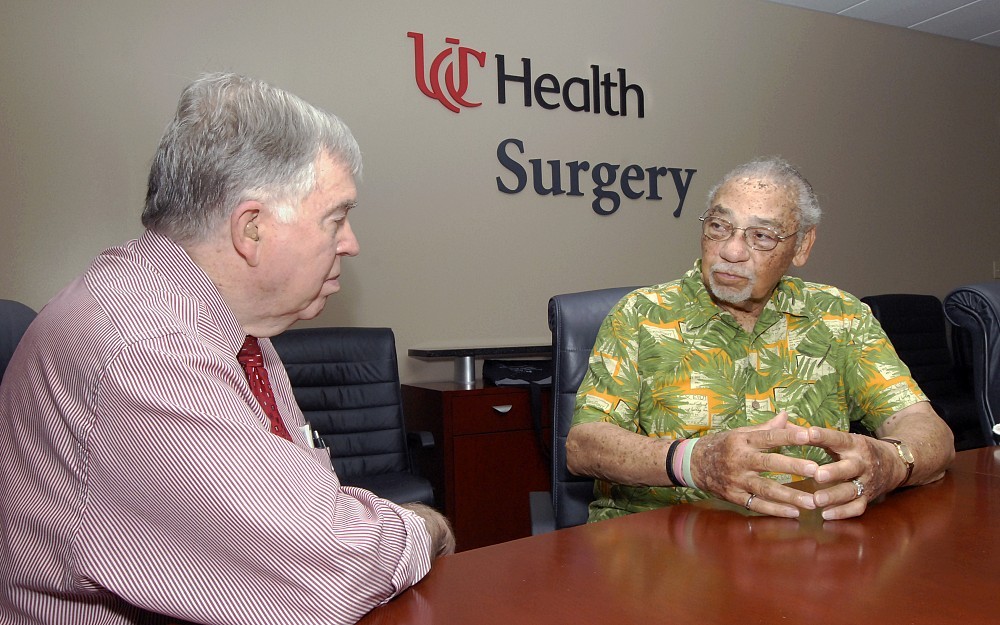
Clark Beck and J. Wesley Alexander, MD, professor emeritus of surgery
Tags
Related Stories
UC expert weighs in on current MASH treatment approaches
June 5, 2026

As MedCentral recently reported, pending broader pharmacologic approvals for metabolic dysfunction-associated steatohepatitis (MASH), lifestyle modifications remain the go-to intervention.
At least two weather patterns increase headaches, UC study suggests
June 4, 2026
University of Cincinnati physicians and collaborators identified two specific weather patterns that increase headache and migraine risk and found the preventive medication fremanezumab (Ajovy) can reduce weather‑associated headaches. The findings will be presented at the American Headache Society Annual Scientific Meeting in Orlando.
UC researcher secures $3.3M grant to study microplastics’ impact on heart
June 2, 2026
The National Institute of Environmental Health Sciences awarded a $3.3M grant to University of Cincinnati researcher Hong‑Sheng Wang, PhD, to study how microplastics and nanoplastics affect cardiovascular health.