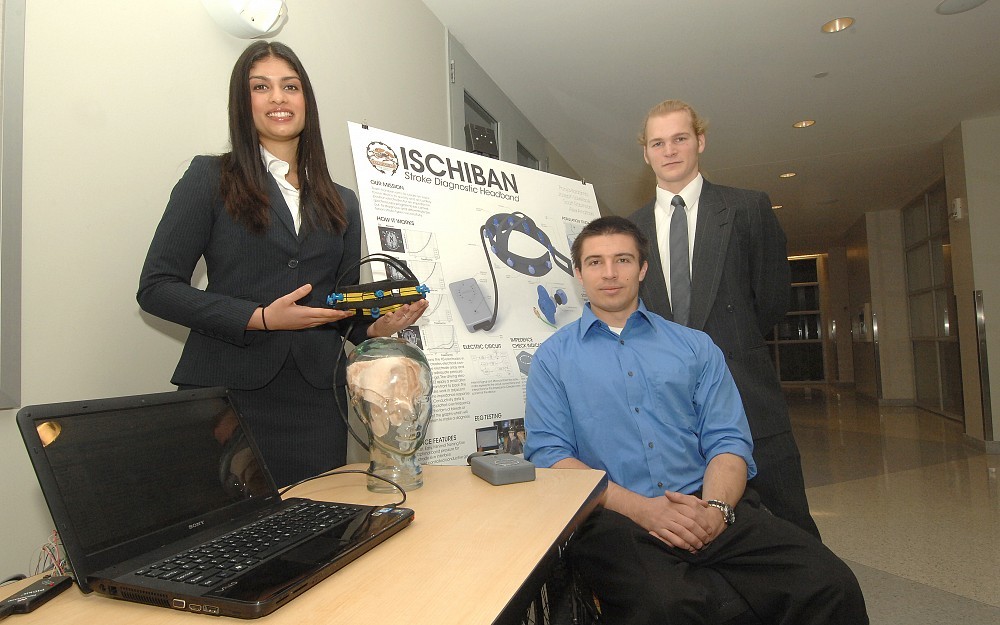
Alumni Win Cincinnati Innovates Awards for New Device

A team of UC engineering and design students is now learning the in and outs of business after winning two awards from the 2011 Cincinnati Innovates competition.
Team Ischiban, comprising UC alums Joseph Lovelace, Scott Robinson and Pooja Kadambi, developed their
last year as their senior project in the department of biomedical engineerings Medical Device Innovation and Entrepreneurship Program (MDIEP). Industrial designer Alex Androski joined the team in spring to develop higher-quality models and posters and a neural monitoring application presented at DAAP.
The device, a portable headband that can take EEG measurements, was designed to differentiate between ischemic and hemorrhagic stroke. Within five minutes, the 10 electrodes in the headband can potentially measure impedance in the brain and produce critical information for neurologists, dramatically decreasing the time to treatment and reducing the risk of permanent disability.
For their project, the team received the $10,000 Taft Legal/Patent Award and $5,000 from Northern Kentucky Vision 2015 Awardand are now working to bring their UC-developed device to the wider world.
"Its really exciting, says Lovelace, a computer engineering graduate. "We entered the Cincinnati Innovates competition specifically with the Taft award in mind. One of our biggest hurdles to overcome is patent application, with the legal fees and the cost to file itself. It couldnt have worked out any better.
Team members are currently finalizing the creation of their limited liability company (LLC), Ischiban-Neural Engineering Systems, and working to find additional grant funding and potential investors. Its been a new experience for all of them.
"Starting a company, doing a business planits a different world, says Kadambi, a biomedical engineering graduate currently enrolled in UCs computer engineering graduate program. "Its a huge shift to speak the business language instead of the science one. But we are communicating with each other to find a way to make it work. We want this to succeed.
In response to the new challenges, she says the team has consciously slowed down its process to listen to the mentoring available to it, provided by UC faculty from engineering, emergency medicine, neurology and biomedical engineering.
Jason McMullan, MD, assistant professor of emergency medicine, was one of several UC faculty advising the team. He says current options to diagnose and monitor strokes are imperfect, with no way
to differentiate between ischemic and
hemorrhagic stroke or detect a secondary hemorrhage without advanced
imaging.
The promise of the
Ischiban device, he says, is in its potential ability to detect
hemorrhage in real-time, at the bedside, and without advanced imaging.
Students from UCs colleges of law and business are also working with the team, gaining real-world experience while helping the team set up the company and complete legal documents and contracts.
"Its through and through a UC product, says Kadambi. "Being able to talk to people within such a large university and having them willing to help you is a great thing.
The Cincinnati Innovates competition is not the first time Team Ischiban members have garnered attention: They were the only undergraduates to present at the annual Point of Care Technologies Conference in June and, at UC, they took first place at MDIEPs annual showcase/competition after earning over $7 million in "Bearcash investments.
While Lovelace says getting FDA approval for a stroke diagnostic device is the "holy grail for the team, they are looking towards more basic monitoring applications to start off.
"Monitoring brain waves, measuring the magnitude and speed of brain wavestheres a lot of useful information you can get from that data, he says. "Stroke differentiation is our end goal. Its the most difficult to attain and it takes the most scrutiny from the FDA. But theres a great deal of health applications for the device in the interim.
Potential applications include using the headband to send EEGs from first responders to the ED or as an easily-removable monitoring device for surgical or military applications.
Theres even a role for it in video game development, expanding on the latest motion-capture platforms like the Kinect system. Whichever they decide to develop first, the engineers are already back to work in the lab.
"Weve started test runs and making small numbers of the device, says Lovelace. "Its very exciting. Were very happy about getting back to that point.
Tags
Related Stories
UC radiation oncologist speaks with Local 12 news about clinical trial for head and neck cancer treatment
August 10, 2026

Dr. Sara Medek, a UC radiation oncology professor, speaks with Local 12 news about a new clinical trial aimed at reducing radiation in certain areas while still treating cancer effectively but with fewer painful side effects.
Cancer Center director charts future based on collaboration, AI
August 10, 2026

David Gius, MD, PhD, was featured in a Cincinnati Business Courier article and The Cancer Letter’s “The Directors" podcast discussing his priorities and goals as he recently took the helm as director of the University of Cincinnati Cancer Center.
Bidirectional link between oral, kidney health calls for patient education, access
August 4, 2026

Despite growing awareness of the connection between oral health and chronic health conditions, patient awareness and access to dental care remain limited, according to University of Cincinnati experts who recently spoke with Healio | Nephrology News & Issues.