Researchers Receive Federal Grant to Study Treatments for Fungal Pneumonia

CINCINNATIResearchers in UCs College of Medicine, the Cincinnati Department of Veteran Affairs (VA) Medical Center and the James L. Winkle College of Pharmacy recently received a grant from the National Institute of Allergy and Infectious Diseases (NIAID) to collaboratively study new therapies for pneumonia caused by the fungus Pneumocystis.
The granttotaling $544,424 over the next yearwill be focused on finding compounds and correct medication dosage to help treat Pneumocystis pneumonia, which is a major cause of morbidity and mortality in HIV patients and other patient populations who receive immunosuppressive agents for the treatment of cancer, organ transplantation, autoimmune diseases and other disorders.
"Pneumocystis colonization, or infection without symptoms, of the respiratory tract of patients with chronic obstructive pulmonary disease (COPD) has recently been shown to be associated with worsening lung function, says Peter Walzer, MD, professor in the division of infectious diseases and associate chief of staff for research at the Cincinnati VA. "Thus, new treatments for Pneumocystis pneumonia may have broader application to patients with chronic lung disorders.
Walzer is the principal investigator on the study along with co-investigators Melanie Cushion, PhD, professor of infectious diseases and research microbiologist at the Cincinnati VA, and Michael Linke, PhD, a research microbiologist at the Cincinnati VA.
"We will be screening these compounds, many of which are brand new and are not yet approved by the Federal Drug Administration, in animal models to determine their effects, says Cushion.
This study is an extension of ongoing research conducted by Walzer about the underlying mechanisms of this illness.
Pankaj Desai, PhD, a professor and director of the Drug Development Graduate Program in the College of Pharmacy, is also involved in the study and will lend his knowledge to help determine the pharmacokinetics of these drugs and their effect in the body.
"For our medical center, this is an excellent example of how a multidisciplinary group can be involved in early stages of developing novel molecular entities, both small molecules and biopharmaceuticals such as antibodies and evaluate their efficacy, safety and clinical viability, similar to what a drug company would do, he says.
"This is an important collaboration that could lead to discoveries and possibly cures for an illness that has been attributed to morbidities for over 30 years, Cushion adds.

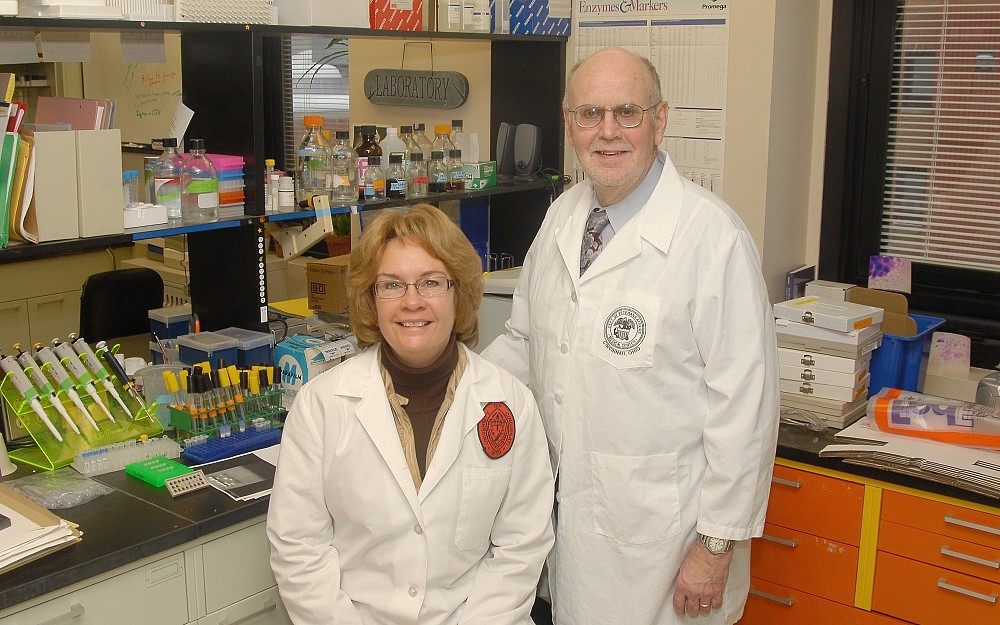
Peter Walzer, MD, and Melanie Cushion, PhD

Pankaj Desai, PhD
Related Stories
UC radiation oncologist speaks with Local 12 news about clinical trial for head and neck cancer treatment
August 10, 2026

Dr. Sara Medek, a UC radiation oncology professor, speaks with Local 12 news about a new clinical trial aimed at reducing radiation in certain areas while still treating cancer effectively but with fewer painful side effects.
Cancer Center director charts future based on collaboration, AI
August 10, 2026

David Gius, MD, PhD, was featured in a Cincinnati Business Courier article and The Cancer Letter’s “The Directors" podcast discussing his priorities and goals as he recently took the helm as director of the University of Cincinnati Cancer Center.
UC graduates cross finish line at commencement
August 7, 2026
The University of Cincinnati recognized 2,125 graduates in two ceremonies at summer commencement Friday on campus at Fifth Third Arena.