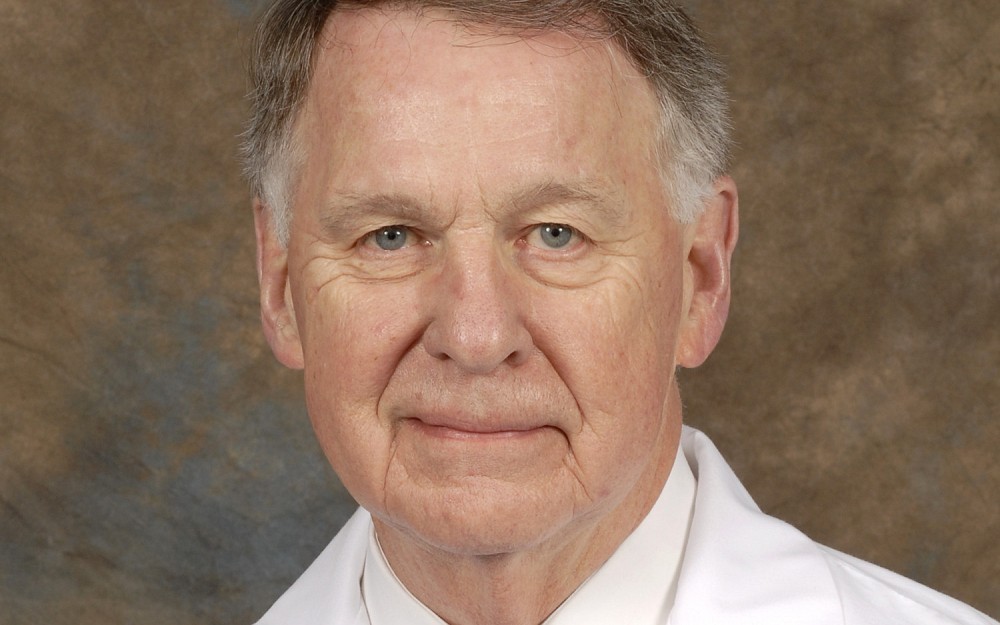
Anesthesiologist Receives Humanitarian Award from ASA

Phillip Bridenbaugh, MD, professor emeritus and former chair of UCs department of anesthesiology, has received the 1st annual Nicholas Greene Humanitarian Award from the American Society of Anesthesiologists (ASA). The award is given to an individual for their humanitarian contributions for outstanding volunteer service. This award recognizes Bridenbaugh for his 10 years of service to the Overseas Teaching Program of the ASA. The mission of this program is to "support and encourage anesthesia training in existing programs in developing countries."
Bridenbaugh led the department of anesthesiology from 1977 to 2003. He served as the president of the Ohio Society of Anesthesiologists from 1991 to 1992, as the president of the ASA from 1996 to 1997 and has held many offices in other anesthesia societies including the American Society of Regional Anesthesia and the Society of Academic Anesthesia Chairmen.
His other honors include the Gaston Labat Award by the American Society of Regional Anesthesia in 1993, the Distinguished Service Award by the Ohio Society of Anesthesiologists in 1999 and the Heidbrink Award by the American Dental Society of Anesthesiologists in 2004.
Bridenbaugh has authored 92 journal articles and has served on the editorial boards of many publications including Regional Anesthesia, Anesthesiology, Anesthesia and Analgesia and Regional Anesthesia and Pain Management. He is co-editor of Neural Blockade: In Clinical Anesthesia and Management of Pain.
A Q&A With Bridenbaugh
How did you become involved in the the Overseas Teaching Program?
"It was founded in 1990 by Nicholas Greene, MD, and I worked closely with Greene to establish the program. I then traveled annually to the Kilimanjaro Christian Medical Center in Tanzania, Ghana and Rwanda, where a staff of volunteers trained practitioners and medical students in the practice of anesthesia care."
To what degree do you feel the program impacts practitioners and students?
"Practitioners who volunteer to go to Africa and teach in these hospitals briefly see how little they have in the way of receiving health care, so few doctors, so little or old equipment and medicine. It makes one blessed to be in our practices and leaves these practitioners with a desire to develop their own doctors and teachers to carry on what we have taught them. We are there to teach future teachers."
As the chair of the World Federation of Societies of Anesthesiologists (WFSA) foundation, what message would you like to share with anesthesiologists in training about global experiences and giving back to the profession?
"Being chair of the WFSA foundation allows me to further share the needs of underdeveloped countries' health care systems and the need for teaching and volunteer programs throughout them."
Tags
Related Stories
UC expert weighs in on current MASH treatment approaches
June 5, 2026

As MedCentral recently reported, pending broader pharmacologic approvals for metabolic dysfunction-associated steatohepatitis (MASH), lifestyle modifications remain the go-to intervention.
At least two weather patterns increase headaches, UC study suggests
June 4, 2026
University of Cincinnati physicians and collaborators identified two specific weather patterns that increase headache and migraine risk and found the preventive medication fremanezumab (Ajovy) can reduce weather‑associated headaches. The findings will be presented at the American Headache Society Annual Scientific Meeting in Orlando.
UC researcher secures $3.3M grant to study microplastics’ impact on heart
June 2, 2026
The National Institute of Environmental Health Sciences awarded a $3.3M grant to University of Cincinnati researcher Hong‑Sheng Wang, PhD, to study how microplastics and nanoplastics affect cardiovascular health.