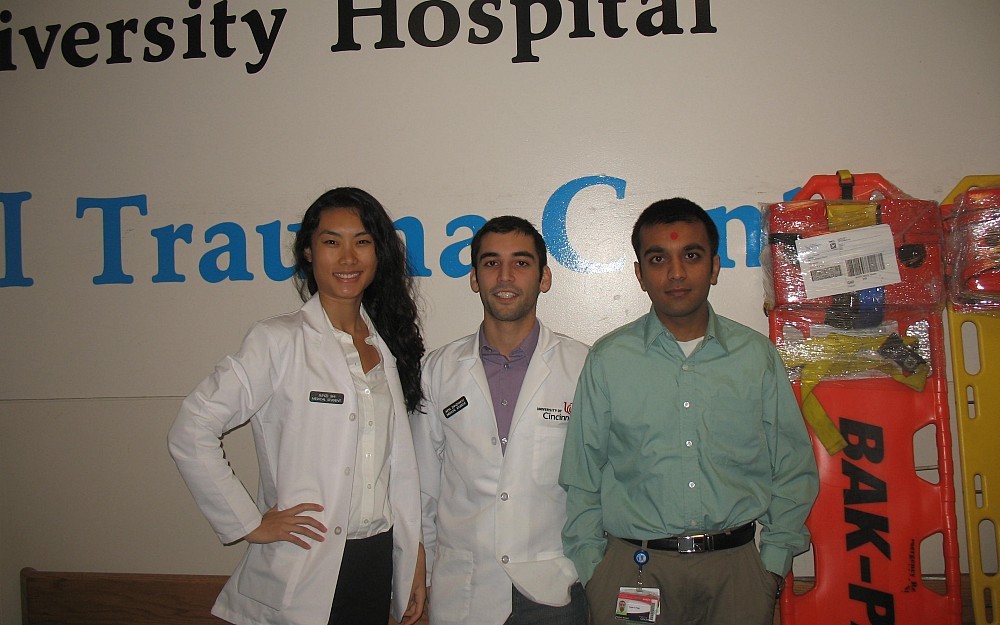
First-Year Medical Students Respond at Accident Scene Because of New Training

It was well after midnight when three first-year students at the University of Cincinnati (UC) College of Medicine came upon the scene of a two-car collision. One of the passengers was lying on the roadside and three others were trapped in one of the vehicles. There were bystanders, but no help had arrived on the scene as yet.
"We made a firm decision to stop, one of the medical students, MD/PhD candidate Zubin Patel, recalls of the agreement to pull over and offer assistance. "There were other people there, but they really didnt know what do.
The decision to act, Patel says, came readily because he and his classmates had recently completed first responder training (training similar to that of EMTs, firefighters and police officers) as part of the new curriculum that went into effect at the UC College of Medicine in 2011.
"We used our skills to manage the safety of the scene, do trauma assessments and calm the victims until the EMTs arrived, at which time we also helped secure the victims to backboards for transport, first-year MD/PhD candidate Arya Zandvakili recounts of his actions and those of his classmates, Patel and medical student Junzi Shi.
Shi remembers the event as "chaotic with an overturned car a lot of spilled fluids. The driver of the car, she says, was stuck upside down and screaming. "Having had the training helped us to remain mentally calm, and to recall the proper actions even in the midst of great turmoil.
According to UCs associate dean of medical education, Anne Gunderson, EdD, the former UC medical student curriculum represented a traditional model consisting of two years of basic science coursework, followed by two years of clinical experiences. In light of significant changes in health care and national trends in medical education, Gunderson says that the integrative curriculumwhich now includes clinical experiences such as first responder training, patient assessments and community services interactions in the first yearbetter prepares physicians for practice in the 21st century.
Students are taught emergency response methods by a team of paramedics and physicians led by Donald Locasto, MD, an associate professor in UCs department of emergency medicine, medical director for the Cincinnati Fire Department and former paramedic.
Locasto, a UC Health emergency medicine physician, says the importance of this program is two-fold: the medical students are now much more comfortable in the clinical setting knowing that if a patient becomes critically ill, they will know what to do and additionally patients seen in the UC clinical system are now safer considering that all of the medical students can initiate lifesaving care immediately. He says,"they are now prepared, even in their personal lives, to provide life saving medical assistance to the people around them such as their family, friends or even strangers involved in a car wreck on dark highway.
"Ive seen those scenarios before where I felt I might have been helpful but would not have been comfortable stopping, says Patel, adding, "Theres not a morsel of doubt in my mind that the training was important for us to do that.
Indeed, Shi exudes the same confidence: "I think we behaved in a very professional manner even though none of us had experienced this type of situation before.
And it's not the first time since the curriculum change that medical students have had to act quickly as a first responder. Other students are now beginning to relay how they've already used the training in an emergency situation.
"These students embody the essence of what it means to be a physician: to help their fellow man, no matter what the situation, adds Locasto.
Related Stories
UC radiation oncologist speaks with Local 12 news about clinical trial for head and neck cancer treatment
August 10, 2026

Dr. Sara Medek, a UC radiation oncology professor, speaks with Local 12 news about a new clinical trial aimed at reducing radiation in certain areas while still treating cancer effectively but with fewer painful side effects.
Cancer Center director charts future based on collaboration, AI
August 10, 2026

David Gius, MD, PhD, was featured in a Cincinnati Business Courier article and The Cancer Letter’s “The Directors" podcast discussing his priorities and goals as he recently took the helm as director of the University of Cincinnati Cancer Center.
UC graduates cross finish line at commencement
August 7, 2026
The University of Cincinnati recognized 2,125 graduates in two ceremonies at summer commencement Friday on campus at Fifth Third Arena.