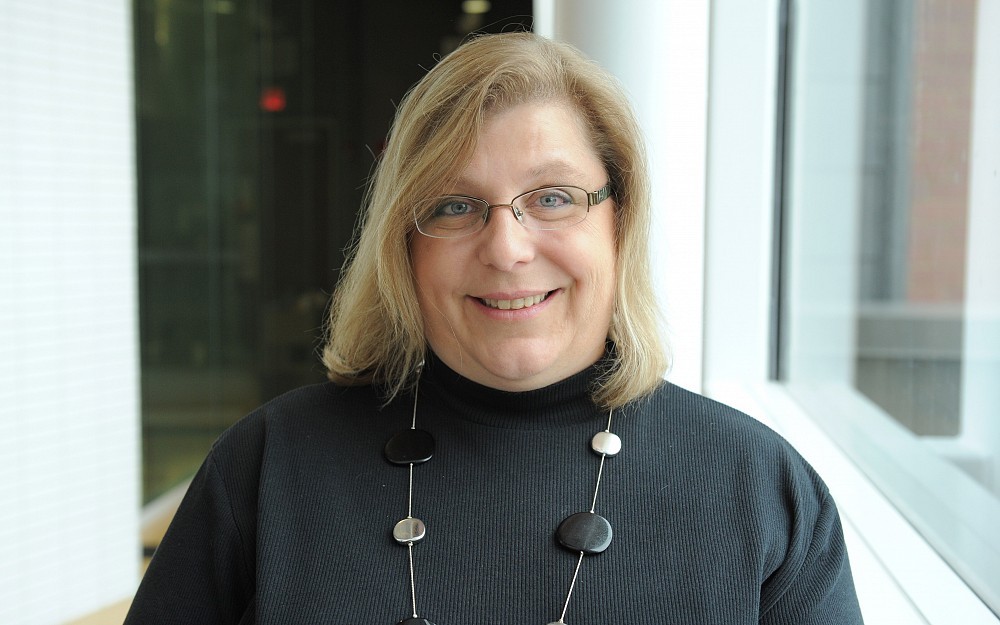
Focus on Staff With Joyce LaClair

Joyce LaClair, fellowship program coordinator for the division of pulmonary, critical care and sleep medicine who also provides administrative support to faculty in the division, has a true passion for health care that dates back to her time as a student at Xavier University when she also worked as a home health aide, taking care of the elderly nuns at Mount Notre Dame in Reading.
"I loved taking care of senior citizens, so I became a state-tested nursing assistant and spent the next 10 years working at a home health agency, she says, adding that she started out as a home health aide, advancing to a scheduling coordinator, to billing/payroll and then to office manager.
In April 2003, LaClair decided to make a career changestill staying true to medicinewhen she was offered the opportunity to work in the pulmonary, critical care and sleep medicine division at UC.
What are your duties?
"Beside my role as fellowship coordinator and administrative support, I am the faculty recruitment coordinator and event planner for the division.
"Most recently, I volunteered to lead a task force of four to develop a certification program for Pulmonary and Critical Care Medicine Coordinators though Training Administrators for Graduate Medical Education (TAGME), a national certification board. Together, we wrote a 200-question assessment, refined it, passed it, and I became the first C-TAGME certified PCCM coordinator in the country.
What is your favorite part of the job?
"I enjoy managing the fellowship program and coordinating the day-to-day schedules of my physicians, but the favorite part of my job is the people I work with. The pulmonary, critical care and sleep physicians, fellows and staff are phenomenal. The encouragement and support I have received over the years from our division has been the highlight of my career at UC.
Can you compare your experiences as a home health aide to those of being a fellowship coordinator?
"As a home health aide, I cared for the elderly in their homes. The type of work involved assistance with showering or bathing, light housekeeping, grocery shopping, scheduling and transporting to doctors appointments, making sure they were eating and taking their medicines appropriately and whatever other tasks were necessary for them to maintain their independence in their home.
"My job as a home health aide and my current position as fellowship coordinator have many similaritiesnot in the sense of the actual responsibilities but in the sense that I am still acting as a caregiver. I am a caregiver by nature. Now, instead of caring for the elderly, I care for our physicians and our fellowship program.
"I miss the reward I felt from putting a smile on a senior citizens face and of providing some company and conversation to those that were lonely. It was amazing to do small things that make such a big impact on a human beings quality of life. Now, I still do the same in that I find ways to make life easier on the trainees and the educators in pulmonary, critical care and sleep medicine at UC.
What do you like to do when you arent at work?
"I enjoy spending time with my family, playing with my dogs, reading and decorating.
Focus On highlights faculty, staff, students and researchers at the UC Academic Health Center. To suggest someone to be featured, please email uchealthnews@uc.edu.
Tags
Related Stories
On-site training in Speech & Hearing Clinic sets UC’s programs apart
August 27, 2026
At the University of Cincinnati’s Speech & Hearing Clinic, Doctor of Audiology and Speech-Language Pathology graduate students gain real-world experience while providing free speech and hearing services to the community.
Funding expands UC research into weight gain side effects of bipolar medication
August 26, 2026
University of Cincinnati researchers have been approved for funding by the Patient-Centered Outcomes Research Institute (PCORI) to expand the implementation of healthy lifestyle interventions and metformin prescription to help manage weight gain in overweight or obese youth taking second-generation antipsychotic medications.
One in four NFL players had CTE at death
August 25, 2026

Forbes cites research on concussions and football helmets by the University of Cincinnati in a report that found one in four NFL players had brain damage at death.