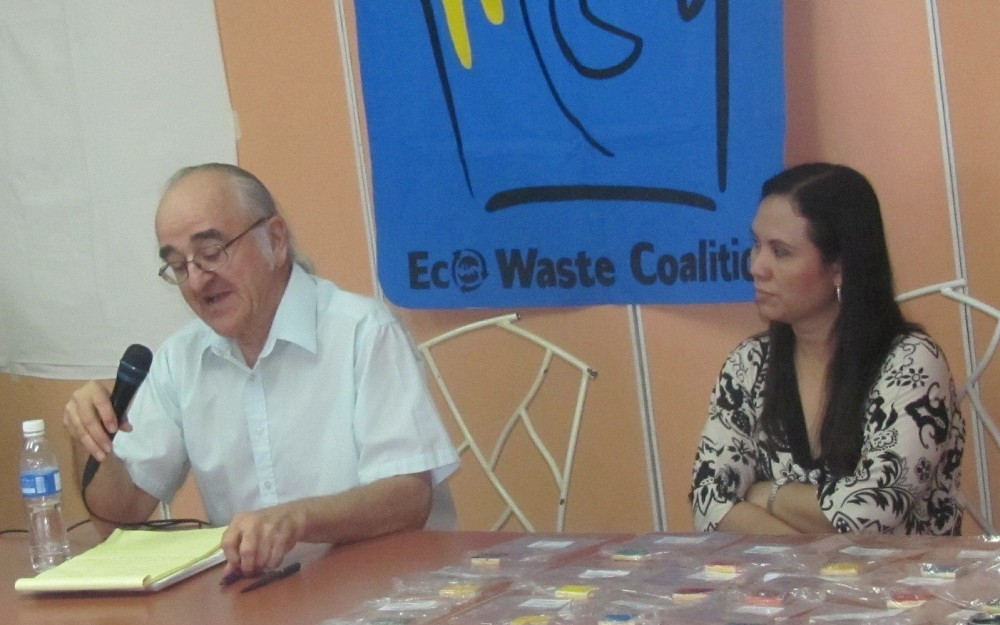
Clark Works to Reduce Global Health Threat of Lead

Scott Clark, PhD, recently traveled to the Philippines for the EcoWaste Coalition partners meeting to provide scientific support for the IPEN Asia Lead Elimination Project, an effort to introduce a global ban on the addition of lead to household decorative paints and in consumer products, such as toys, in Asian countries. The EcoWaste Coalition is a public interest network of community, church, school, environmental and health groups pursuing sustainable solutions to waste, climate change and chemical issues facing the Philippines and the world. Although lead content in paint has been restricted in the United States since 1978, Clarks research has shown that consumer paints containing dangerous levels of lead are still available in major countries, including the Philippines, on three continents. For more information, visit ecowastecoalition.org.
Tags
Related Stories
Cancer Center plays key role in lab research, clinical trials for new pancreatic cancer drug
September 1, 2026

WLWT and WCPO highlighted the contributions of University of Cincinnati Cancer Center researchers that helped lead to the recent FDA approval of daraxonrasib, a new treatment for pancreatic cancer.
Cancer Center physician receives $150,000 New Investigator Research Grant to study treatment-resistant leukemia
September 1, 2026
The University of Cincinnati Cancer Center’s Sarah Skuli, MD, PhD, received a two‑year, $150,000 Leukemia Research Foundation New Investigator Grant to study TP53‑mutated leukemia, a treatment‑resistant subtype with very poor outcomes.
Heavy social media use linked to depression
August 31, 2026

U.S. News and World Report, Yahoo! News, MSN, USA Today and other national media highlight a new study by the University of Cincinnati and Northwestern University that found a correlation between heavy social media use and depression in adults.