College of Medicine Has Plan, Emerging Strong From Perfect Storm

College of Medicine finances took center stage during the latest in a series of presentations by senior associate deans.
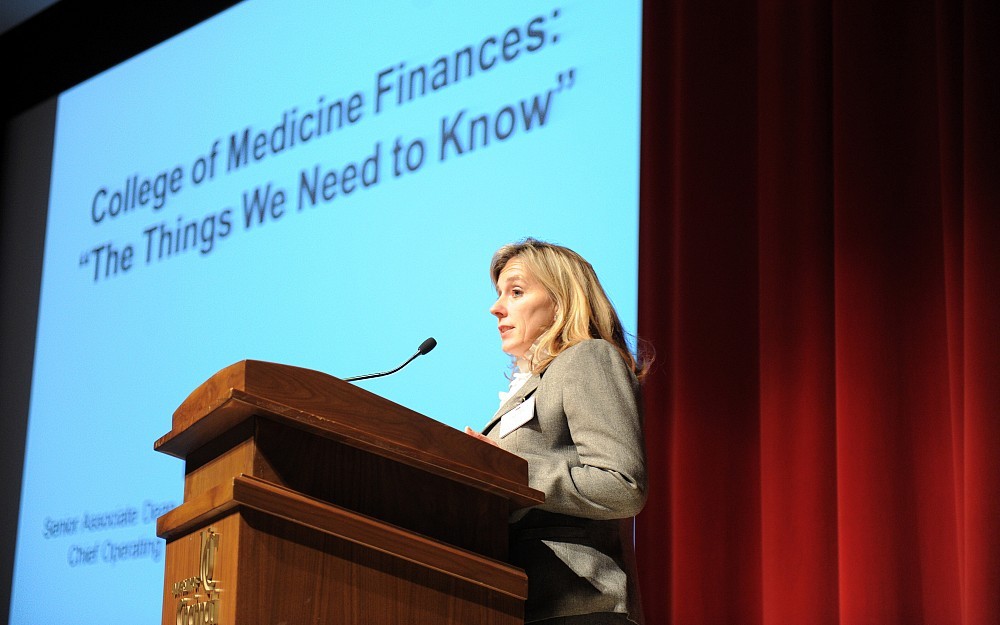
Nearly 200 people were in attendance Tuesday, Feb. 28, in Kresge Auditorium, to hear from Lori Mackey, senior associate dean for operations and finance, as she presented "College of Medicine Finances: The Things We Need to Know. Mackey shared information about the colleges budget, financial challenges and the strategy for managing the current situation in order to remain strong. She concluded the presentation with a question and answer session.
"We are faced with tremendous challenges, Mackey said, "but if theres one thing we can always count on: The College of Medicine is a known entity in the community, the College of Medicine will continue to be strong and the College of Medicine will always be here.
What Happened
Mackey described the last five years as the perfect storm.
"If you think about it, weve had an absolute horrible economy, she said.
For the College of Medicine that means that endowment income is significantly impacted, and people in the community dont have as much discretionary income to give as gifts.
Mackey added that stimulus money from the National Institutes of Health (NIH) and other federal sources has dried up and current funding opportunities are even more competitive than they have ever been.
She highlighted recent news about lowering of the NIH salary cap and reminded attendees that this lowering doesnt mean faculty are paid any less. Instead, she said, the difference will have to be made up through cost sharing, which the college has to absorb.
Whats Been Done?
Upon the arrival of Thomas Boat, MD, as College of Medicine dean in July 2011, the college acted quickly to combine the senior level finance and operations position with Mackeys chief operating officer role at University of Cincinnati Physicians. This, Mackey said, saved costs and put one person in place with a vested interest in "both sides of the house to ensure missions stayed aligned with the integration of the health system.
Leadership then quickly implemented a plan to reduce $5 million in the already-finalized budget for fiscal year 2012 (July 1, 2011 to June 30, 2012). This was achieved by restructuring basis science business offices, closing the department of public health sciences and increasing the Deans Fund contribution from University of Cincinnati Physicians.
Finally, Mackey said, a $1.3 million cut was made to the deans office budget.
"We felt like if we were going to ask the departments to do it we needed to start with ourselves, she said, "really identify inefficiencies and take them out of our system.
Strategy Moving Forward
A strategic approach to financial management will be required to ensure the strength of the College of Medicine moving forward.
Plans include increasing philanthropy and reducing costs not only through expense reduction (departments have been asked to reduce budgets by 3 percent for fiscal year 2013) but also by defining external funding requirements.
The College of Medicine gets 69 percent of its research funding from the NIH and another 17 percent from other federal agencies. Reliance on this funding, Mackey said, will have to shift and new funding sources will need to be identified.
Mackey outlined a plan for
standardizing the faculty recruitment process,
eliminating redundancies in operations and consolidating administrative functions,
implementing a faculty workload document and objective evaluation for annual reviews, and
a review process for position control and travel approvals.
She also highlighted how changes to the financial commitments to the college from UC Health and University of Cincinnati Physicians will aid in the College of Medicines bottom line.
"We really do have a commitment that over the next couple years we [University of Cincinnati Physicians] always want to send over 2 to 3 percent of our clinical revenue, said Mackey. "When Dr. Boat and I first got here, and looked at UCP, they were sending over a little less than .5 percent.
The health system (formerly Health Alliance, now UC Health), sends over an education and research payment ($3.8 million for fiscal year 2012) and UC and UC Health are negotiating a new agreement to better define what this payment should be. An increase is expected for 2013.
Growth Must Continue
"One of the things you need to think about in all of this is that weve committed to our health system over the next five years to grow, Mackey said. "Sodepending on how effective we can be in our recruitmentwe want to add anywhere between 125 and 200 physicians in the next five years who will be doing academic and clinical work.
Mackey and College of Medicine leadership are committed to the UC2019 initiative and believe investing in specific programs and recruitment of world-class faculty will aid in the support of that initiatives discovery, community, global engagement and mission-based health care aims.
Additional strategic initiatives for the coming year that Mackey outlined include:
plans for increased support to basic science departments,
bridge funding to the physician scientists training program,
target growth in specific programs including brain tumor and environmental health,
creation of a lab medicine program in support of the pathology department,
continue work toward National Cancer Institute designation for the UC Cancer Institute, and
creation of a biomedical informatics department in conjunction with Cincinnati Childrens.
For even more details, you can view a video of the discussion or download the full PowerPoint (PDF).
Related Stories
UC radiation oncologist speaks with Local 12 news about clinical trial for head and neck cancer treatment
August 10, 2026

Dr. Sara Medek, a UC radiation oncology professor, speaks with Local 12 news about a new clinical trial aimed at reducing radiation in certain areas while still treating cancer effectively but with fewer painful side effects.
Cancer Center director charts future based on collaboration, AI
August 10, 2026

David Gius, MD, PhD, was featured in a Cincinnati Business Courier article and The Cancer Letter’s “The Directors" podcast discussing his priorities and goals as he recently took the helm as director of the University of Cincinnati Cancer Center.
UC graduates cross finish line at commencement
August 7, 2026
The University of Cincinnati recognized 2,125 graduates in two ceremonies at summer commencement Friday on campus at Fifth Third Arena.