Researchers Seek Clues to Mysteries of Stress

Everyone experiences stress, to some degree. But how many people actually understand stress? Thats the question Department of Psychiatry and Behavioral Neuroscience faculty members are working on at UCs Reading Campus.
"What were trying to do is develop a multi-pronged group of stress-oriented investigators who can cover a wide area of the problem without duplicating each other, says James Herman, PhD, professor and director of the Stress Neurobiology Laboratory. "Everyone has their own individual niche, interconnected with the general concept of stress biology.
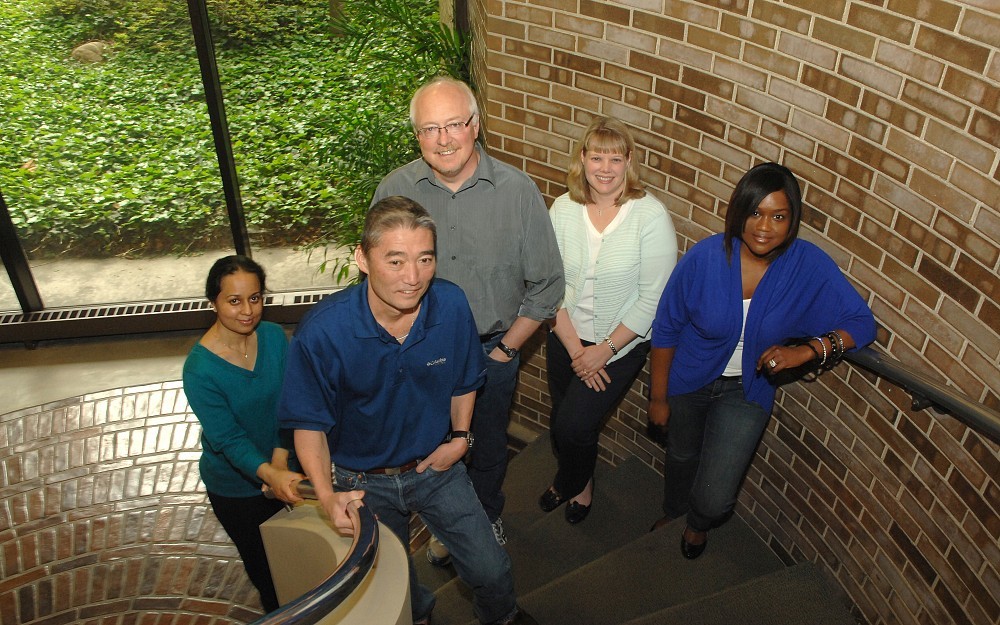
Herman works with faculty members Randall Sakai, PhD, Renu Sah, PhD, and Yvonne Ulrich-Lai, PhD, with Matia Solomon, PhD, currently a postdoctoral research fellow, officially joining the team in August as a faculty member in the department of psychology with a secondary appointment in psychiatry and behavioral neuroscience.
"What were most known for is our work in delineating the pathways to the brain that controls stress responding, says Herman. "Our group has been the one that has put the whole notion of balance among the brains limbic regions on the map in terms of stress regulationcertainly of hormone secretion, but probably generalizing to autonomic function and behavior as well.
The brain takes information coming in, Herman explains, and filters it through its memory systems to create an interlinked set of descending information that converges on the physiological systems that mount stress responses. The prefrontal cortex (executive control), hippocampus (memory) and amygdala (emotion) work together to control stress responding.
"If you take any one of those things out of the equation, you end up with a pathological response, Herman says.
Researchers in the stress lab are also known for defining domains of glucocorticoid signaling in the brain, Herman says, referring to the hormones that produce an array of physical and mental responses to stress.
"It used to be thought that there was one region of the brain that recognized glucocorticoids, and that was all she wrote, Herman says. "Weve shown that its important to know that these pieces of information come in to all regions of the brain, and its the aggregate signal that really dictates what the outflow is.
In an attention-grabbing research paper published in PNAS, the official journal of the National Academy of Sciences, Ulrich-Lai and Herman demonstrated that pleasurable activity reduces stress by inhibiting anxiety responses in the brain. The research identified key neural circuits related to pleasurable activity, including "comfort food or sex.
In another high-profile paper, Herman, Sakai and Solomon were part of a team that showed that elevated levels of sodium blunt the bodys natural responses to stress by inhibiting stress hormones that would otherwise be activated in stressful situations. The research was reported in The Journal of Neuroscience, the official journal of the Society for Neuroscience.
Earlier this year, Sah received word that she has won a $397,405 award from the National Institutes of Healths National Institute of Mental Health for research into the neurological basis of panic disorder. And Ulrich-Lai, who trained with Herman as a postdoc, received a $353,125 award from the NIHs National Institute of Diabetes and Digestive and Kidney Diseases for her investigations into the relationship between food and stress. Total funding for the group is more than $2.5 million a year.
Plenty of mysteries remain, Herman says, including understanding how stress reactions vary between resilience and resistance.
"Why is it that some people are likely to become depressed after a traumatic experience and others can have exactly the same experience and have no symptoms whatsoever, he asks. "Or why does one person become depressed and the other person have post-traumatic stress disorder?
"And the other big question is, what can we do about it? A lot of our drugs medicate the entire body, with all its ramifications. So one of the challenges will be to develop circuit-based medicine where we can figure out how to get precisely targeted molecules that can reduce the impact of stress on malfunctioning brain pathways without also affecting other critical brain functions.
Team Members
James Herman, PhD, professor and director, Stress Neurobiology Laboratory
Research focus: Stress pathways to the brain, with particular emphasis on what goes wrong under pathological circumstances. Major disease focuses in the area of depression and post-traumatic stress disorder.
Randall Sakai, PhD, professor
Research focus: Behavioral, neuroendocrine and neurochemical effects associated with chronic stress, with particular emphasis on stress and depression. Currently examining the effects of social stress using neuroethological rodent models.
Yvonne Ulrich-Lai, PhD, assistant professor
Research focus: Identifying the neural and hormonal substrates responsible for interactions among diet, obesity and stress. Exploring how the consumption of "comfort foods alters the brain to confer stress relief.
Renu Sah, PhD, assistant professor
Research focus: Neurobiology of anxiety disorders using translational approaches, with the long-term goal of identifying novel therapeutic targets of intervention. Current studies focus on post-traumatic stress disorder (PTSD) and panic disorder.
Matia Solomon, PhD, postdoctoral research fellow (assistant professor fall 2012)
Research focus: Understanding the neurobiology of depression and complex social behavior. Currently investigating novel pre-clinical models of depression (i.e., chronic stress, post-partum) and social anxiety.
Tags
Related Stories
Cancer Center plays key role in lab research, clinical trials for new pancreatic cancer drug
September 1, 2026

WLWT and WCPO highlighted the contributions of University of Cincinnati Cancer Center researchers that helped lead to the recent FDA approval of daraxonrasib, a new treatment for pancreatic cancer.
Cancer Center physician receives $150,000 New Investigator Research Grant to study treatment-resistant leukemia
September 1, 2026
The University of Cincinnati Cancer Center’s Sarah Skuli, MD, PhD, received a two‑year, $150,000 Leukemia Research Foundation New Investigator Grant to study TP53‑mutated leukemia, a treatment‑resistant subtype with very poor outcomes.
Heavy social media use linked to depression
August 31, 2026

U.S. News and World Report, Yahoo! News, MSN, USA Today and other national media highlight a new study by the University of Cincinnati and Northwestern University that found a correlation between heavy social media use and depression in adults.