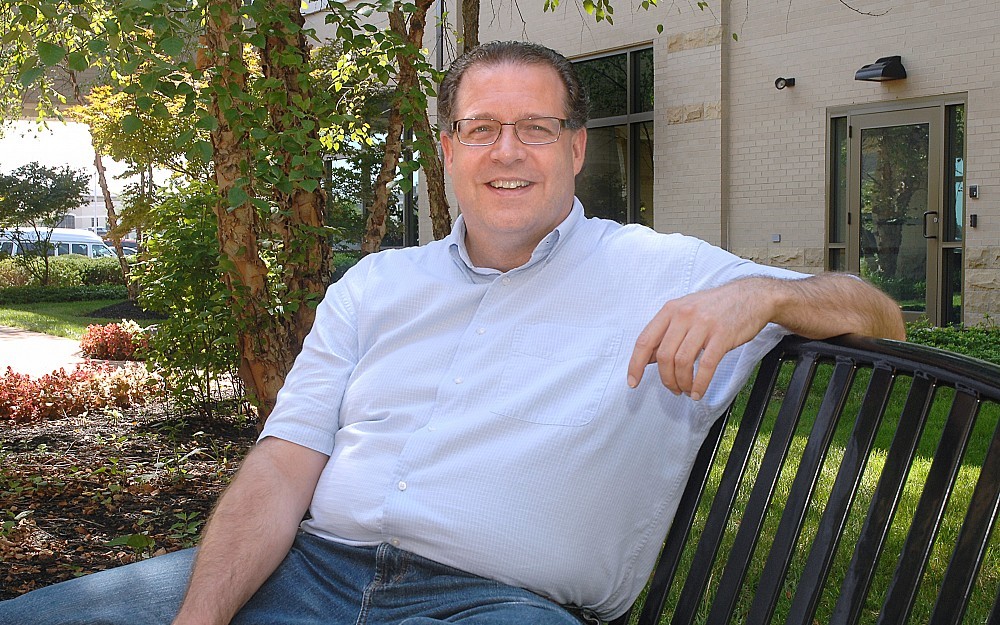
Man Encourages Others to Seek Help for Urinary Incontinence After Successful Treatment

Marc Bourgeois, 48, says urinary incontinence was one of the most frustrating and embarrassing things he has dealt with in his lifebut that doesnt prevent him from talking about it with other men.
Its quite the oppositeBourgeois calls attention to the importance of regular medical checkups to anyone who will listen, whether its a co-worker or the deli clerk at his neighborhood Kroger.
"If I can prompt just one man to seek help for his urinary incontinence, it was worth it because it is most often very treatable with the right doctor, says Bourgeois. "Ive been amazed by how many men Ive encountered who have trouble with urinary continence since sharing my experience.
In February 2012, Bourgeois began experiencing unusually high urinary frequency in the middle of the night. This progressed to complete loss of control over his bladder while he slept.
"Id wake up soaked four to five times a night. I started wearing Depends and avoiding water six hours before going to bed to try and prevent it. It caused me extreme anxiety, he recalls. "It came on gradually and I was so caught up in the business of life that I wasnt paying attention to the signs my body was sending.
Those signs included a weak urine stream and overall reduced urine output. He was referred for additional testing to Ayman Mahdy, MD, PhD a UC Health urologist, assistant professor at the UC College of Medicine and the director of voiding dysfunction and female urology. Mahdy is fellowship trained in urinary incontinence, voiding dysfunction and female urology.
Mahdy prescribed a bladder scope test (cystoscopy) and a comprehensive video-urodynamics examination to fully assess Bourgeois bladder and kidney health to determine the best course of action.
Tests revealed the underlying source of Bourgeois incontinence: a blockage in his bladder, caused by an enlarged prostate. He was diagnosed with chronic urine retention with reflux. This chronic retention had caused resulted in "overflow incontinence, which indicated further imaging and kidney function evaluation. Tests showed long-term pressure from the backup of urine had resulted in a distended bladder and stress on his kidneys that had severely compromised his left kidney health. During testing, Mahdys team removed a liter of retained urine from Bourgeois bladder.
"I had to self-catheterize until they cleared me for surgery. It was one of the hardest things Ive ever done, but the Kristy (nurse) was so patient and coached me until I got it right, recalls Bourgeois.
"Back pressure is detrimental to the kidneysit causes the organ to lose its ability to function normally. It was critical that we remove the bladder obstruction right away to reduce the pressure on Mr. Bourgeois kidney to preserve his remaining kidney function, explains Mahdy.
Bourgeois underwent a transurethral resection of the prostateknown for short as a "TURP procedureto remove the blockage in May 2012 at UC Health West Chester Hospital. By 10 a.m. the next day, Bourgeois had his catheter removed and was able to spontaneously and completely empty his bladder. He didnt need the catheter anymore to eliminate urine from his bladder effectively. Within a week, he had completely regained control of his bladder.
"My prayersand my motherswere answered when I found Dr. Mahdy. Because of him, I can have a normal life. I have reset my life in many ways, and I hope other men realize through my testimonial that they dont have to suffer in silence from urinary incontinence.
Appointments and Information
Mahdy offers medical and surgical management of a full spectrum of voiding dysfunction and urinary incontinence problems. For more information, visit ucphysicians.com/urologyor call 513-475-8787.

Ayman Mahdy, MD, PhD, and video urodynamics staff
Related Stories
Cancer Center plays key role in lab research, clinical trials for new pancreatic cancer drug
September 1, 2026

WLWT and WCPO highlighted the contributions of University of Cincinnati Cancer Center researchers that helped lead to the recent FDA approval of daraxonrasib, a new treatment for pancreatic cancer.
Cancer Center physician receives $150,000 New Investigator Research Grant to study treatment-resistant leukemia
September 1, 2026
The University of Cincinnati Cancer Center’s Sarah Skuli, MD, PhD, received a two‑year, $150,000 Leukemia Research Foundation New Investigator Grant to study TP53‑mutated leukemia, a treatment‑resistant subtype with very poor outcomes.
Heavy social media use linked to depression
August 31, 2026

U.S. News and World Report, Yahoo! News, MSN, USA Today and other national media highlight a new study by the University of Cincinnati and Northwestern University that found a correlation between heavy social media use and depression in adults.