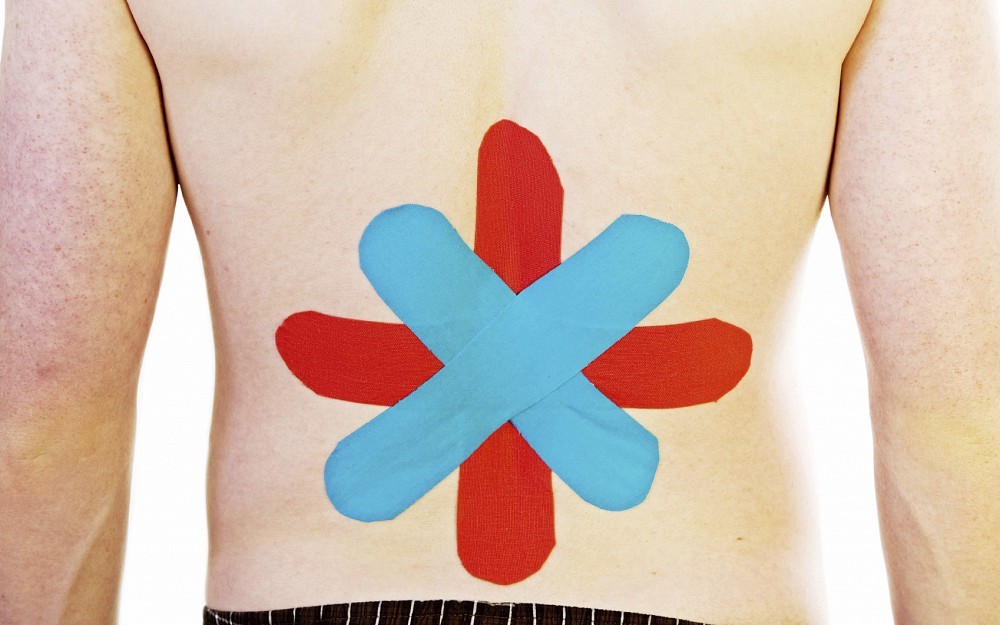
UC HEALTH LINE: Kinesiology Tape Gaining Popularity

CINCINNATIWith all the flags, uniforms and equipment of more than 200 countries, the 2012 Summer Olympics were colorful enough. But one piece of equipment in particular stood out to television viewers who might not have noticed it in previous Olympics: kinesiology tape.
The brightly colored tape was seemingly on display everywhere at the London Olympics, particularly in events such as diving, beach volleyball and track and field. In some cases, it seemed to follow geometric patterns; in others, it appeared to trace the path of a lost explorer. (In those ways it differs from standard athletic tape, which is typically wrapped around a joint for support.)
Kinesiology tape is an elastic, adhesive therapeutic tape developed by Japanese chiropractor Kenzo Kase in the 1970s. There are now numerous brands of the tape, with some sold only to clinicians and some sold directly to consumers with instructions for application included (prices are typically in the $8 to $13 range per package).
Jessica Colyer, MD, an assistant professor in the University of Cincinnati (UC) Department of Physical Medicine and Rehabilitation and a UC Health physiatrist who sees patients at Drake Center, says kinesiology tape is intended to relax and decrease strain on overused muscles and tendons. In some cases, she adds, rehabilitation therapists use the tape to excite underused muscles.
Typically, the tape is applied to an area of the body then stretched to a specific tightness. Unlike standard athletic tape, which is commonly worn only during a specific activity, kinesiology tape is often worn for several days at a time.
"Anecdotally, I have had much success in treating rotator cuff strains, patellar tracking issues of the knee and wrist tendonopathies by recommending kinesiology tape use, Colyer says.
Colyer notes, however, that clinical evidence of kinesiology tapes effectiveness is lacking because of the scarcity of double-blinded controlled studies. "Thats the gold standard in medical research, she says.
Still, Colyer uses kinesiology tape for her own recurrent tendonitis and says she has had much relief from it. She advises using the tape under the supervision of a health professional properly trained in its application.
"I recommend its use in many cases, she says. "Its relatively cost-effective and virtually free from side effectsallergy to adhesive tape (skin rash) is the only one.
Tags
Related Stories
Cancer Center plays key role in lab research, clinical trials for new pancreatic cancer drug
September 1, 2026

WLWT and WCPO highlighted the contributions of University of Cincinnati Cancer Center researchers that helped lead to the recent FDA approval of daraxonrasib, a new treatment for pancreatic cancer.
Cancer Center physician receives $150,000 New Investigator Research Grant to study treatment-resistant leukemia
September 1, 2026
The University of Cincinnati Cancer Center’s Sarah Skuli, MD, PhD, received a two‑year, $150,000 Leukemia Research Foundation New Investigator Grant to study TP53‑mutated leukemia, a treatment‑resistant subtype with very poor outcomes.
Heavy social media use linked to depression
August 31, 2026

U.S. News and World Report, Yahoo! News, MSN, USA Today and other national media highlight a new study by the University of Cincinnati and Northwestern University that found a correlation between heavy social media use and depression in adults.