Screening Still Critical for Early Breast Cancer Detection

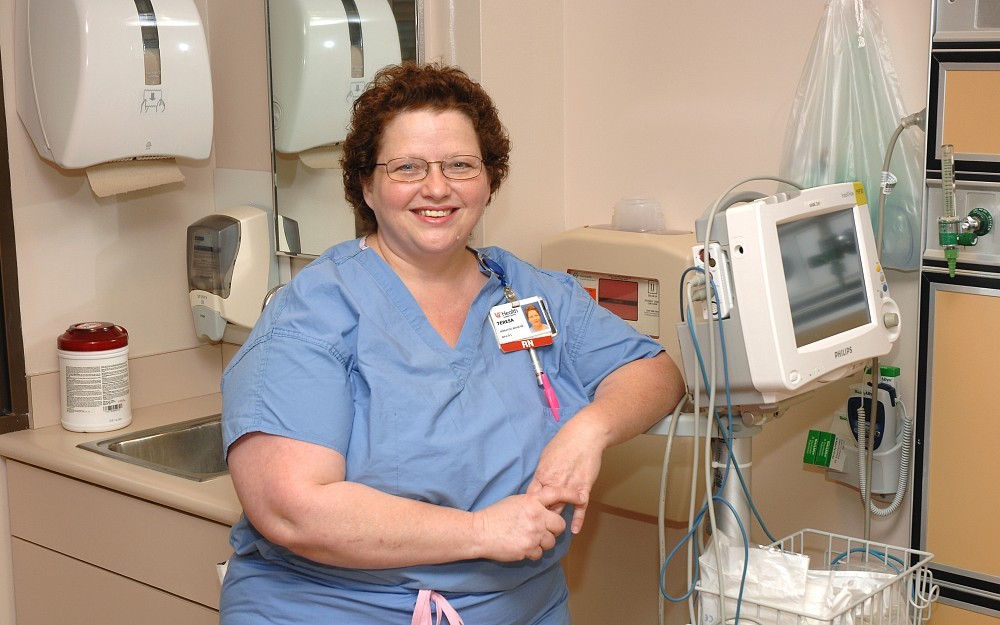
Teresa Smith is a testament to how important both self-breast exams and mammograms can be in detecting breast cancer early, when it is most treatable.
Smith, now 49, found a breast lump during her monthly self-breast exam in March 2011. She immediately scheduled an appointment to have it evaluated by a medical professional.
"I was always very diligent about doing my monthly breast exam. One month the lump wasnt there, and then suddenly it was, Smith recalls. She was over 40, but had put off starting screening mammograms until age 50 because she had no family history of breast cancer that would put her at an increased risk for the disease.
A mammogram and biopsy gave her an official diagnosis of stage 2B breast cancer. The news took Smiths breath away: She was one stage away from the cancer spreading to the lymph nodes, which would have required not only surgery and chemotherapy but also radiation treatments.
"I urge all women to make self-breast exams part of their routine. I am certain it saved my life, Smith adds.
She chose the University of Cincinnati Cancer Institute multidisciplinary breast cancer team for her treatment. On July 18, 2012, she underwent bilateral mastectomies to remove her breast tissue and surrounding lymph nodes followed by DIEP (deep inferior epigastric perforator) flap breast reconstruction at UC Health University Hospital. The procedure creates new breasts using the patients own tissue.
With the DIEP approach, tiny blood vessels from the transferred tissue are surgically reattached to the chest wall. The procedure spares the abdominal muscles, reducing the risk for complications associated with traditional TRAM (transverse rectus abdominis muscle) flap reconstructive surgery. The result is a more natural breast.
A combination of factorsincluding Smiths type of cancer (estrogen-progesterone receptor positive.), stage of disease, general overall healthmade her a good candidate for the dual procedure. Together, Elizabeth Shaughnessy, MD, PhD, breast surgical oncologist, and Minh Doan Nguyen, MD, PhD, plastic and reconstructive surgeon, performed her procedures.
Smith says going into breast cancer surgery knowing she would lose her breasts but still appear feminine afterward made a huge difference for her.
"I didnt want a foreign object (implants) after breast cancer surgery, but I still needed to feel like a woman, she explains. "I certainly dont look the same under my clothes, but I can wear a bra or a swimsuit, I can give someone a hugand no one would know Id had cancer unless I chose to share that information with them.
Early Detection Through Screening
Women in Their 20s
Breast self-exams have been shown to play a small role in early detection, simply because women are more familiar with what is "normal for them. Evaluation should be done monthly, typically after the menstrual cycle. Any changes should be evaluated immediately by a health professional.
Women in Their 20s and 30s
This is a clinical evaluation of the breast, both in physical appearance and feel, by a trained medical professional. This evaluation can help identify changes from what is normal for that individual and guide interventions, as necessary.
Women Age 40 or Older
Although the U.S. Preventative Task Force recently revised its guidelines to suggest that women begin screening mammography at age 50 instead of 40, the American Cancer Society, Radiologic Society of North America and other professional medical organizations maintain that women should begin annual screening at age 40 and continue to do so as long as they are in good health for the best chances of early detection, and therefore cure.
Since the introduction of screening mammography in the 1980s, there have been 15,000 to 20,000 fewer deaths from breast cancer annually in the United States as compared with the pre-screening era.
MORE INFORMATION
- UC Cancer Institute multidisciplinary breast cancer team

Minh-Doan Nguyen, MD, PhD, specializes in microsurgical breast reconstruction.

Elizabeth Shaughnessy, MD, PhD, specializes in the treatment of breast diseases.
Tags
Related Stories
UC expert weighs in on current MASH treatment approaches
June 5, 2026

As MedCentral recently reported, pending broader pharmacologic approvals for metabolic dysfunction-associated steatohepatitis (MASH), lifestyle modifications remain the go-to intervention.
At least two weather patterns increase headaches, UC study suggests
June 4, 2026
University of Cincinnati physicians and collaborators identified two specific weather patterns that increase headache and migraine risk and found the preventive medication fremanezumab (Ajovy) can reduce weather‑associated headaches. The findings will be presented at the American Headache Society Annual Scientific Meeting in Orlando.
UC researcher secures $3.3M grant to study microplastics’ impact on heart
June 2, 2026
The National Institute of Environmental Health Sciences awarded a $3.3M grant to University of Cincinnati researcher Hong‑Sheng Wang, PhD, to study how microplastics and nanoplastics affect cardiovascular health.