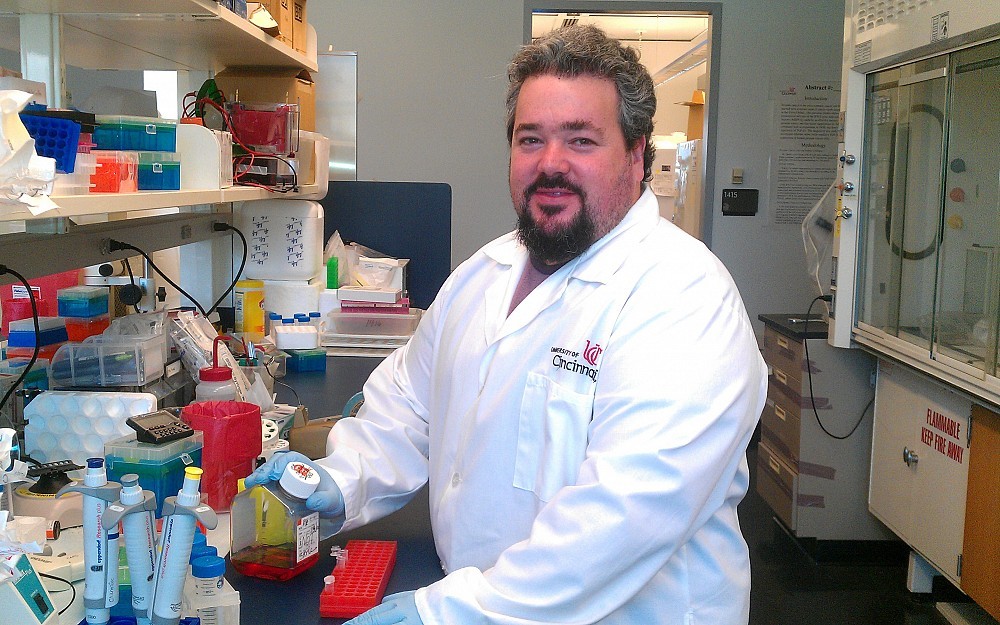
Focus On Research with Jason Steel, PhD

Jason Steel, PhD, witnessed the devastating impact of cancer first-hand as a teenager when his grandmother was diagnosed with and eventually died of the disease. The experience motivated him to pursue medical research as a career.
An Aussie by birth, Steel completed both his undergraduate and doctoral degrees at Charles Sturt University in Australia. He then completed two postdoctoral fellowships at the National Institutes of Health (NIH)the first in cancer gene therapy at the National Cancer Institute, under the tutelage of John Morris, MD, current director of the UC Cancer Institute Experimental Therapeutics/Phase 1 Program. His second fellowship focused on cytokine immunology and immunotherapy.
Steel moved to Cincinnati in 2011 to rejoin his former mentor as part of the UC Cancer Institute Lung Cancer Program. He serves as a research assistant professor in the department of internal medicines hematology oncology division. Here, he tells us about his work.
What is the focus on your laboratory research?
"Our laboratorys overall goal is to develop and test immunotherapy treatments for lung cancer. We have been looking at how lung cancer is able to thwart the immune system, thereby allowing tumors to grow and metastasize. We have found that lung cancer can suppress the secretion of immune stimulating proteins as well as increase the production of proteins that can inhibit immune cells. Based on this knowledge, we are testing compounds that may restore the immune balance, thereby allowing the immune cells to recognize and kill cancer cells.
What keeps you motivated in your work?
"More people die of lung cancer each year than the next four major cancers: breast, prostate, pancreatic and colon cancer. The overall survival for lung cancer is a dismal 15 percent, and this decreases to only 2 percent in patients with metastatic disease. Most patients with lung cancer are diagnosed with metastatic disease.
Despite this statistic, lung cancer remains one of the most poorly funded research areas. Whenever I need motivation to continue my work, I just have to think about the 98 percent of people with advanced lung cancer who will die within five years and this spurs me to try to make a difference.
Tell us about why you became interested in research and, specifically, lung cancer research.
"My grandmother was diagnosed with cancer when I was in high school. During her battle with cancer, she encouraged me to go into research. When she passed away I was in university and had to choose my research specialty. I chose cancer research. As I began to develop as a researcher, I found that there was a great need for work focusing on lung cancer. This led me to apply my skills in immunology and immunotherapy to try to find effective therapies against this terrible disease.
What are you most proud of in your career so far?
"I was lucky to work with some outstanding researchers as a postdoctoral fellow at NIH. Through their mentorship, I was able to win three consecutive NIH Fellows Awards for Research Excellence for three separate projects. Out of the thousands of applicants, I was the only person to hold three consecutive awards.
When you arent working, what do you spend your free time doing?
"I spend my free time with my family. I have a rambunctious 3-year-old son who ensures that my free time is his playtime. There is nothing like chasing balloons around the house to make me forget about work for a while.
Tags
Related Stories
UC radiation oncologist speaks with Local 12 news about clinical trial for head and neck cancer treatment
August 10, 2026

Dr. Sara Medek, a UC radiation oncology professor, speaks with Local 12 news about a new clinical trial aimed at reducing radiation in certain areas while still treating cancer effectively but with fewer painful side effects.
Cancer Center director charts future based on collaboration, AI
August 10, 2026

David Gius, MD, PhD, was featured in a Cincinnati Business Courier article and The Cancer Letter’s “The Directors" podcast discussing his priorities and goals as he recently took the helm as director of the University of Cincinnati Cancer Center.
Bidirectional link between oral, kidney health calls for patient education, access
August 4, 2026

Despite growing awareness of the connection between oral health and chronic health conditions, patient awareness and access to dental care remain limited, according to University of Cincinnati experts who recently spoke with Healio | Nephrology News & Issues.