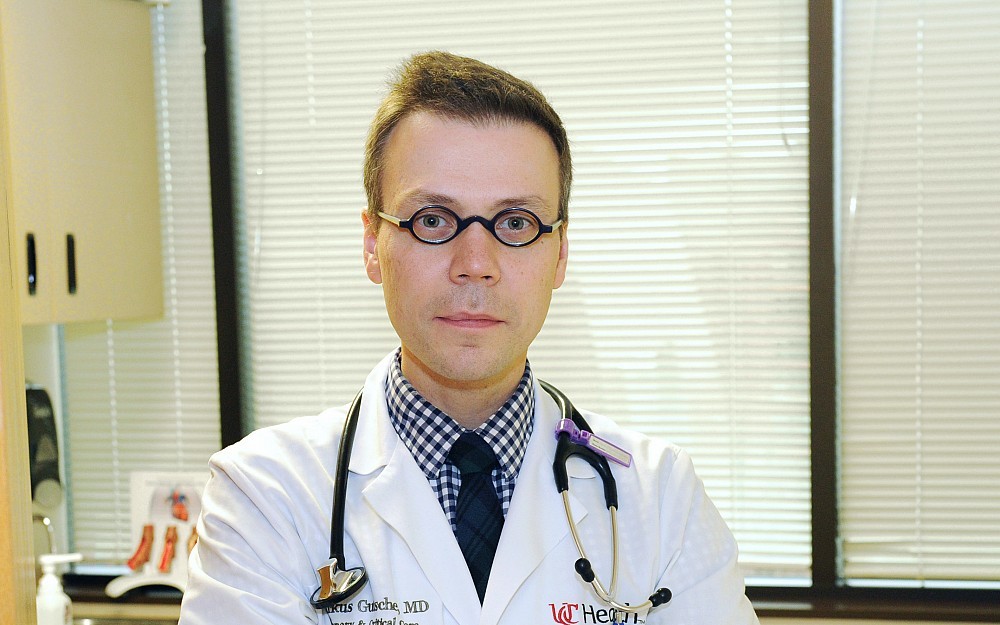
Focus on Faculty With Markus Gutsche, MD, PhD

Markus Gutsche, MD, PhD, is an assistant professor of medicine and director of the Interstitial Lung Disease (ILD) Program at UC and within UC Health. Gutsche received his medical degree from the Albert Ludwig University of Freiburg in Germany as well as completed his residency at the Upstate University Hospital/SUNY Upstate Medical University in New York and a pulmonary and critical care fellowship at Stanford Medical Center in California.
What brought you to UC?
"During my training in pulmonary and critical care medicine at Stanford, I developed an interest in Interstitial Lung Diseases and underwent further subspecialty training within this field. The University of Cincinnati is well known for its expert work both in the clinical practice as well as cutting-edge research in rare lung diseases and ILD. I felt both inspired and honored by the prospect of helping to expand and further develop a comprehensive ILD program at UC and UC Health for patients with this challenging disorder who live in the Tristate area.
What is Interstitial Lung Disease?
"Interstitial Lung Disease comprises a large group of lung disorders most of which lead to progressive pulmonary fibrosis, or scarring of the lung tissue. The causes of interstitial lung disease can range from inhalation of hazardous material, like asbestos or certain dusts, to autoimmune diseases such as rheumatoid arthritis. However, often the cause remains unknown. Once lung scarring has occurred it is usually irreversible. While some patients may be candidates for lung transplantation some may actually benefit from early intervention and specific therapies to halt further progression to irreversible lung scarring.
Why did you decide to study or specialize in this disease? Please explain your specific ILD research focus, if applicable.
"The care of patients with ILD requires a very systematic approach including a comprehensive history and physical examination with particular attention to detail as well as collaboration with other specialtiesradiologists, pathologists, rheumatologists in a multidisciplinary approach. I have a vested interest in spending sufficient time with my patients to illuminate the cause of their ILD and explore appropriate treatment options. Because so many of the interstitial lung disorders are poorly understood, there also exists a great need for further research in this area to improve the overall care of patients afflicted by ILD.
What are your plans for the ILD program at UCboth clinically and scientifically?
"I strive to offer my patients the most comprehensive ILD care program within the Greater Cincinnati and Tristate area. We also plan to open an ILD clinic for our veterans at the (Cincinnati) VA. Over time, via systematic observation and data collection through our clinical work and by collaborating with scientists at UC, I am hopeful that we will make steady progress in understanding this group of challenging disorders and improve the overall management of our ILD population in this area.
Tags
Related Stories
On-site training in Speech & Hearing Clinic sets UC’s programs apart
August 27, 2026
At the University of Cincinnati’s Speech & Hearing Clinic, Doctor of Audiology and Speech-Language Pathology graduate students gain real-world experience while providing free speech and hearing services to the community.
Funding expands UC research into weight gain side effects of bipolar medication
August 26, 2026
University of Cincinnati researchers have been approved for funding by the Patient-Centered Outcomes Research Institute (PCORI) to expand the implementation of healthy lifestyle interventions and metformin prescription to help manage weight gain in overweight or obese youth taking second-generation antipsychotic medications.
One in four NFL players had CTE at death
August 25, 2026

Forbes cites research on concussions and football helmets by the University of Cincinnati in a report that found one in four NFL players had brain damage at death.