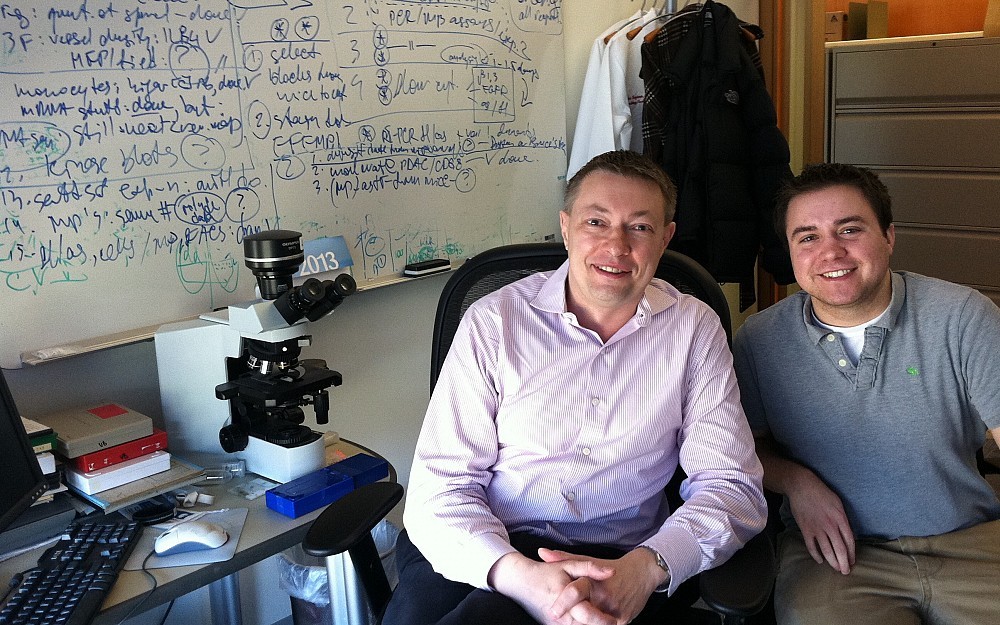
Future Med Student s Lab Experience Fuels Passion for Medical Research

Richard Godby has always felt drawn to clinical medicine. However, hes also enthralled by the scientific discovery processa more recent interest that developed throughout his undergraduate career.
"I love the intellectual challenges of medicine and the fact that solutions lead to improved health care. When scientists and physicians work together, the power of basic science emerges in clinical practice and seemingly distinct approaches coalesce to yield tangible outcomes, says Godby, who will graduate this month at the top of his class and serve as the Marshal for the UC College of Engineering and Applied Sciences biomedical engineering (BME) program, entering medical school at UC this fall. "Its fascinating to read about and observe scientific concepts, study those concepts and come up with your own conjectures about what is realityand try to prove it in the lab. Then the process continues when others challenge your ideas.:
His BME undergrad experience ingrained in him the value of translational researchmoving promising ideas beyond the lab bench and into clinical application. This, teamed with his interest in medical research, led him to pursue a co-op in the lab of UC Cancer Institute researcher Vladimir Bogdanov, PhD.
Bogdanov specializes in hemostasisthe process that causes bleeding to stopand specifically, alternatively spliced Tissue Factor (asTF) as a target for diseases including cancer, occlusive diseases, sickle cell and others.
When Godby entered Bogdanovs lab, he was brimming with enthusiasm, but was an admitted novice when it came to the interworkings of a basic science laboratory.
"Id never even used a pipette, Godby recalls, noting that the rapport among him, Bogdanov and the lab staff overcame that obstacle quickly and resulted in a very positive co-op experience.
"Dr. Bogdanov encouraged me to come to grand rounds and shadow in the clinic and basically get a holistic picture of how what we are doing here in the lab influences clinical care. It was just a really good experience.
Training Scientifically Minded Clinicians
Giving future physicians hands-on experience with and an appreciation for science is very rewarding, says Bogdanov, who has had three co-op students rotate fthrough his laboratory since joining the UC College of Medicine faculty in the summer of 2009.
"Richard was a pleasure to have in the lab. He was hardworking and applied a lot of effort to self-improve in real time. Ive had the pleasure of working with many talented medical students, but sometimes you really see someones potential. In the lab, you learn to think on your heels and become a better critical thinker and strategic risk taker, says Bogdanov.
"As a faculty mentor, you hope that experience in the research lab with stay with them when they begin practicing medicine so they continue to contribute to the research that ultimately improves care at the bedside.
Student-Faculty Research Project
During his six-month co-op, Godby worked with Bogdanov to examine the biologic properties of the mouse form of asTF and its usefulness in mouse models. The study goal was to articulate the potential significance of having or not having asTF in an effort to understand the molecules role in disease development.
Numerous models exist for studying Tissue Factor, but a comprehensive evaluation of the Tissue Factor system showing the potential significance of havingor not having the asTF moleculedid not previously exist in the scientific literature.
The study, published in July 2012, was recently listed in the Top Ten most read original research articles in Molecular Medicine, an open access journal seeking insight into the cellular and molecular basis of disease.
Related Stories
Co-op broadens horizons for architectural engineer
August 17, 2026
UC architectural engineering graduate Jeremy Ackley turned his co-op rotations with CMTA, a national engineering consulting firm in Texas, into a full-time role, showcasing the University of Cincinnati’s national co-op footprint.
Emeritus professor honored for gas turbine research
August 17, 2026
Mark Turner has been part of the University of Cincinnati's College of Engineering and Applied Science for 25 years. His work in the field of gas turbine simulation and design continues to leave a significant impact on the industry. He was honored by the American Society of Mechanical Engineers with the International Gas Turbine Institute Scholar Award. Turner is part of the Department of Aerospace Engineering and Engineering Mechanics at UC.
UC scholarship honoring a family’s matriarch continues
August 17, 2026
“I get chills thinking about what she means to our family,” says Norma Wellman Cobb’s grandson, Thomas Beach, reflecting on how his grandmother’s perseverance and unwavering belief in the power of education shaped generations.