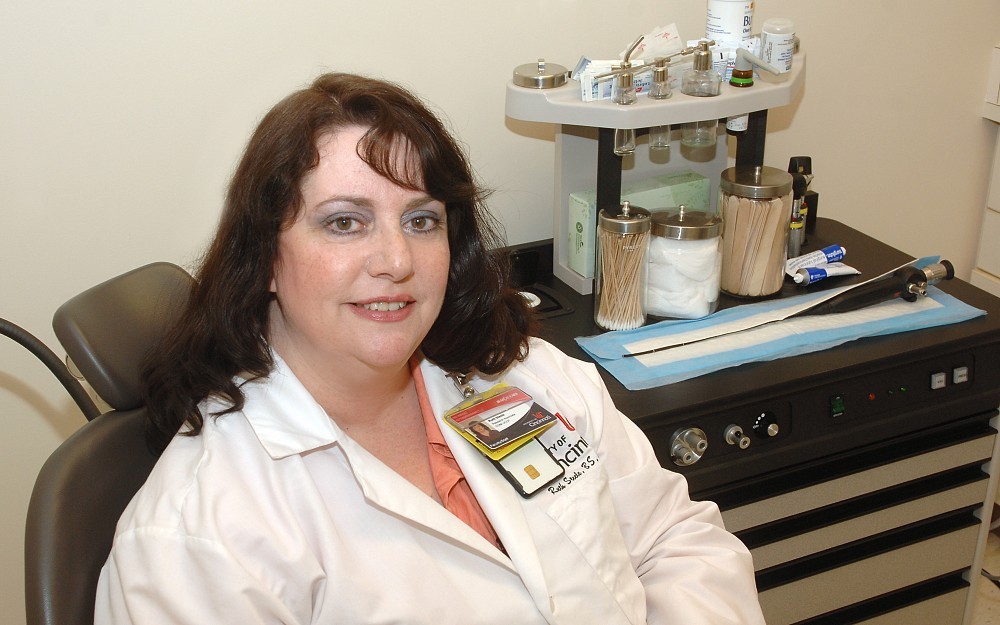
Focus on Staff With Ruth Steele

Cancer research is something senior clinical trials research coordinator Ruth Steele says is "near and dear" to her heart and gives her a great deal of motivation. Steele has personally witnessed the devastating effects of cancer in her extended family. Her mother, four aunts, an uncle and several cousins have all battled cancersbreast, liver, lung, brain and renal.
Her path to oncology clinical research was not intentional. With a bachelors degree in allied health sciences and paramedic certification, Steele spent 23 years of her professional career as a paramedic. During this time, Steele began working part time in clinical research through the UC College of Medicine's department of dermatology. When a workplace injury made it impossible for her to continue as a paramedic, she pursued a new path working full-time in research. Although she left UC briefly to work at a free-standing research facility, Steele quickly realized she enjoyed the academic clinical cancer research environment more. She has worked in what is now the centralized UC Cancer Institute clinical trials office for about 8 years. Steele is certified by the American College of Research Professionals
Here she tells us why she enjoys working in oncology clinical trials.
Describe an average day in the life of a clinical trials research coordinator?
"There is no average day! I do a lot of running back and forth between the UC Cancer Institute clinical trials office and the Barrett Center. Every week, I screen new patients scheduled for consultations with our lung and head/neck cancer teams against all of our open clinical research protocols.
"I am in the clinic with our oncologists, so I am able to alert them in advance of the patients appointment or potential research studies the patient would qualify for. Clinical trials then become part of the treatment planning conversation. If the trial is a good match for the patient, I follow-through to explain patient rights and get signed consent. Then, I oversee their treatment process on the clinical trial side-by-side with the physicians and nurse practitioners.
How has your past life as a paramedic prepared you for your role in clinical research?
"Being a paramedic taught me to analyze things quickly but thoroughly and then act expediently. It also gave me great multitasking skillsall of which help me in my role as a clinical trials coordinator. My primary role is to screen, consent and oversee treatment and follow-up for head/neck and lung cancer patients enrolled to clinical trials, but I also facilitate monitoring visits for sponsored research studies, manage data for childrens oncology studies and non-treatment brain tumor studies. Every day is different.
Why do you enjoy your job?
"I love working with patients and being able to help guide them to the right people and understand all their options for care. It is also very rewarding just to make patients laugh during a very trying time. At the end of the day, we want our patients to feel fully cared for and have a solid understanding of what to expect from their involvement in clinical research.
"Ive worked on several clinical research trials for drugs that are now helping patients. It is very rewarding to see these efforts come full circle and benefit patients dealing with cancer."
As a single mom of threeages 17, 16 and 7Steeles personal life stays busy, as she attends her teenage boys sporting events and daughters ballet classes. She is also finishing up her Black Belt Six Sigma executive training through the Ohio State University.
Related Stories
UC radiation oncologist speaks with Local 12 news about clinical trial for head and neck cancer treatment
August 10, 2026

Dr. Sara Medek, a UC radiation oncology professor, speaks with Local 12 news about a new clinical trial aimed at reducing radiation in certain areas while still treating cancer effectively but with fewer painful side effects.
Cancer Center director charts future based on collaboration, AI
August 10, 2026

David Gius, MD, PhD, was featured in a Cincinnati Business Courier article and The Cancer Letter’s “The Directors" podcast discussing his priorities and goals as he recently took the helm as director of the University of Cincinnati Cancer Center.
UC graduates cross finish line at commencement
August 7, 2026
The University of Cincinnati recognized 2,125 graduates in two ceremonies at summer commencement Friday on campus at Fifth Third Arena.