Study Finds Plasmin Delivered Through a Bubble More Effective Than tPA in Busting Clots

CINCINNATIA new study from the University of Cincinnati (UC) College of Medicine has found that, when delivered via ultrasound, the natural enzyme plasmin is more effective at dissolving stroke-causing clots than the standard of care, recombinant tissue plasminogen activator (rt-PA).
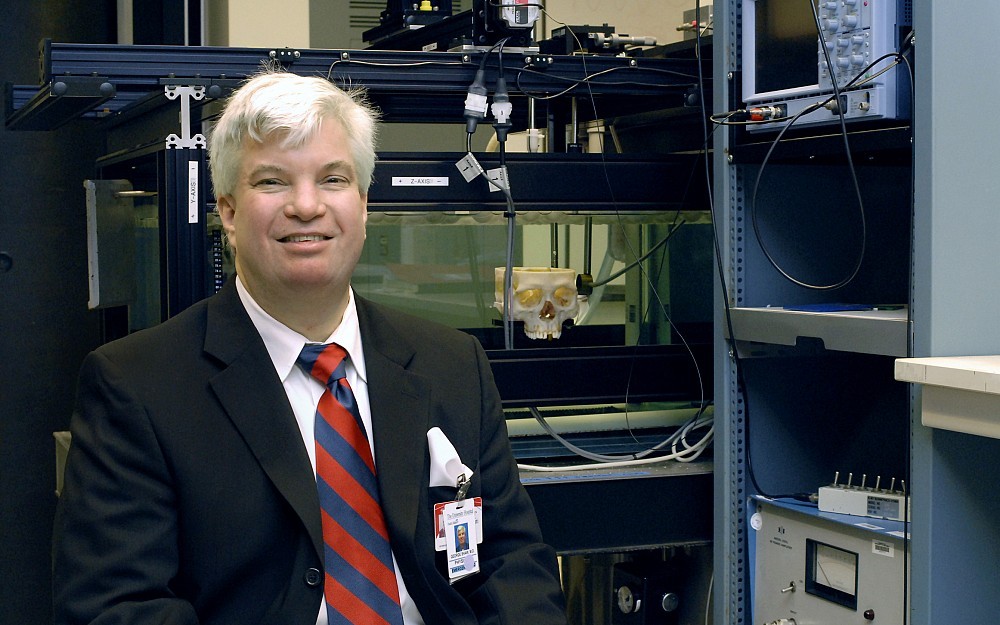
The novel delivery method involved trapping plasmin into bubble-like liposomes, delivering them to the clot intravenously and bursting it via ultrasound. That method is necessary, says UC associate professor of emergency medicine George "Chip Shaw III, MD, PhD, because plasmin cannot be delivered through traditional methods. Intravenous delivery of rt-PA is designed to solve that problem by catalyzing the conversion of existing plasminogen inside the body to plasmin, which in turn degrades blood clots.
"Plasmin is the enzyme that actually chews up the fibrin in clots, says Shaw. "The problem is you can only give plasmin inter-arterially, which has safety risks and takes longer to deliver. IV therapy is always easier and quicker, but if you give plasmin intravenously, the body inhibits it immediately. If you can encapsulate it, it doesnt get inhibited and you can target it to the clot.
In their in-vitro study, Shaw and researchers Madhuvathi Kandadai, PhD, and Jason Meunier, PhD, enclosed plasmin and a gas bubble inside a liposome. They then delivered the liposome to a clot in an in-vitro lab clot model and dissolved it using ultrasound waves, thus delivering the plasmin enzyme to the clot. After 30 minutes, clots treated with plasmin showed significantly greater breakdown than clots treated with rt-PA.
They worked with colleague Christy Holland, PhD, professor in UCs cardiovascular diseases division, to develop the technique. As director of the Image-guided Ultrasound Therapeutics Laboratories at UC, Holland has studied the use of liposomes and ultrasound to deliver drugs in a less invasive, more targeted fashion.
The standard of care for acute ischemic stroke is intravenous delivery of U.S. Food and Drug Administration-approved rt-PA within three hours of stroke onset. Ischemic stroke is the most common type of stroke, accounting for about 87 percent of all stroke cases.
But Shaw says there is a "critical need for a safer and more effective thrombolytic, as rt-PA carries a risk of bleeding. Intracranial hemorrhage currently occurs in 6 percent of patients receiving rt-PA therapy.
"Previous in vivo studies have demonstrated better safety of plasmin as compared with rt-PA, he says. "Currently, intra-arterial plasmin is undergoing clinical trials. Our next step is to work on targeting the liposome by putting antibodies on its surface that will stick it to the clot. We also want to improve the efficiency of encapsulating the plasmin in the liposome. Right now, about 15 percent of the plasmin gets into the liposomewere aiming for 50 percent.
Kandadai, a postdoctoral fellow in the UC Department of Emergency Medicine, will present the abstract, "Plasmin loaded echogenic liposomes: A Novel Thrombolytic, at the Society for Academic Emergency Medicine annual meeting May 14-18 in Atlanta. Meunier, a research assistant professor of emergency medicine, is also a co-author.
Related Stories
UC expert weighs in on current MASH treatment approaches
June 5, 2026

As MedCentral recently reported, pending broader pharmacologic approvals for metabolic dysfunction-associated steatohepatitis (MASH), lifestyle modifications remain the go-to intervention.
At least two weather patterns increase headaches, UC study suggests
June 4, 2026
University of Cincinnati physicians and collaborators identified two specific weather patterns that increase headache and migraine risk and found the preventive medication fremanezumab (Ajovy) can reduce weather‑associated headaches. The findings will be presented at the American Headache Society Annual Scientific Meeting in Orlando.
UC researcher secures $3.3M grant to study microplastics’ impact on heart
June 2, 2026
The National Institute of Environmental Health Sciences awarded a $3.3M grant to University of Cincinnati researcher Hong‑Sheng Wang, PhD, to study how microplastics and nanoplastics affect cardiovascular health.