HEALTH LINE: How to Properly Dispose of Prescription Drugs

CINCINNATI
The general public has more choices when it comes to properly disposing of unwanted prescription medicationsat specific community events or by disposing the medications in local drop boxes.
"We know that many of these medications have the potential to be abused by someone other than the prescription holder, or fall into the wrong hands such as a childs, says Marianne Ivey, PharmD, an associate professor at the University of Cincinnati James L. Winkle College of Pharmacy.
Ivey has been an advocate for safe, convenient and responsible means of getting unused or expired medications out of circulation since 2009, when she was part of Leadership Cincinnati, a program designed by the Cincinnati USA Regional Chamber to foster community leadership.
The best way to dispose of medications, for both the individual and the environment, Ivey says, is to utilize resources currently available through sanctioned government programs.
For example, twice a year the U.S. Drug Enforcement Administration (DEA) holds community Take-Back events nationwide so that citizens can properly dispose of unwanted prescription medications. The DEA reports that since the first event in 2010 the agency has collected 1,409 tons of medications at over 5,000 locations.
And it appears that people are becoming more aware of the events.
At the last Take-Back event in April 2013, the DEA collected 371 tons of medications, over a quarter of the total medications collected in six events since 2010.
But what if you cant make it to a Take-Back event?
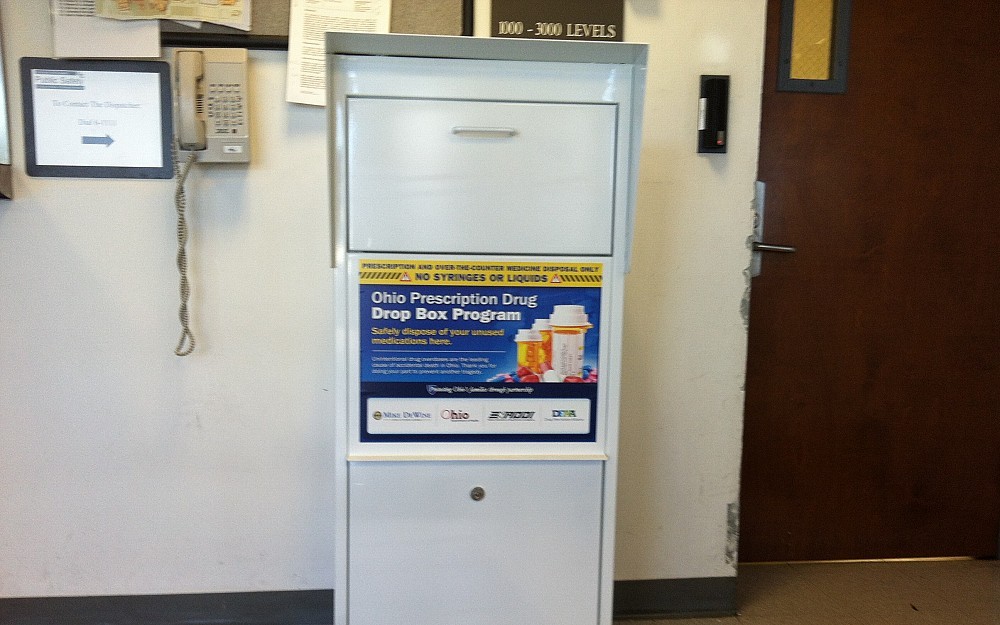
In Ohio, citizens have access to over 50 Prescription Drug Drop Boxes, which are located at municipal police stations. The drop boxes are provided to communities by the Ohio Attorney Generals Office in partnership with the Ohio Department of Health and Drug Free Action Alliance.
Six of the drop boxes are located throughout Greater Cincinnati, one of which is located on UCs main campus in the Public Safety Office in 3 Edwards Center. Since its installation earlier this year, the box doesnt receive large quantities of medications but there is a "steady flow of items to the box, says UCs assistant chief of police, Lt. Col. Jeff Corcoran. The boxes are also clearly labeled for pill collection only, no liquids or needles, he says.
The UC location is intended for use by UCs student population, many of whom either live on campus or in the surrounding neighborhood, and faculty and staff; as with all of the drop boxes it is supervised 24/7. A list of local and statewide drop box locations can be found at the website of the Ohio attorney general, while the next Take-Back event is due to take place in the fall of 2013.
A new generation of products which contain a solution for dissolving unwanted medications and activated charcoal to make the medication inactive will soon become more available, Ivey says. But in the meantime, the drop boxes are a convenient option.
Tags
Related Stories
UC radiation oncologist speaks with Local 12 news about clinical trial for head and neck cancer treatment
August 10, 2026

Dr. Sara Medek, a UC radiation oncology professor, speaks with Local 12 news about a new clinical trial aimed at reducing radiation in certain areas while still treating cancer effectively but with fewer painful side effects.
Cancer Center director charts future based on collaboration, AI
August 10, 2026

David Gius, MD, PhD, was featured in a Cincinnati Business Courier article and The Cancer Letter’s “The Directors" podcast discussing his priorities and goals as he recently took the helm as director of the University of Cincinnati Cancer Center.
Bidirectional link between oral, kidney health calls for patient education, access
August 4, 2026

Despite growing awareness of the connection between oral health and chronic health conditions, patient awareness and access to dental care remain limited, according to University of Cincinnati experts who recently spoke with Healio | Nephrology News & Issues.