Innovative 'Split Liver' Transplant Saves Two Lives

With a new member of the UC Health transplant team and a partnership with surgeons at Cincinnati Children's Hospital Medical Center, two patients received the gift of life this spring.
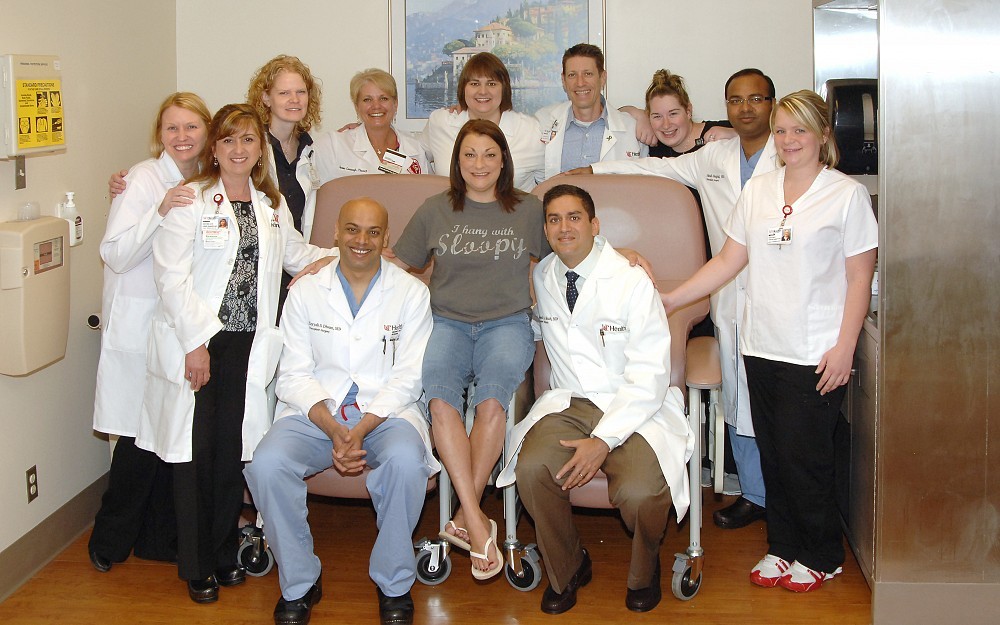
The UC Health Liver Transplant team led by surgeons and College of Medicine faculty Shimul Shah, MD, and Tayyab Diwan, MD, participated in a split-liver transplant at University of Cincinnati Medical Center (UCMC) Saturday, April 27, transplanting three-quarters of a donor liver into patient Andrea Beegle. A 1-year-old child at Cincinnati Childrens received the remaining quarter of the organ.
Split liver transplants are rare and require complex, highly skilled surgical teams. "The idea behind split liver transplant is that you can take one organ and give it to two people," says Shah, who joined UC Health in 2012 as director of the liver transplant program. "It's a great way to reduce our organ shortage and transplant wait list. In Mrs. Beegle's case, she was sick for a long time, but her MELD (model for end-stage liver disease) score wasn't high enough that she was regularly attracting offers for a transplant."
Beegle, a hair stylist from Kentucky, had suffered fatigue and pain of chronic liver failure for years before receiving her diagnosis in 2010.
She had been on the transplant wait list just 18 months when she received a call from her transplant coordinator late in the night Saturday, April 20. At the hospital with her husband and sister, Beegle had prepared herself for a false alarm. Then, the nurses told her it was time to go to the operating room.
"It felt like something sucked all the air out of the room," she remembers.
For the donor surgery, Diwan worked with Greg Tiao, MD, surgical director of the Cincinnati Children's liver transplantation program. As the site with the donor organ receives priority, surgeons split the liver at Cincinnati Children's, with Tiao advising Diwan and Shah on the size and condition of the available organ.
"My job then is to find the perfect recipient--based on how sick they are, their size and other considerations based on their liver anatomy," says Shah. "It's complex decision making."
In order to avoid a complication called "small-for-size syndrome," Shah looked for a patient who can function with a smaller organ.
"The main complication is that all the vessels are half the size, so the risk for thrombosis is very high. Everything is a lot smaller and alignment is critical," he says, "Because of that, your complication rate is higher. The key with the small-for-size syndrome is getting patients through the first two to six weeks--that's when the liver is regenerating, and that's the critical part."
Because of the higher complication rate, Shah says split liver transplants are not recommended for very sick patients. But he estimates that, with the right conditions, UC Health could soon perform three to five split liver transplants a year.
"There are many technical considerations and moving parts to make these operations work," he says, "but we have a very nice partnership with Cincinnati Children's, and we are trying to help our patients in every way possible. All over the country, patients die waiting for a liver transplant. We have to try and get our patients transplanted as often as we can."
Related Stories
UC radiation oncologist speaks with Local 12 news about clinical trial for head and neck cancer treatment
August 10, 2026

Dr. Sara Medek, a UC radiation oncology professor, speaks with Local 12 news about a new clinical trial aimed at reducing radiation in certain areas while still treating cancer effectively but with fewer painful side effects.
Cancer Center director charts future based on collaboration, AI
August 10, 2026

David Gius, MD, PhD, was featured in a Cincinnati Business Courier article and The Cancer Letter’s “The Directors" podcast discussing his priorities and goals as he recently took the helm as director of the University of Cincinnati Cancer Center.
UC graduates cross finish line at commencement
August 7, 2026
The University of Cincinnati recognized 2,125 graduates in two ceremonies at summer commencement Friday on campus at Fifth Third Arena.