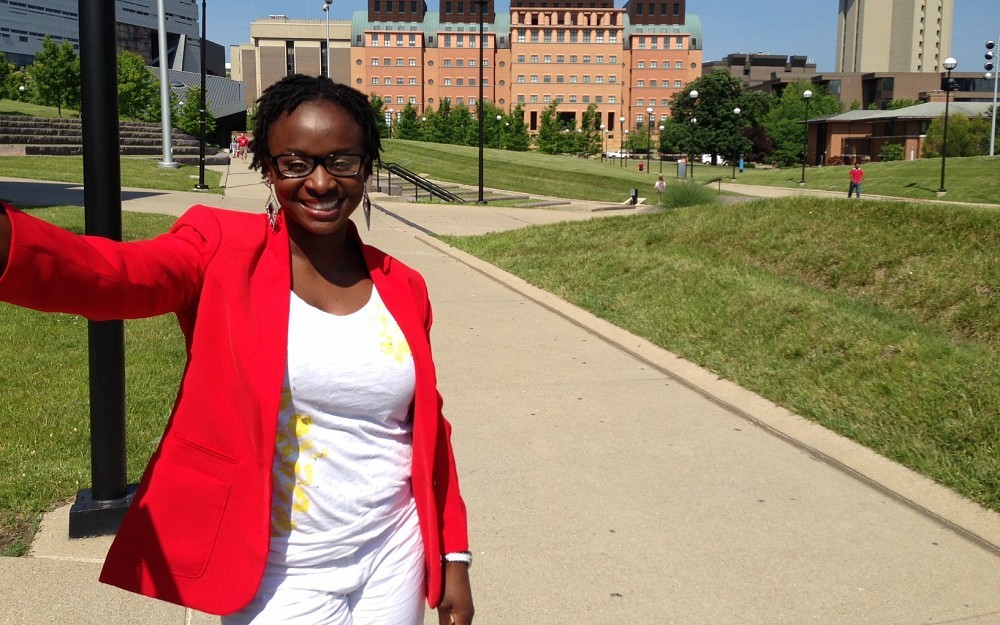
Focus on Alumni with Abena Amoah, MSW

Focus On highlights faculty, staff, students and alumni at the UC Academic Health Center. To suggest someone to be featured, please email uchealthnews@uc.edu.
Born in Ghana, Abena Amoah, MSW, moved to the United States with her sister when she was 14 years old. Living in New Jersey, she maintained her international focus, working with the United Nations during college and at a refugee resettlement agency through AmeriCorps.
Once she moved to Cincinnati, Amoah worked a residential counselor for at-risk youth. After completing her masters degree at the UC School of Social Work in 2009, she started working with another disadvantaged populationindividuals in the criminal justice system.
As a social worker in the Covington office of the Kentucky Department of Public Advocacy (DPA), Amoah works with the defense team in criminal cases to provide alternative sentencing plans for defendants.
In addition to receiving the National Criminal Justice Associations 2011 Outstanding Criminal Justice Program Award in the Southern region, the DPAs alternative sentencing program was recently recognized by the Harvard Kennedy School.
How did you begin work at the Department of Public Advocacy?
"I actually did my graduate internship here. My concentration at the School of Social Work was administration, so I was looking for an agency that would give me both a micro-level experience as well as a macro-level understanding of how in programs are implemented on a long-term basis.
"When I did my internship, the program was in its end stage as a pilot program. It started as an 18-month pilot project in 2006 based on the Bronx Public Defenders program, which looks at social work interventions within the criminal justice system.
"As social workers, were trying to dissect the underlying issues in our client population, which include severe, untreated mental health issues as well as substance abuse. After we do a full psychosocial assessment, we develop an alternative sentencing plan to bring to courtthat may be regular, therapeutic treatment, or it may be a long-term treatment center as opposed to incarceration.
"We want to find out what the underlying problem is for our client and how we can find treatment options to prevent future recidivism. Our job is to look at that individual as a human being, to define them beyond the crime that they have committed.
Youve worked with refugees and youth
was it an adjustment to work in courts? Did you want to work in the criminal justice system?
"I never thought I wanted to, but I never closed my eyes to it. Ive learned that theres a common trend in people, regardless of what their circumstances are. They want to survive and they will go into survival mode to do that.
"Individuals in the criminal justice system are just as the same as the some of the kids I used to work with. They have extenuating circumstances, very limited family support, poor education and have always lived in poverty. So when your basic needs are not being met, youre going to do whatever it takes to meet those basic needsand if you are in an active addiction, youre going to do anything to fund that addiction.
Do you think this is a future model for the criminal justice system?
"Yes. I know that with Kentucky, one of the reasons the government wanted to look at alternative sentencing was that the jails were overcrowded. It forced them to come up with a solution.
"But this new wave of heroin addiction is a big issue in the state. If someone is severely addicted to drugs, keeping them incarcerated for six months or a year doesnt solve their problemthe minute they get out they go right back to the same behavior. So the question is: What can we do to change that behavior so that those individuals dont keep using? When more people use, it affects the community as a whole.
Would you recommend a criminal justice internship or career path to social work students?
"I actually believe the ideal probation officer should be a social workerwere trained to connect individuals to services, to navigate systems and to be a change agent. We have the skills.
"Ive had a few UC students work with me as interns and its an amazing experience. Not only are you learning about the criminal justice system, but you also learn about other social service entities. You have to know where to get food stamps, where homeless services are, who provides mental health services, so that when youre making recommendations to the court, its for a holistic approach. You get a taste of everything and you can decide what you want to do.
Related Stories
UC radiation oncologist speaks with Local 12 news about clinical trial for head and neck cancer treatment
August 10, 2026

Dr. Sara Medek, a UC radiation oncology professor, speaks with Local 12 news about a new clinical trial aimed at reducing radiation in certain areas while still treating cancer effectively but with fewer painful side effects.
Cancer Center director charts future based on collaboration, AI
August 10, 2026

David Gius, MD, PhD, was featured in a Cincinnati Business Courier article and The Cancer Letter’s “The Directors" podcast discussing his priorities and goals as he recently took the helm as director of the University of Cincinnati Cancer Center.
UC graduates cross finish line at commencement
August 7, 2026
The University of Cincinnati recognized 2,125 graduates in two ceremonies at summer commencement Friday on campus at Fifth Third Arena.