Study Shows Combination Stroke Therapy Safe and Effective

CINCINNATIThe combination of the clot-busting drug tPA with an infusion of the antiplatelet drug eptifibatide dissolves blood clots safely and more quickly than tPA alone, a study led by University of Cincinnati (UC) researchers has found.
Results from the study, known as the CLEAR-ER Stroke Trial, are published online in the journal Stroke: Journal of the American Heart Association. UC was the coordinating center for the trial, which included nine medical centers comprising 21 hospitals.
The CLEAR-ER Stroke Trial was sponsored by the National Institutes of Healths National Institute of Neurological Disorders and Stroke (NINDS) as a Specialized Programs of Translational Research in Acute Stroke (SPOTRIAS) project.
Standard treatment for acute ischemic stroke (characterized by an obstruction to the blood flow, typically a clot), is intravenous (IV) delivery of U.S. Food and Drug Administration-approved tissue plasminogen activator (tPA) within three hours of stroke onset.
The CLEAR-ER (Combined Approach to Lysis Utilizing Eptifibatide and rt-PA in Acute Ischemic Stroke Enhanced Regimen) trial was a phase-2 clinical trial designed to determine the safety of an enhanced dosing regimen using eptifibatide and establish evidence for a phase-3 clinical trial, which would use a larger pool of subjects. As an antiplatelet medication, eptifibatidedelivered intravenouslyworks together with the tPA to break up the existing clot and prevents formation of additional clots by decreasing the clumping of blood platelets.
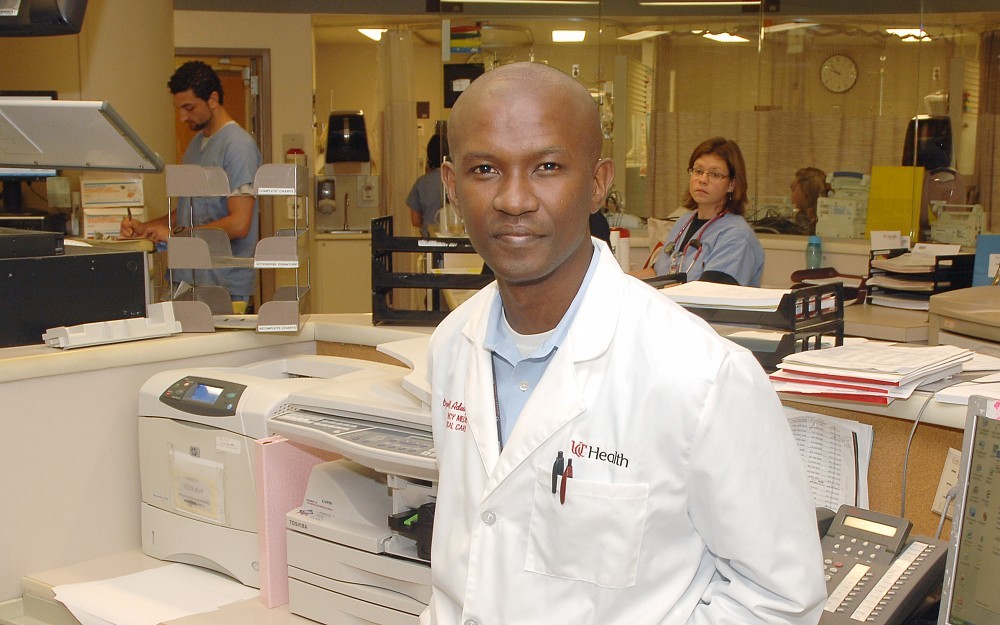
"Through our teams research efforts, we were able to determine that eptifibatide may be safely combined with medium-dose IV tPA administered within three hours of symptom onset and that a phase-3 clinical trial is warranted, says Opeolu Adeoye, MD, UC assistant professor of emergency medicine and neurosurgery and a neurointensivist at UC Medical Center.
Adeoye was co-principal investigator along with Arthur Pancioli, MD, professor and Richard C. Levy Chair for Emergency Medicine at UC. Both Adeoye and Pancioli are members of the UC Neuroscience Institute, one of four institutes affiliated with the UC College of Medicine and UC Health.
Says Pancioli: "We know that the combination of these two medications dissolves clots faster and more completely than tPA alone. Our goal is to determine if we can use this combination to improve the outcomes for acute stroke victims.
CLEAR-ER investigators enrolled 126 subjects from July 2009 to October 2012. Of those, 101 received tPA plus eptifibatide and 25 received tPA alone. As the trial was a double-blind, randomized study, neither patient nor doctor was aware if the substance administered in addition to tPA was a medication or a placebo.
Investigators examined safety at specified endpoints, watching for incidence of intracerebral hemorrhage (ICH), and 90-day outcomes using a standardized measurement tool. Of the subjects who were given tPA plus eptifibatide, 50 (49.5 percent) had what were classified as good outcomes. Those who received tPA alone had nine good outcomes (36 percent).
Safety between the two groups was shown to be comparable at 36-hour, seven-day and 90-day endpoints.
The potential next step in investigation of the enhanced regimen, a phase-3 clinical trial, would typically use a larger pool of subjects determined by data from the phase-2 trial. Phase-3 trials, the last step before marketing of a medication, typically confirm its effectiveness, monitor side effects, compare it to commonly used treatments and collect information that will allow it to be used safely.
Adeoye also presented the study results at the American Heart Association/American Stroke Associations International Stroke Conference, held Feb. 5-8 in Honolulu.
Drugs for the CLEAR-ER trial were supplied by Genentech (tPA) and Merck (eptifibatide, marketed as Integrilin). Adeoye serves as a consultant to Genentech and is a member of its speakers bureau. Pancioli reports no conflicts.

Arthur Pancioli, MD, Richard C. Levy chair for emergency medicine, instructs third-year medical student Kourtni Starkey in the emergency department at University Hospital.
Related Stories
UC radiation oncologist speaks with Local 12 news about clinical trial for head and neck cancer treatment
August 10, 2026

Dr. Sara Medek, a UC radiation oncology professor, speaks with Local 12 news about a new clinical trial aimed at reducing radiation in certain areas while still treating cancer effectively but with fewer painful side effects.
Cancer Center director charts future based on collaboration, AI
August 10, 2026

David Gius, MD, PhD, was featured in a Cincinnati Business Courier article and The Cancer Letter’s “The Directors" podcast discussing his priorities and goals as he recently took the helm as director of the University of Cincinnati Cancer Center.
UC graduates cross finish line at commencement
August 7, 2026
The University of Cincinnati recognized 2,125 graduates in two ceremonies at summer commencement Friday on campus at Fifth Third Arena.