Clinical Trial Examines Efficacy, Safety of Drug Combination for Lung Cancer

CINCINNATIResearchers at the University of Cincinnati Cancer Institute are looking for patients with lung cancer whose tumors test positive for the ALK gene to participate in a clinical trial examining the safety and efficacy of an experimental drug named AT13387 in combination with the standard therapy crizotinib.
ALK, otherwise known as Anaplastic Lymphoma Kinase, affects the nervous system. The ALK gene can cause tumors by forming a fusion with other genes, by gaining additional gene copies or by fusing with mutations of the actual DNA code for the gene itself.
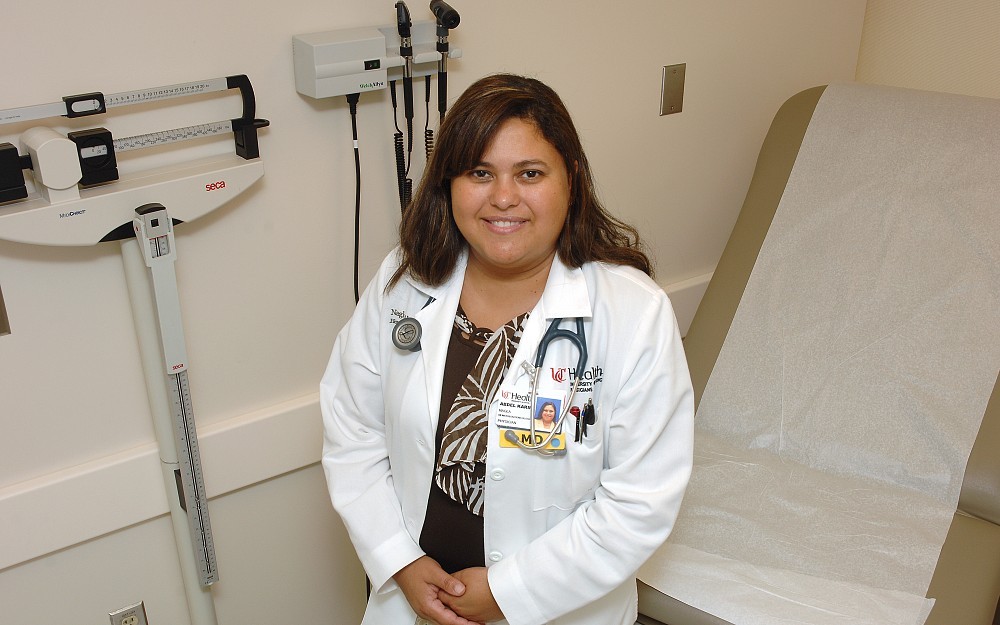
"Non-small cell lung cancer is the most common type of lung cancer, says Nagla Karim, MD, member of the UC Cancer Institute, assistant professor in the division of hematology oncology at the UC College of Medicine, UC Health physician and principal investigator on this study. "About 85 percent of lung cancers are non-small cell lung cancers, whereas only 4 to 5 percent of patients with non-small cell lung cancer test positive for the ALK gene.
"The experimental drug AT13387 has been shown to have anti-cancer effects against tumor cells. AT13387 blocks a protein that affects other proteins inside certain cancer cells and helps to prevent the cancer cells from reproducing and spreading. We want to see if coupling AT13387 with the FDA-approved anti-cancer drug crizotinib (made by Pfizer), which is given to patients with ALK-positive lung cancer, will improve outcomes.
For this trial, participants will be broken up into three groups. For the first group, patients who have already been receiving crizotinib (250 milligrams twice daily) will also intravenously receive escalating doses of AT13387 until the maximum tolerated dose is reached for three weeks. The patients will be monitored for safety and efficacy of dosage.
For the second group, which will be randomly split, some patients will receive crizotinib while others will receive the combination of AT13387 and crizotinib.
For the third group, also randomized, AT13387 will be administered alone once weekly for three weeks or in combination with crizotinib at the maximum tolerated dose established.
"Participants in all parts of the study will receive treatment until disease progression occurs or the patient experiences adverse effects, Karim says, adding that the trial is expected to run for up to two and a half years. "Our hope is to find a more effective treatment for patients with lung cancer, improving their outcomes.
This trial is funded by Astex Pharmaceuticals, Inc. Karim cites no conflict of interest.
Related Stories
UC expert weighs in on current MASH treatment approaches
June 5, 2026

As MedCentral recently reported, pending broader pharmacologic approvals for metabolic dysfunction-associated steatohepatitis (MASH), lifestyle modifications remain the go-to intervention.
At least two weather patterns increase headaches, UC study suggests
June 4, 2026
University of Cincinnati physicians and collaborators identified two specific weather patterns that increase headache and migraine risk and found the preventive medication fremanezumab (Ajovy) can reduce weather‑associated headaches. The findings will be presented at the American Headache Society Annual Scientific Meeting in Orlando.
UC researcher secures $3.3M grant to study microplastics’ impact on heart
June 2, 2026
The National Institute of Environmental Health Sciences awarded a $3.3M grant to University of Cincinnati researcher Hong‑Sheng Wang, PhD, to study how microplastics and nanoplastics affect cardiovascular health.