Research Team Wins Grant to Continue Development of Portable Sensor

CINCINNATIUniversity of Cincinnati (UC) researchers have received a four-year, $1.5 million grant from the National Institutes of Health (NIH) to continue development of a portable sensor that will be used to measure metal levels in humans.
The portable sensor will combine lab-on-a-chip sensing with microfluidics to measure a sample derived from a few droplets of blood for manganese and lead in participants. Such a point-of-care sensor would provide faster results than traditional blood testing methods, be more convenient for study participants and be more environmentally friendly.
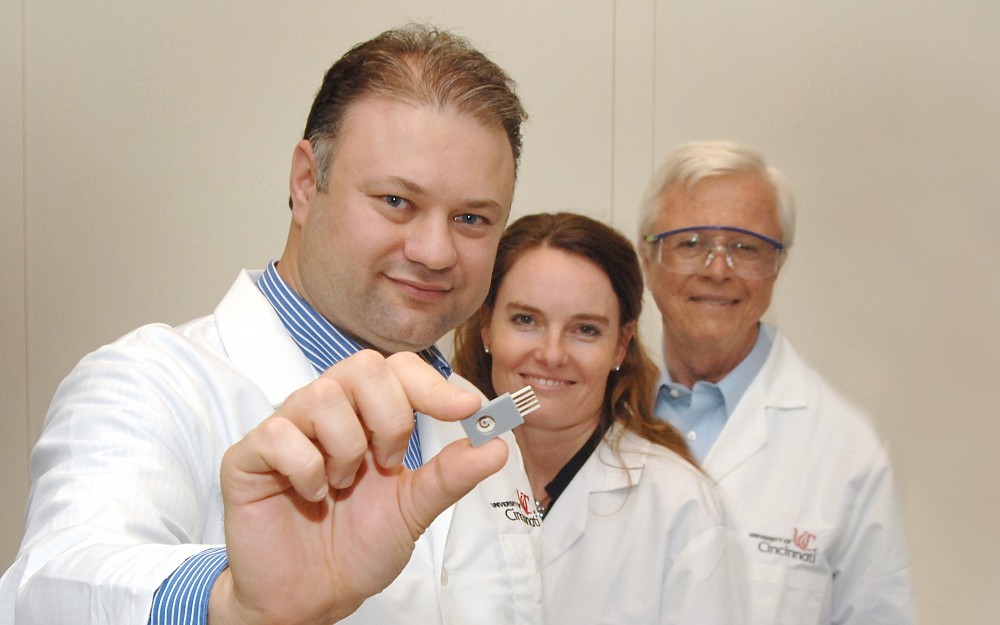
Led by Ian Papautsky, PhD, the principal investigator, the research team represents a true collaboration at UC, bringing together investigators from three colleges: Papautsky, an associate professor in the College of Engineering and Applied Sciences Department of Electrical Engineering and Computer Systems; Erin Haynes, DrPH, an assistant professor in the College of Medicines Department of Environmental Health; and William Heineman, PhD, a professor in the McMicken College of Arts and Sciences Department of Chemistry.
The sensor will be validated in conjunction with the CARES (Communities Actively Researching Exposure Study) project, a related effort in eastern Ohio communities. Haynes is principal investigator of CARES, a partnership between UC and several communities that is looking at air pollution and its effects on child neurodevelopmentparticularly related to manganese, a neurotoxic metal used widely in the production of steel, aluminum alloys, batteries and fertilizers. The sensor will also test for the presence of lead and cadmium, both of which also have demonstrated health risks.
The CARES research team has 407 participants aged 7 to 9. Subjects participated in several activities designed to test their ability to learn and coordinate their movements. Parents completed questionnaires about their children and samples of hair and blood were collected from the children for analysis. (The blood is currently drawn from a vein, but use of the sensor would involve a single prick such as those used for allergy testing.)
"Providing health care providers and scientists the ability to measure in real time whole blood metals in a clinic or research study setting would be fantastic, says Haynes, adding that it currently takes three to nine months for blood metals results to be returned from the laboratory. "This wait time is unacceptable for study participants who may have high levels of concern about their exposure.
Development of the sensor began with a previous grant from the NIH, intended to encourage exploratory and developmental research, which enabled Papautsky, Haynes and Heineman to demonstrate a proof-of-concept version of the sensor. The new version, the focus of the current effort, will go directly into a USB port, Papautsky says, adding that the team will also explore reducing its size (the sensor itself is about the size of a matchbox cover) and integrating control electronics into a more compact system.
"Our multidisciplinary team has already taken the first steps toward developing the sensor and has demonstrated its feasibility through pilot tests, says Papautsky. "We are now poised to fully develop the sensor system for point-of-care application.
Papautsky is director of the Ohio Center for Microfluidic Innovation at UC, where the sensor is made, and has a long-standing interest in the use of microfabrication techniques and microfluidics to study and solve public health problems. Heineman is an electrochemist whose research interests include sensors and microfluidic systems for chemical analysis.
"This is a real collaborationwe didnt just meet to write the proposal, says Papautsky, noting that his and Heinemans teams meet regularly and also stay in contact with Haynes, who originally brought the idea of the metals sensor to Papautsky. "Its a true research enterprise.
The research team has tested the sensor for safety and effectiveness in existing human blood samples. It aims to test it in the field over the next four years, drawing a subset of participants from the CARES study cohort.
Ultimately, Papautsky says, commercialization is likely, with possible broad use of the sensor in clinic, research and international health care settings.
Related Stories
Co-op broadens horizons for architectural engineer
August 17, 2026
UC architectural engineering graduate Jeremy Ackley turned his co-op rotations with CMTA, a national engineering consulting firm in Texas, into a full-time role, showcasing the University of Cincinnati’s national co-op footprint.
Emeritus professor honored for gas turbine research
August 17, 2026
Mark Turner has been part of the University of Cincinnati's College of Engineering and Applied Science for 25 years. His work in the field of gas turbine simulation and design continues to leave a significant impact on the industry. He was honored by the American Society of Mechanical Engineers with the International Gas Turbine Institute Scholar Award. Turner is part of the Department of Aerospace Engineering and Engineering Mechanics at UC.
UC scholarship honoring a family’s matriarch continues
August 17, 2026
“I get chills thinking about what she means to our family,” says Norma Wellman Cobb’s grandson, Thomas Beach, reflecting on how his grandmother’s perseverance and unwavering belief in the power of education shaped generations.