Grant Helps Researchers Study 'Turbocharger Effect' in Skeletal Muscle

CINCINNATIUniversity of Cincinnati (UC) researchers have been awarded a five-year, $2.1 million grant from the National Institutes of Health (NIH) to study an isoform that plays a critical role in human resistance to fatigue.
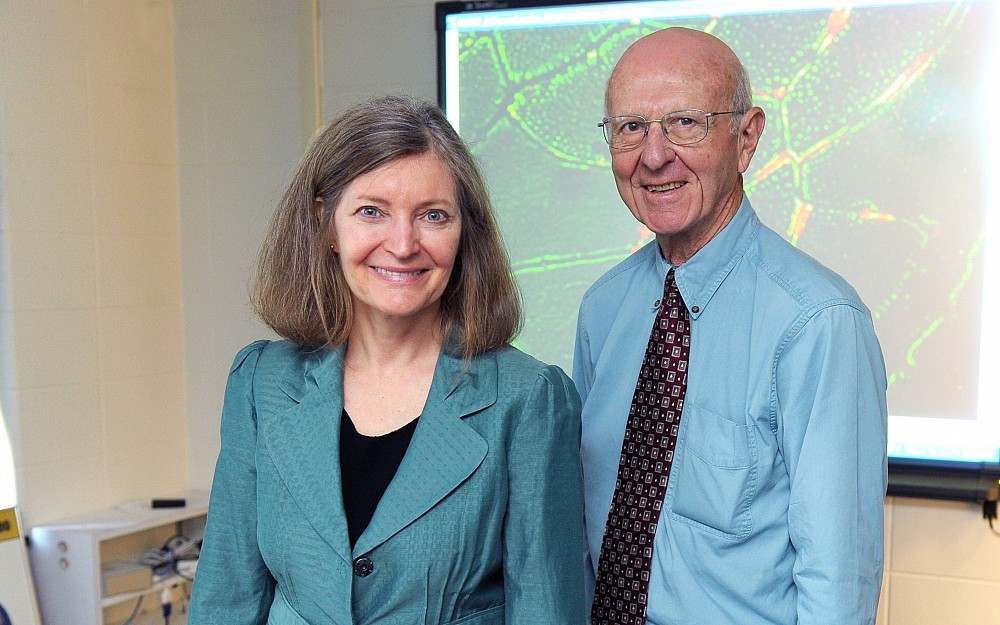
Judith Heiny, PhD, and Jerry Lingrel, PhD, received the award from the National Institute of Arthritis and Musculoskeletal and Skin Diseases, one of 27 units within the NIH. Heiny is an associate professor in the UC College of Medicines Department of Molecular and Cellular Physiology; Lingrel is a professor in the Department of Molecular Genetics, Biochemistry and Microbiology and acting chair of the Department of Cancer Biology.
Heinys lab focuses on the molecular mechanisms of muscle fatigue, which occurs when the skeletal muscles (muscle attached to bone, such as the muscles in the arms and legs) are unable to continue contracting.
"Muscle fatigue is a normal property of skeletal muscle, Heiny says. "However, it can become exaggerated in aging or in human heart failure. Skeletal muscle fatigue with exercise intolerance is almost a diagnostic criterion for heart failure.
Isoforms are closely related variants of the same enzyme. Heiny and Lingrel, using genetically modified mice with an isoform of the Na,K-ATPase enzyme known as alpha 2 deleted only in the skeletal muscles (whats known as a "targeted knockout), observed that the skeletal muscles of these mice fatigued much more quickly than mice without the knockout.
"They didnt run as long as their colleagues, and they had a dramatically reduced exercise capacity, Heiny says.
Heiny likened the action of this isoform to the "turbocharger on an engine which kicks in when extra work is demanded. She adds: "Its not active in resting muscle. It turns on and becomes activated only when youre using your muscles.
The Na,K-ATPase enzyme pumps sodium out of cells, while pumping potassium into them. Skeletal muscles express very high levels of the alpha 2 isoform of the enzyme, in addition to the more common alpha 1 isoform that is found in all living cells.
Heiny and Lingrel deleted the alpha 2 isoform in their genetically modified mice. They found that this isoform is switched on rapidly at the start of muscle use, providing the "turbocharger effect.
Working muscles naturally lose some potassium, and the researchers postulate that this isoform provides the extra capacity to pump it back. "The alpha 2 enzyme keeps us moving, Heiny added.
Their new research project will seek a better understanding of the isoforms mechanisms. "The mechanisms of fatigue arent that well understood, Heiny says. "Some of them are, but its still an incomplete picture.
"This is a major isoform, and its sitting there not working until you really need it, says Lingrel. "That happens only in rare cases in other kinds of proteins.
"So that is the major challenge: What turns it on?
Heiny and Lingrel will focus their research on the regulation of the isoform, with a number of possible translational applications including heart failure and endurance-based sports activities such as swimming, running and bicycling.
"The field of exercise physiology is always looking for something to resist muscle fatigue, says Lingrel. "But were not at that point yet.
Related Stories
UC radiation oncologist speaks with Local 12 news about clinical trial for head and neck cancer treatment
August 10, 2026

Dr. Sara Medek, a UC radiation oncology professor, speaks with Local 12 news about a new clinical trial aimed at reducing radiation in certain areas while still treating cancer effectively but with fewer painful side effects.
Cancer Center director charts future based on collaboration, AI
August 10, 2026

David Gius, MD, PhD, was featured in a Cincinnati Business Courier article and The Cancer Letter’s “The Directors" podcast discussing his priorities and goals as he recently took the helm as director of the University of Cincinnati Cancer Center.
UC graduates cross finish line at commencement
August 7, 2026
The University of Cincinnati recognized 2,125 graduates in two ceremonies at summer commencement Friday on campus at Fifth Third Arena.