Boat Cites 'Huge Strides,' but Says Challenges Remain

Thomas Boat, MD, Christian R. Holmes Professor and dean of the UC College of Medicine, divided his annual update on the college into three parts: change and its impact, opportunities and reasons for celebrationand there were plenty of each.
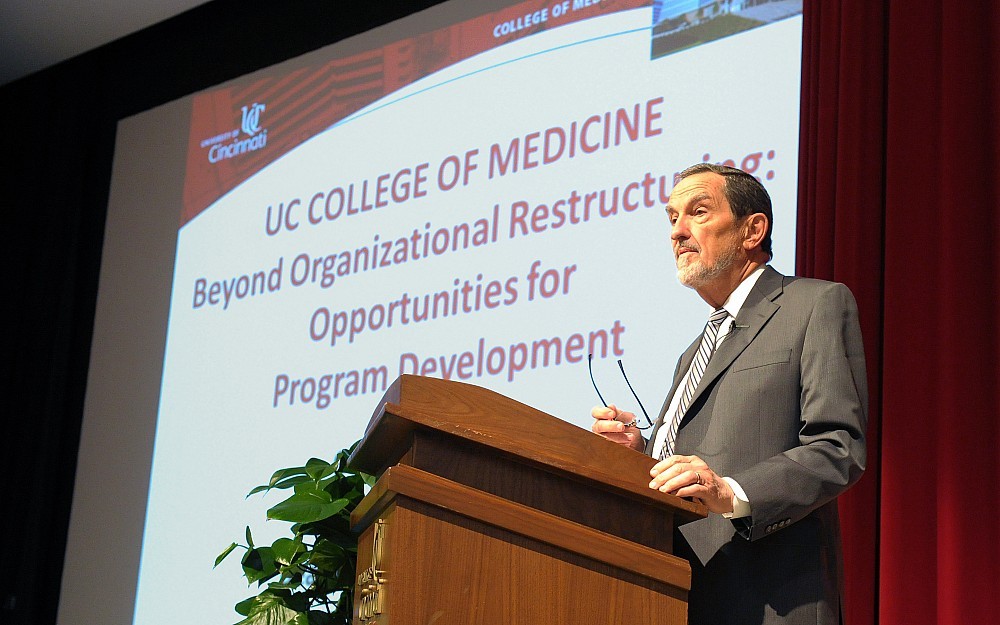
Boat, dean of the college and UC vice president for health affairs since July 2011, delivered his third annual update to faculty and staff Tuesday, Oct. 29, in Kresge Auditorium. A crowd of about 250 was on hand to hear his remarks, "Beyond Organizational Restructuring: Opportunities for Program Development.
"We have made huge strides in the development of clinical programs and in creating a curriculum that has really transformed our educational program, and we are beginning to make progress toward restructuring and revitalizing our research, Boat said at the outset of the talk.
Boat pointed to extensive restructuring that has been underway for the past few years at the College of Medicine, including the faculty practice, UC Health/University of Cincinnati Physicians integration, the UC Health system itself, which was formed after the Health Alliance was dissolved, and the colleges support services. In addition, the colleges departmental lineup has changedincluding addition of a biomedical informatics department and reorientation of basic sciences.
Boat singled out UC Health, which now includes UC Medical Center, West Chester Hospital, the Daniel Drake Center for Post-Acute Care, UC Physicians and a partnership with the Lindner Center of HOPE. Net revenues were most recently reported at $1.2 billion, only slightly lower than the old Health Alliance that included six institutions in addition to UC Medical Center.
"UC Health is the only health system in the city thats rapidly gaining market share, Boat said, citing a growth from 9 percent market share to almost 14 percent. "That is really remarkable. Further growth is going to be a goal, and its going to be important.
Another point of pride is the restructuring of medical education, with an integrated curriculum and more clinical experiences occurring in the first two years on campus. "Our medical students feel well prepared to go into the junior year clinical experiences, probably more so than they have in the past, Boat said.
In addition, an undergraduate medical curriculum is up and running, which Boat termed "an important opportunity for us to create longitudinally integrated experiences for students across the campus.
Boat also noted the recent restructuring of the health affairs campuswhich also includes the College of Nursing, the James L. Winkle College of Pharmacy and the College of Allied Health Scienceswith Nursing Dean Greer Glazer, PhD, named associate vice president for health affairs. Emphasis will be placed on promoting interprofessional activities, especially education, among the four colleges.
Challenges inevitably come with change, Boat said, and the College of Medicine has its share including mandated UC-wide compliance measures, adoption of new Funds Flow approaches intended to level the playing field for all faculty and programs, transition to an increasing level of interdisciplinary programming and fostering entrepreneurship in the face of increasing standardization.
"I dont think we can do well in the future, let alone survive, unless were working in an increasingly interdisciplinary mode, said Boat, citing such models as the UC Neuroscience Institute and the UC Cancer Institute. The Cincinnati Cancer Center, he added, is a partnership with Cincinnati Childrens Hospital Medical Center and is seeking National Cancer Institute designation under the leadership of Shuk-Mei Ho, PhD, its director.
Related Stories
UC radiation oncologist speaks with Local 12 news about clinical trial for head and neck cancer treatment
August 10, 2026

Dr. Sara Medek, a UC radiation oncology professor, speaks with Local 12 news about a new clinical trial aimed at reducing radiation in certain areas while still treating cancer effectively but with fewer painful side effects.
Cancer Center director charts future based on collaboration, AI
August 10, 2026

David Gius, MD, PhD, was featured in a Cincinnati Business Courier article and The Cancer Letter’s “The Directors" podcast discussing his priorities and goals as he recently took the helm as director of the University of Cincinnati Cancer Center.
UC graduates cross finish line at commencement
August 7, 2026
The University of Cincinnati recognized 2,125 graduates in two ceremonies at summer commencement Friday on campus at Fifth Third Arena.