Gardner Center Researchers Publish Results of Parkinson's Studies

As a disease with no known cure at present, Parkinsons disease is the focus of numerous research efforts worldwide. Researchers at the UC Neuroscience Institutes James J. and Joan A. Gardner Center for Parkinsons Disease and Movement Disorders are playing a key role in those efforts, participating in two clinical trials with recently published results.
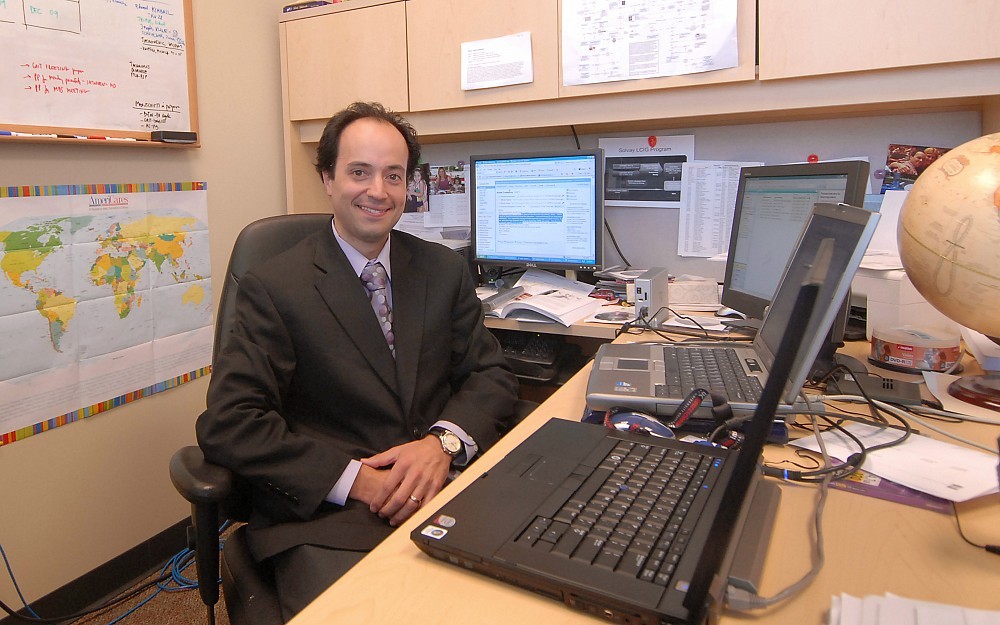
Alberto Espay, MD, an associate professor in the UC Department of Neurology and Rehabilitation Medicine and a clinician-researcher at the Gardner Center, was an author for studies published in Lancet Neurology and JAMA Neurology. UC was a site for both trials and ranked as the highest enrolling site for one of them, Espay says.
Parkinsons disease is a chronic, degenerative neurological disorder in which certain cells in a region of the brain, called the substantia nigra, begin to die. These cells produce a chemical called dopamine that is responsible for transmitting signals within the brain that contribute to the coordination of movement. The death of these cells leaves patients less able to direct or control their movements, producing a variety of motor symptoms, including slowness, stiffness, walking difficulty and tremor.
Parkinsons disease affects one in 100 people over the age of 60, the average age of disease onset. An estimated 5 to 10 percent of patients experience onset by age 40. Recent research indicates that at least 1 million people in the United States, and 6 million worldwide, suffer from Parkinsons disease.
The trial reported in Lancet Neurology compared an intestinal gel delivered via a surgically implanted tube with a similar medication taken orally. The levodopa-carbidopa intestinal gel (LCIG) was found to reduce "off time in patients with advanced Parkinsons disease who participated in the phase-3 randomized, double-blind clinical trial. "Off time occurs when Parkinsons symptoms re-emerge as the beneficial effects of oral treatments wear off.
Cincinnati was one of 11 U.S. sites that participated in the trial, supported by Abbott. (Last year, Abbott separated into two independent companies, Abbott and AbbVie, with AbbVie composed of Abbotts former proprietary pharmaceutical business.) Three sites in New Zealand also participated.
UC was the top-enrolling site, Espay says, and recently underwent an audit by the U.S. Food and Drug Administration to ensure that data was properly collected and all procedures done according to the study protocol. The audit was completed successfully.
"By now weve accumulated about three years worth of safety and efficacy data in terms of the infusion of levodopa during waking hours, says Espay, who was the principal investigator at the Cincinnati site and worked in cooperation with Nathan Schmulewitz, MD, an associate professor in the division of digestive diseases who implanted the tube.
"This trial confirmed the large magnitude of benefit documented in the open label study: This is not a cosmetic change in Parkinsons disease; its a dramatic alteration of patients function.
Espay says the trials results are under evaluation by the FDA, which must decide whether to approve the intestinal gel approach for marketing. A decision is expected in the first quarter of 2014, he says. (It is currently approved for use in Canada and many European countries.)
The second study was reported in JAMA Neurology and focused in inosine, a precursor of uric acid, delivered twice daily by capsule. As a phase-2 clinical trial, it focused on safety. Researchers found inosine to be "generally safe, tolerable and effective in raising serum and cerebrospinal fluid urate levels in early Parkinsons, and said the findings "support advancing to more definitive development of inosine as a potential disease-modifying therapy for Parkinsons.
Espay, principal investigator at the Cincinnati site, says the study began after researchers noted that patients with gout, a disease characterized by high levels of uric acid or urate, have a low rate of developing neurodegenerative conditions, including Parkinsons. Since then, several other population studies have demonstrated a similar relationship between the levels of urate and Parkinsons and even the progression of disease once established. Higher urate levels appear protective by lowering the risk of the disease and slowing its progression.
"This was the first clinical trial to see that if by up-regulating the concentration, that you could replicate the same kind of relationship that is seen naturally, he says.
To qualify, patients had to be in the early stages of Parkinsons and also at a point where they did not need to be on some sort of symptomatic therapy (i.e., their tremors were not severe enough).
The next phase of the study, Espay says, will focus on safety and efficacy. Because inosine is beneficial at a molecular rather than symptomatic perspective, a positive result would make it the first therapy for Parkinsons in which the disease itself, rather than the symptoms only, was modified.
"Altering or slowing down the disease itself is something that so far we cannot claim to have achieved, he notes.
The trial was sponsored by the Michael J. Fox Foundation for Parkinson's Research.
Tags
Related Stories
UC radiation oncologist speaks with Local 12 news about clinical trial for head and neck cancer treatment
August 10, 2026

Dr. Sara Medek, a UC radiation oncology professor, speaks with Local 12 news about a new clinical trial aimed at reducing radiation in certain areas while still treating cancer effectively but with fewer painful side effects.
Cancer Center director charts future based on collaboration, AI
August 10, 2026

David Gius, MD, PhD, was featured in a Cincinnati Business Courier article and The Cancer Letter’s “The Directors" podcast discussing his priorities and goals as he recently took the helm as director of the University of Cincinnati Cancer Center.
Bidirectional link between oral, kidney health calls for patient education, access
August 4, 2026

Despite growing awareness of the connection between oral health and chronic health conditions, patient awareness and access to dental care remain limited, according to University of Cincinnati experts who recently spoke with Healio | Nephrology News & Issues.