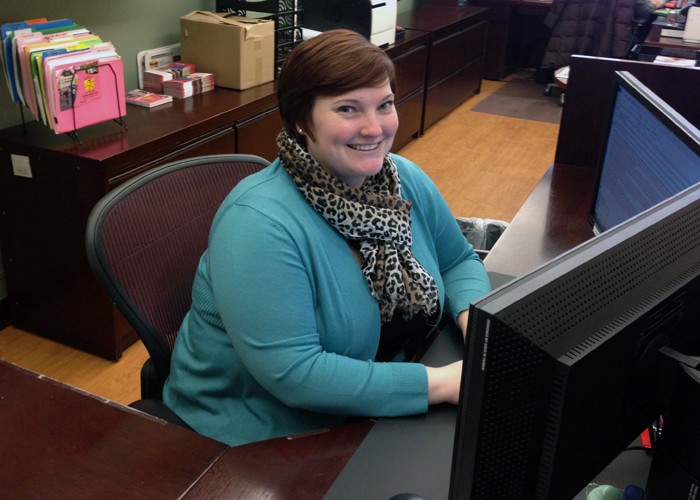
Focus On Students With Brigid Higgins

Born and raised in Cincinnati, Brigid Higgins, a masters of public health student and development coordinator for the Cincinnati Cancer Center and UC Cancer Institute, graduated from the University of Dayton with a Political Science degree. With her last semester underway, Higgins says shes learned a lot from the program and how what is taught in the classroom really plays a factor into the world around us.
Why did you choose the MPH program, and why do you feel an MPH degree is important?
"I have always worked for organizations that have been in health care-related fields, so I knew I wanted to pursue something in that field. When I started exploring different masters programs, I discovered the MPH program (which is housed in the department of environmental health) and felt that the curriculum allowed for a wide variety of discovery into the world of public health and that it would give me a solid foundation off of which to build a career.
"I think people forget (the) importance (of public health). Public health includes improving our quality of life with increasing life expectancy, worldwide reduction in infant and child mortality and the elimination or reduction of many communicable diseases because of vaccines. Additionally, the field involves quality improvement in health care processes, innovation, policy development and advocacy.
What is the most interesting thing youve learned so far?
"I have taken away so much interesting information from all of my classes overall, but the most interesting was my Understanding Vulnerable Populations course. I really enjoyed this class because it exposed me to a better understanding of vulnerable populations. I think many times we look at issues from a one-sided point of view; the way we personally would deal with the issue and not considering other circumstances that people are dealing with. It is a hard realization that different populations have disparities in health care access and quality when access and quality of care have never been an issue for me. It allowed my thought processes to go from a macro-level to a micro-level and allowed me to examine the reasons for these disparities in these particular populations.
What do you hope to do with your degree?
"I am still trying to figure out what I want to do when I graduate. I know I would like to stay local and work for one of the hospital systems, perhaps in program planning or project management.
What do you like to do in your spare time?
"I love traveling. I have a sister who lives in San Francisco and a brother who lives in Houston, so any chance I get to visit them in wine country or in warm weather makes me happy. After graduation I am planning a trip to Alaska with some of my family members, so that will be my next adventure. Other than traveling, I enjoy spending time with my friends and family, visiting local breweries, playing sand volleyball or just hanging out.
Tags
Related Stories
UC radiation oncologist speaks with Local 12 news about clinical trial for head and neck cancer treatment
August 10, 2026

Dr. Sara Medek, a UC radiation oncology professor, speaks with Local 12 news about a new clinical trial aimed at reducing radiation in certain areas while still treating cancer effectively but with fewer painful side effects.
Cancer Center director charts future based on collaboration, AI
August 10, 2026

David Gius, MD, PhD, was featured in a Cincinnati Business Courier article and The Cancer Letter’s “The Directors" podcast discussing his priorities and goals as he recently took the helm as director of the University of Cincinnati Cancer Center.
Bidirectional link between oral, kidney health calls for patient education, access
August 4, 2026

Despite growing awareness of the connection between oral health and chronic health conditions, patient awareness and access to dental care remain limited, according to University of Cincinnati experts who recently spoke with Healio | Nephrology News & Issues.