Cancer Vaccine Could Use Immune System to Fight Tumors

CINCINNATICincinnati Cancer Center (CCC) and UC Cancer Institute researchers have found that a vaccine, targeting tumors that produce a certain protein and receptor responsible for communication between cells and the bodys immune system, could initiate the immune response to fight cancer.
These findings, published in the Feb. 27 online edition of the journal Gene Therapy, build on previously reported research and could lead to new treatments for cancer.
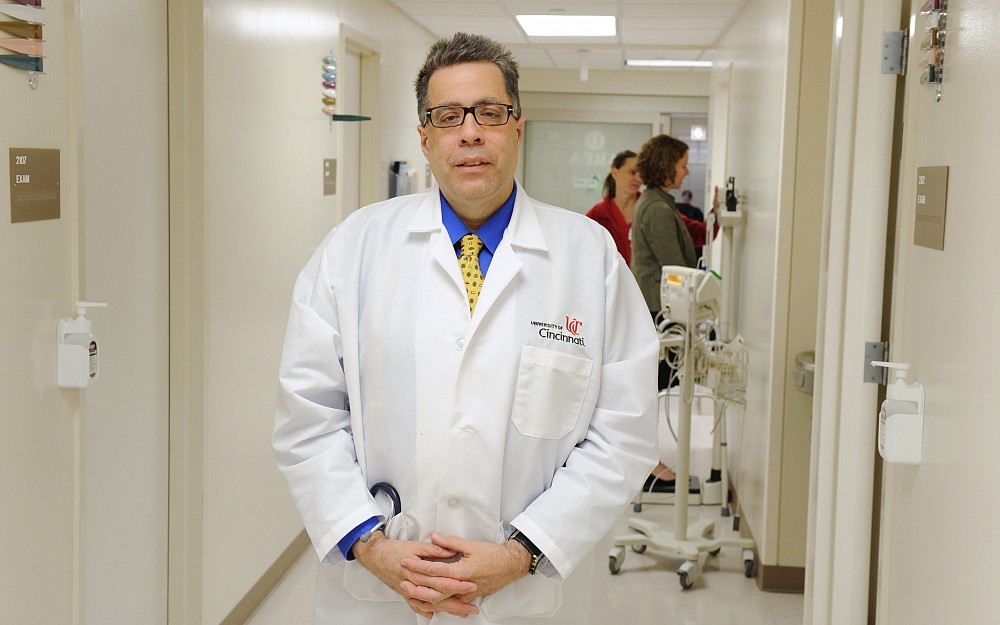
Principal Investigator John Morris, MD, clinical co-leader of the Molecular Therapeutics and Diagnosis Program for the CCC, co-leader of the UC Cancer Institute's Comprehensive Lung Cancer Program, professor in the division of hematology oncology at the UC College of Medicine and UC Health medical oncologist, says a number of antitumor vaccines have shown promise for causing immune responses against tumor antigens to improve patient outcomes.
"Recently, human Interleukin-15 (IL-15) has entered clinical trials for treatment of patients with melanoma, a type of skin cancer, and renal cancer. In this study, we examined the effectiveness of a vaccination targeting tumors that produced IL-15 and its cell surface receptor called IL-15R-alpha (a) and examined their ability to up-regulate (or increase) immune responses to tumor antigens, Morris says. "We showed that the presence of both IL-15 with its receptor IL-15Rá increased the cell-surface production and secretion of IL-15, and in turn, stopped tumor cells from reproducing.
Researchers used IL-15 to develop a whole tumor cell vaccine to target breast (TS/A) and prostate (TRAMP-C2) cancer cells in animal models; results showed that tumor cells stopped growing after the vaccine was introduced and that beneficial effects were enhanced further when IL-15Rá was co-produced by the vaccine cells.
Morris says vaccination with modified tumor cells producing IL-15 and IL-15Rá slowed tumor growth and led to increased survival for animal models. Furthermore, the cells that control the immune responses (CD8+ T-cells and NK cells) were elevated in these tumors, showing evidence of a true immune response.
"IL-15 is a powerful pro-inflammatory protein that can enhance immune responses, he says. "Our findings suggest that genetically altering tumor cells to produce IL-15 and IL-15Rá can cause and enhance immune responses to tumor antigens found in these tumor cells and can be used as a vaccine to target these antigens.
"Additionally, this provides evidence needed to begin investigating a vaccine in human cancer clinical trials to determine whether genetically modified tumor cells producing IL-15 and IL-15Rá may induce anti-cancer responses.
This study was funded by the Intramural Research Program of the National Cancer Institute, the LCS Foundation, Cincinnati, and the UC division of hematology oncology. Morris cites no conflict of interest.
The University of Cincinnati, Cincinnati Childrens Hospital Medical Center and UC Health have created the Cincinnati Cancer Centera joint effort designed to leverage the strengths of all three organizations in order to provide the best possible cancer diagnostics, research, treatment and care for individuals in the Tristate region and the nation. To learn more, visit cincinnaticancercenter.org.
Related Stories
UC radiation oncologist speaks with Local 12 news about clinical trial for head and neck cancer treatment
August 10, 2026

Dr. Sara Medek, a UC radiation oncology professor, speaks with Local 12 news about a new clinical trial aimed at reducing radiation in certain areas while still treating cancer effectively but with fewer painful side effects.
Cancer Center director charts future based on collaboration, AI
August 10, 2026

David Gius, MD, PhD, was featured in a Cincinnati Business Courier article and The Cancer Letter’s “The Directors" podcast discussing his priorities and goals as he recently took the helm as director of the University of Cincinnati Cancer Center.
UC graduates cross finish line at commencement
August 7, 2026
The University of Cincinnati recognized 2,125 graduates in two ceremonies at summer commencement Friday on campus at Fifth Third Arena.