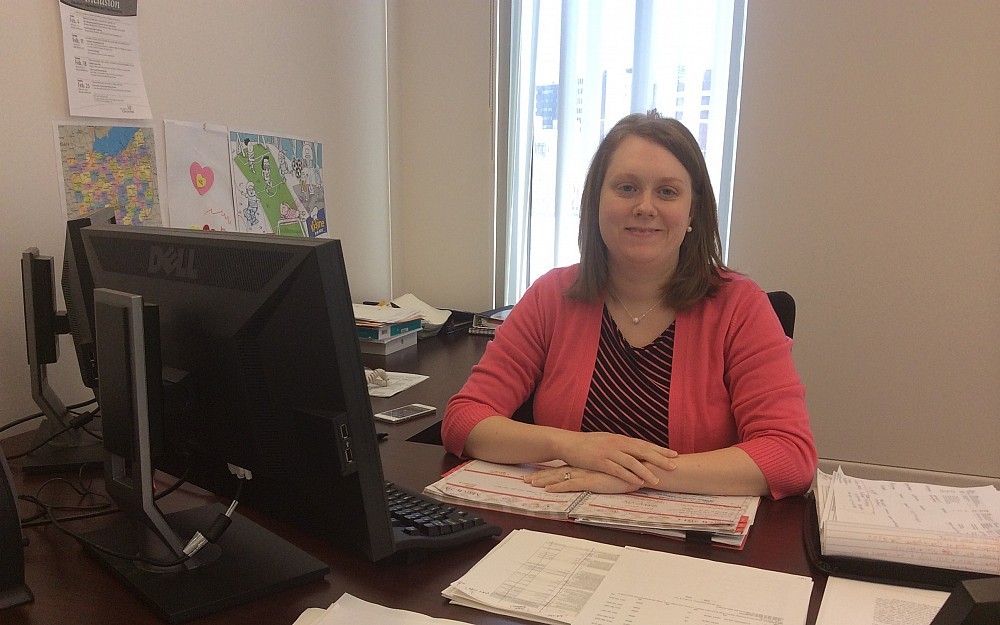
Focus on Staff: Amy Fullenkamp

Amy Fullenkamp, PhD, couldnt have predicted six years ago that shed be sitting where she is today.
A 2008 doctoral graduate from Ohio State Universitys molecular, cellular and developmental biology program, Fullenkamp had plans to be a bench scientist. But during her postdoctoral training in UCs Department of Environmental Health, she got a taste of epidemiology and opportunities to work directly with the community to better understand health problems.
She left the bench behind for a chance to finish her postdoc work with environmental healths Erin Haynes, DrPH, and completed UCs certificate in Clinical and Translational Science.
Recently, Fullenkamp was named to a program director position at the UC College of Nursing, where she is leading a newly funded planning grant from the HealthPath Foundation of Ohio. She and her team will use the next six months to gather data and feedback about needs, barriers and existing programming in place to encourage students from rural communities to pursue health-related careers.
The HealthPath Foundation project is one of many efforts underway across UCs Academic Health Center to create a more diverse and culturally competent interprofessional health care workforce.
You have a hard science background, so tell us a bit more about why you moved in the direction of epidemiology and community-based research?
"I enjoy health-based research and the thought process that is involved with developing a research project. However, over time I realized that I had a strong interest in community-based research, often called CBPR, and public health issues. I then decided to move away from the bench and translate those skills into CBPR. I am also currently working on a masters in epidemiology so that I can broaden my skill set in that area even further."
Tell us a bit more about the HealthPath Foundation of Ohio grant you are leading.
"It is a seven-month planning grant from The Health Path Foundation of Ohio. The UC colleges of nursing and medicine are conducting this research study, which is aimed at developing a pipeline program curriculum to support diverse studentsethnically, racially, gender, economically, educationally, and geographicallyto pursue health professions careers in primary care.
"We are working with the community in order to obtain their feedback on health needs as well as educational pipeline programming needs in five target areas including: Adams, Brown, Clermont, Hamilton and Warren counties.
Do you have any expectations about what you might learn from your conversations with the community?
"We could be surprised. I do think these communities are going to be excited that we are coming to them to learn about their needs from their perspectives. From those conversations, I think we will learn how to better address their suggestions and concerns regarding educational pipeline programming for students in their communities facing barriers to pursuing careers in health care.
Once youve gathered data, what are the next steps?
"Once we have gathered the data, a pipeline program curriculum will be developed in partnership with the broader University of Cincinnati Academic Health Center to address the feedback we have heard from the community. We will then submit our findings and proposal for implementation funding.
On a more personal note, tell us a bit more about you and what you like to do in your spare time?
"I have an almost-3-year-old daughter who keeps me on my toes and I absolutely love it! Outside of spending time with my family, I also enjoy gardening, sewing and crafting of all kinds.
Tags
Related Stories
UC radiation oncologist speaks with Local 12 news about clinical trial for head and neck cancer treatment
August 10, 2026

Dr. Sara Medek, a UC radiation oncology professor, speaks with Local 12 news about a new clinical trial aimed at reducing radiation in certain areas while still treating cancer effectively but with fewer painful side effects.
Cancer Center director charts future based on collaboration, AI
August 10, 2026

David Gius, MD, PhD, was featured in a Cincinnati Business Courier article and The Cancer Letter’s “The Directors" podcast discussing his priorities and goals as he recently took the helm as director of the University of Cincinnati Cancer Center.
UC graduates cross finish line at commencement
August 7, 2026
The University of Cincinnati recognized 2,125 graduates in two ceremonies at summer commencement Friday on campus at Fifth Third Arena.