UC Cancer Institute 1 of 18 Programs Chosen for Distress Screening Program

A cancer diagnosis can be devastating, and as treatment begins and side effects arise, the despair or anxiety can deepen.
Knowing this, the Commission on Cancer is requiring that providers meet a new standard to evaluate patients for distress and provide access to psychosocial care. These interventions must be in place by 2015.
"There is clear evidence that the psychosocial aspect in the care of patients is just as important as the actual treatments being deliveredits important to look at the whole person for better outcomes, says Georgia Anderson, manager of palliative care and outpatient social work within the UC Cancer Institute.
The UC team has been using the National Comprehensive Cancer Network-approved distress thermometer which measures a patients distress in a similar way to painon a scale of zero to 10, 10 being the worstmaking it easier for people to talk to their physicians about the emotional effects caused by the diagnosis, symptoms and treatment of cancer.
"However, we need a more formalized approach to use, and now that its being mandated, this creates a perfect opportunity to make it happen, Anderson continues.
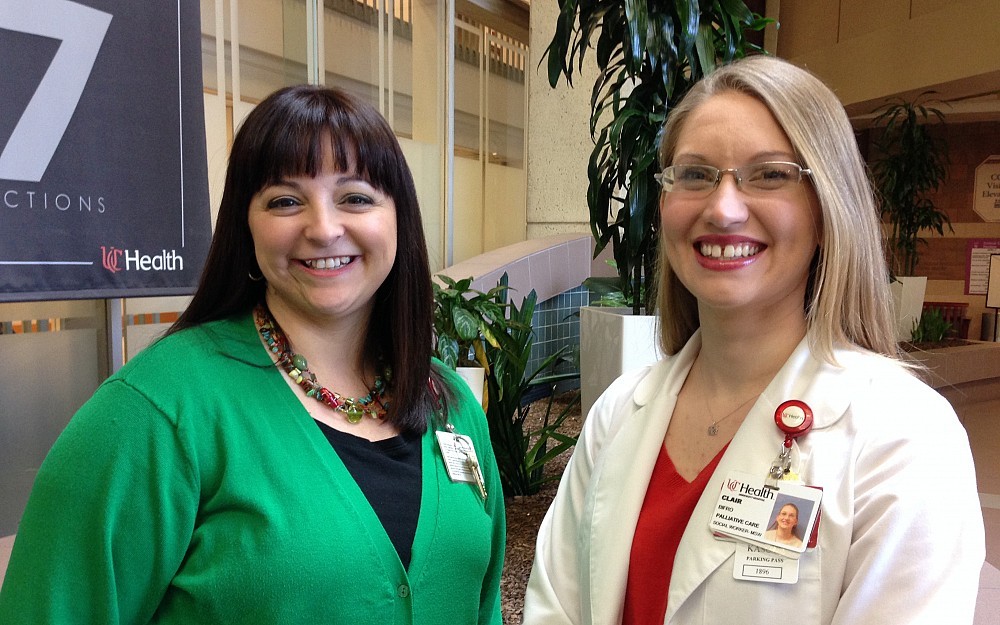
With a desire to improve this initiative at the institute, Anderson and malignant hematology and bone marrow transplant social worker Clair Bifro applied for a spot within the two-year Screening for Psychosocial Distress Program, which is funded by a grant from the National Cancer Institute and is a joint project of Yale University School of Nursing and the American Psychosocial Oncology Society (APOS).
Their program was one of 18 chosen nationally to participate.
"Its a very competitive program, and were excited to have been chosen, says Anderson, adding that the application process involved obtaining two letters of support from administrators, providing demographics about the cancer patient population at UC and detailing specific goals for the UC Cancer Institute.
As an initial step, Anderson and Bifro attended a one-day workshop at the APOS conference in Tampa, Fla., in February.
"It gave us several opportunities to connect to other programs from around the country that are similar to ours and to share ideas with one another, says Bifro, adding that there were various networking events and small group brainstorming sessions throughout the program. "There was also a representation of very diverse programs, and it challenged us to look at this standard from the big picture perspective to think about what would and wouldnt work for our program.
Anderson and Bifro will have four live online teaching sessions throughout the year as part of this program and will then attend an advanced one-day workshop and two live online teaching sessions in the second year.
In the meantime, they will be rolling out an organized, measureable program to meet their goals at the institute which include identifying specific stressors for better interventions; measuring the effectiveness of psychosocial oncology services being provided, including testing, retesting and score tracking; and growing the program by demonstrating the need for services, including adding staff and incorporating practices into treatment plans.
"Were piloting the program in four clinics to start, which include bone marrow transplant and malignant hematology, breast, lung and gastrointestinal cancers, says Bifro, adding that they are starting with newly referred patients and are hoping to collect data after the patients first visit with their cancer specialist. "We plan to begin by utilizing a hard copy of the tool for patient self-assessment but hope down the line to be able to utilize technology to improve the processperhaps even an alert in EPIC to trigger the need for social work interventions following an elevated distress score for a patient.
Currently, Bifro and Anderson are organizing a multidisciplinary steering committee to partner with the program as the screening process is developed.
"We want to be able to decide the point in care for when we need to retest for distress and show how interventions work, says Anderson. "We want to meet these people sooner, when theyre not in crisis mode, and eliminate barriers to treatment so that they can get well and feel emotionally supported.
"This will make psychosocial distress testing and care a standard practice for every patient and highlight that people with cancer do benefit from this type of assessment.
Tags
Related Stories
UC expert weighs in on current MASH treatment approaches
June 5, 2026

As MedCentral recently reported, pending broader pharmacologic approvals for metabolic dysfunction-associated steatohepatitis (MASH), lifestyle modifications remain the go-to intervention.
At least two weather patterns increase headaches, UC study suggests
June 4, 2026
University of Cincinnati physicians and collaborators identified two specific weather patterns that increase headache and migraine risk and found the preventive medication fremanezumab (Ajovy) can reduce weather‑associated headaches. The findings will be presented at the American Headache Society Annual Scientific Meeting in Orlando.
UC researcher secures $3.3M grant to study microplastics’ impact on heart
June 2, 2026
The National Institute of Environmental Health Sciences awarded a $3.3M grant to University of Cincinnati researcher Hong‑Sheng Wang, PhD, to study how microplastics and nanoplastics affect cardiovascular health.