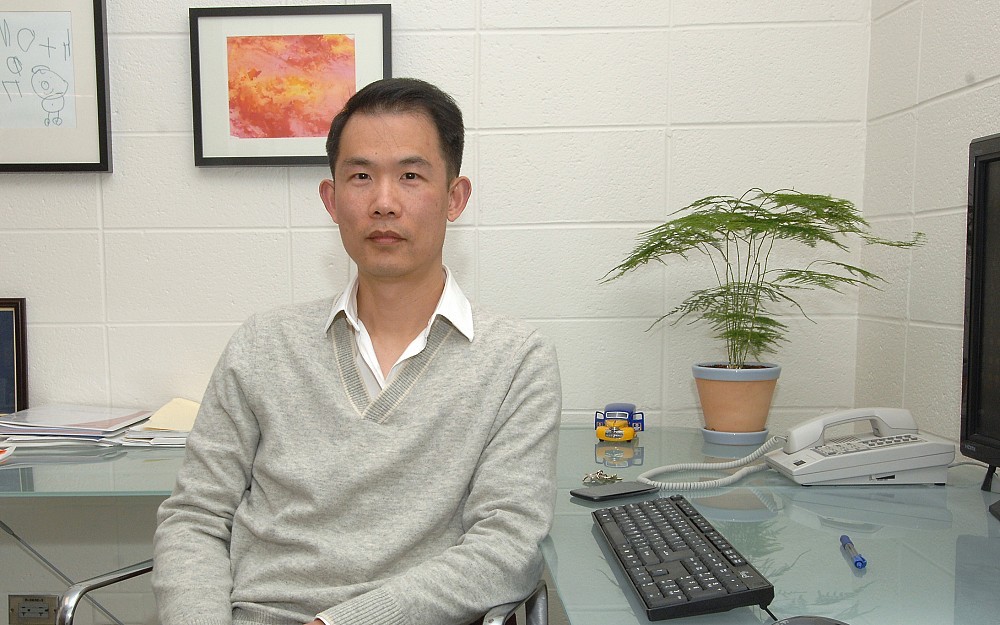
Research Adds Insight Into How BPA Affects Female Hearts

With two recently published studies, a UC researcher is adding insight into how the commonly used chemical bisphenol A (BPA) affects female hearts.
BPA, an environmental pollutant with estrogen activity, is used to make hard, clear plastic and is common in many food product containers. It has been linked to neurological defects, diabetes and breast and prostate cancer.
Hong-Sheng Wang, PhD, an associate professor in the department of pharmacology and cell biophysics, and his team had previously published several papers demonstrating that low-dose BPA promotes the development of cardiac arrhythmias in female but not male rodent hearts. With the two recent papers, they are aiming to address the mechanism of BPAs pro-arrhythmic action.
"We had previously shown that low doses of BPA facilitated the development of arrhythmias in female hearts through alteration of heart cell calcium handling, Wang says, "but the underlying mechanism was not known. Now, we are examining the cardiac-specific signaling mechanism mediating the rapid impact of low-dose BPA in female cardiac muscle cells.
"Mechanistic understanding of BPAs action is an important step toward assessment of BPAs potential toxicity, and knowing at the molecular level how BPA produces its pro-arrhythmic effect may help the development of protective measures, particularly in susceptible populations.
Wangs research is supported by a grant from the National Institute of Environmental Health Sciences (NIEHS) and also supported by the Center for Environmental Genetics, housed in the UC Department of Environmental Health.
In an article in Endocrinology (October 2013), Wangs team illustrated the signaling pathways by which BPA elicits its effects on calcium handling and how BPA affects key cardiac calcium-handling proteins. Their research showed that protein kinase A (PKA) and Ca2+/CaM-dependent protein kinase II (CAMKII) signaling pathways are the two major pathways activated by BPA.
"These pathways are likely localized and not global, impacting only their respective protein targets, Wang says.
In an article in Environmental Health Perspectives (Feb. 25, 2014), a leading environmental health journal published by the NIEHS, Wangs team addressed the cellular mechanism that gives rise to the non-monotonic dose response of BPA in the heart.
"For many chemicals, their toxicity increases with the dose of the chemicalthats the classical the dose makes the poison view, Wang says, and is the classical monotonic dose response. "BPA and other endocrine disrupters and natural hormones often have non-monotonic dose responses.
"These non-monotonic dose responses both are of scientific interest and have important implications for the assessment of toxicity of these chemicals.
In the Environmental Health Perspectives paper, Wang and his team showed that cardiac effects of BPA have dose response curves shaped like an inverted-U, or bell, and illustrated, at the cellular level, how the inverted-dose response of BPA in the heart is generated.
"A non-monotonic dose response is one where the slope of the curve changes sign, Wang says. "With such a response curve, the common practice of predicting low dose effect by extrapolation from high dose effect is no longer valid. And understanding the mechanism of such non-monotonic dose response is recognized as a key step in assessing the potential toxicity of BPA.
Wang says his future research will continue to examine the mechanism of BPAs pro-arrhythmic action in larger animals and also address the potential impact of BPA thats relevant to humans.
"Were starting to look at human tissuenormal and diseased models, he says. "Were particularly interested in diseased models that already have an underlying condition that would make the heart even more susceptible to the impact of BPA.
"I would like to mention that these innovative works were made possible by my outstanding research team, particularly the talented graduate students in my lab," Wang adds. "Xiaoqian Gao, the lead author of the Endocrinology paper, has been selected as a finalist for the 2013 Endocrinology Outstanding Student Award based on this work.
Tags
Related Stories
UC radiation oncologist speaks with Local 12 news about clinical trial for head and neck cancer treatment
August 10, 2026

Dr. Sara Medek, a UC radiation oncology professor, speaks with Local 12 news about a new clinical trial aimed at reducing radiation in certain areas while still treating cancer effectively but with fewer painful side effects.
Cancer Center director charts future based on collaboration, AI
August 10, 2026

David Gius, MD, PhD, was featured in a Cincinnati Business Courier article and The Cancer Letter’s “The Directors" podcast discussing his priorities and goals as he recently took the helm as director of the University of Cincinnati Cancer Center.
Bidirectional link between oral, kidney health calls for patient education, access
August 4, 2026

Despite growing awareness of the connection between oral health and chronic health conditions, patient awareness and access to dental care remain limited, according to University of Cincinnati experts who recently spoke with Healio | Nephrology News & Issues.