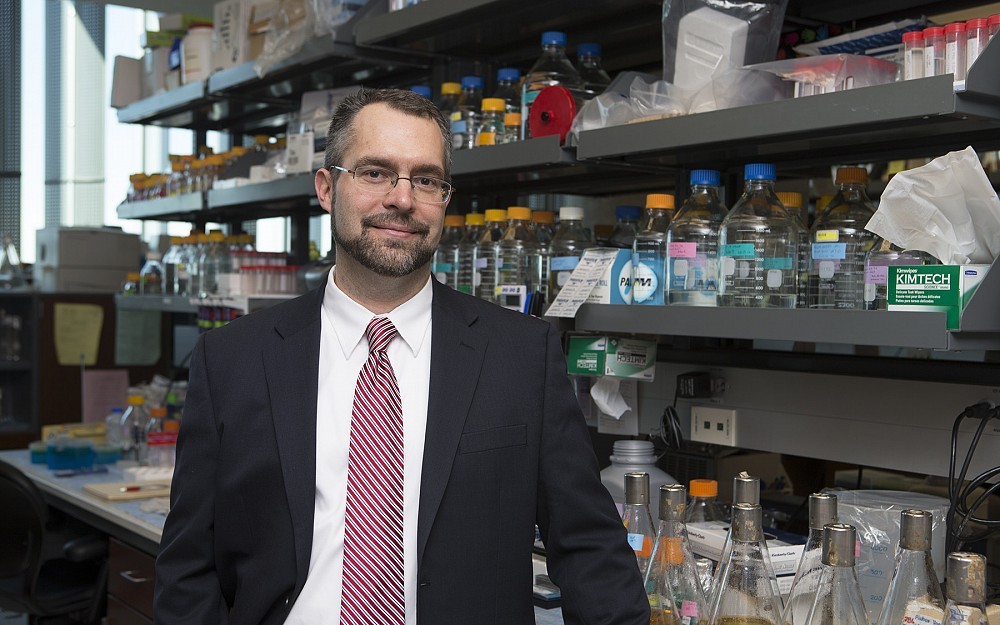
2014 Emerging Entrepreneurial Achievement Award: Andrew Herr, PhD

A breakthrough discovery in the lab of Andrew Herr, PhD, has the potential to provide a powerful weapon against hospital-acquired infections, which cause over 100,000 deaths per year in the United Statesequivalent to the number of deaths due to AIDS, breast cancer and vehicular accidents combined.
For his role in co-founding a company that has an exclusive licensing agreement to develop and market technology resulting from the discovery, Herr has been selected as UCs 2014 recipient of the Emerging Entrepreneurial Achievement Award. He was honored at the All-University Faculty Awards celebration April 17, 2014.
Herrs team in the Department of Molecular Genetics, Biochemistry and Microbiology at the UC College of Medicine discovered the mechanism by which staphylococcal bacteria adhere to one another to form biofilms, surface-adherent colonies that are resistant to antibiotic treatment and immune responses and therefore must often be surgically removed. These biofilms are remarkably adhesive and can grow on many surfaces, including implanted medical devices such as pacemakers, heart valve replacements and artificial joints.
A protein on the bacterial surface becomes adhesive in the presence of zinc, researchers discovered, creating what Herr calls a "zinc zipper that plays a key role in infections. Addition of a zinc-binding chelator (removal agent) called DTPA (diethylenetriamine pentaacetic acid) prevented the biofilm from forming, researchers found.
There are no effective products on the market today that prevent biofilm formation by Staph bacteria. UC filed a patent application covering the use of DTPA or other chelators alone or in combination with antibiotics to prevent bacterial colonization and biofilm formation. Herr was a co-founder of Chelexa Biosciences, which currently has an exclusive licensing agreement with UC to develop and market this technology.
Related Stories
UC radiation oncologist speaks with Local 12 news about clinical trial for head and neck cancer treatment
August 10, 2026

Dr. Sara Medek, a UC radiation oncology professor, speaks with Local 12 news about a new clinical trial aimed at reducing radiation in certain areas while still treating cancer effectively but with fewer painful side effects.
Cancer Center director charts future based on collaboration, AI
August 10, 2026

David Gius, MD, PhD, was featured in a Cincinnati Business Courier article and The Cancer Letter’s “The Directors" podcast discussing his priorities and goals as he recently took the helm as director of the University of Cincinnati Cancer Center.
UC graduates cross finish line at commencement
August 7, 2026
The University of Cincinnati recognized 2,125 graduates in two ceremonies at summer commencement Friday on campus at Fifth Third Arena.