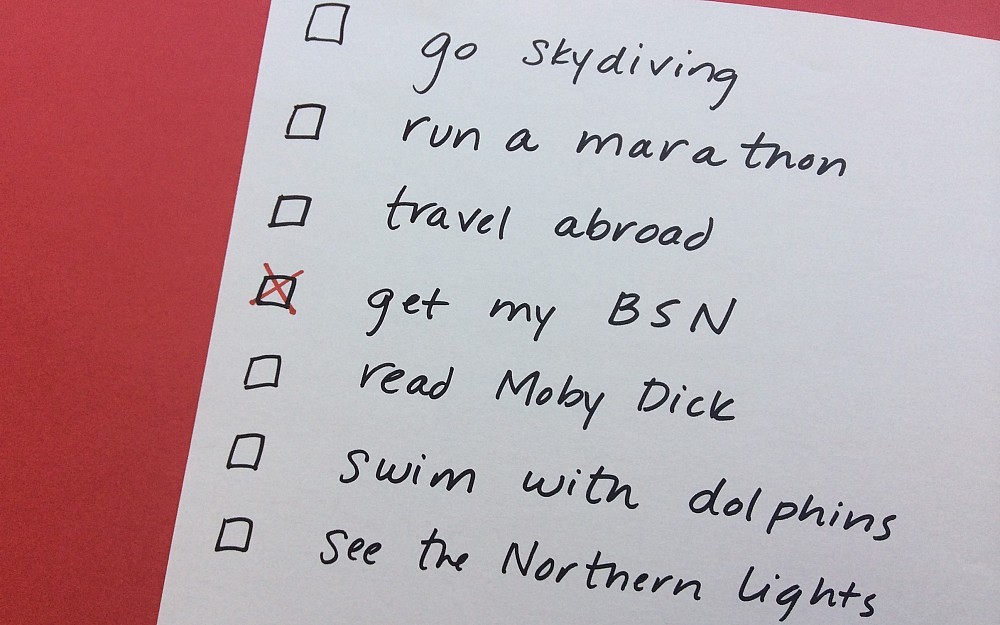
Nursing Grad Checks BSN off 'Bucket List'

You dont often hear of a bucket list that includes "get my bachelors in nursing," but thats what Debra Buck had on hers.
The 53-year-old registered nurse from Goshen, Ohio, returned to school in 2012 to scratch that goal off her list and is now even considering taking classes toward her masters.
A Lifelong Dream
"All my life I wanted to be a nurse, Buck says. "I remember spending time with my grandmamy moms mom who is 99 nowalways playing nurse and healing her dachshund, Tuttie, back to health by putting Band-Aids on her tail.
"My dad's mom was a nurse in World War II; she died when I was 2 years old. My mom had a picture of her in her Red Cross uniform and I always loved that picture.
But dreaming of being a nurse and actually becoming one were two different things, Buck recalls.
"When I graduated from high school my mom and dad and I could not afford nursing school. I worked for an OB/GYN office and the nurses in that office encouraged me to apply for nursing school at the Christ Hospital School of Nursing.
Supported by money left to her by her father-in-lawearmarked by him specifically for Bucks nursing educationthe then 36-year-old earned her diploma in 1996 and has worked at Cincinnati Childrens Hospital Medical Center ever since. She was nominated for a Daisy Award recognizing extraordinary nurses in 2013.
A nurse in the emergency department (ED), Buck says it was a desire to be eligible for a transfer that prompted her to return to school for her bachelors.
"There may come a time when I might not want to work in the ED, and in order to transfer you have to have a BSN, Buck says.
It wasnt until she returned to school that Buck learned of a national push by the Institute of Medicine for all nurses to be baccalaureate trained by 2020.
Adapting Online
UCs College of Nursing has responded to the national drive for bachelors trained nurses. The college has offered both traditional on-site and online RN to BSN programs and, in 2013, the RN to BSN program was moved exclusively online to meet the needs of working nurses in the Cincinnati region and beyond.
UCs online transition happened to fall during Bucks second year of the program.
"I never wanted to do an online class, says Buck, who thought she was "too old for that.
She was intimidated by computers and technology and had to adapt to the move from the traditional classroom to online courses.
"It was hard at first, Buck says. "I learn something new every day about the computer.
Over time, she realized the convenience of online classes, and admits that shes often up until 2 a.m. working on homework.
A first-generation college degree earner, Buck will take part in UCs commencement ceremony April 26.
"Going back for my BSN in my 50s was so challenging for me. I work with nurses my age and older who do not have a BSN and they say, I don't know how you do it.
"I would encourage any person at any age to continue to learn. It is such a great feeling to think that
April 26th, I will have my BSN.

Debra Buck is a 2014 BSN graduate from UC's College of Nursing. She completed the online RN to BSN program.
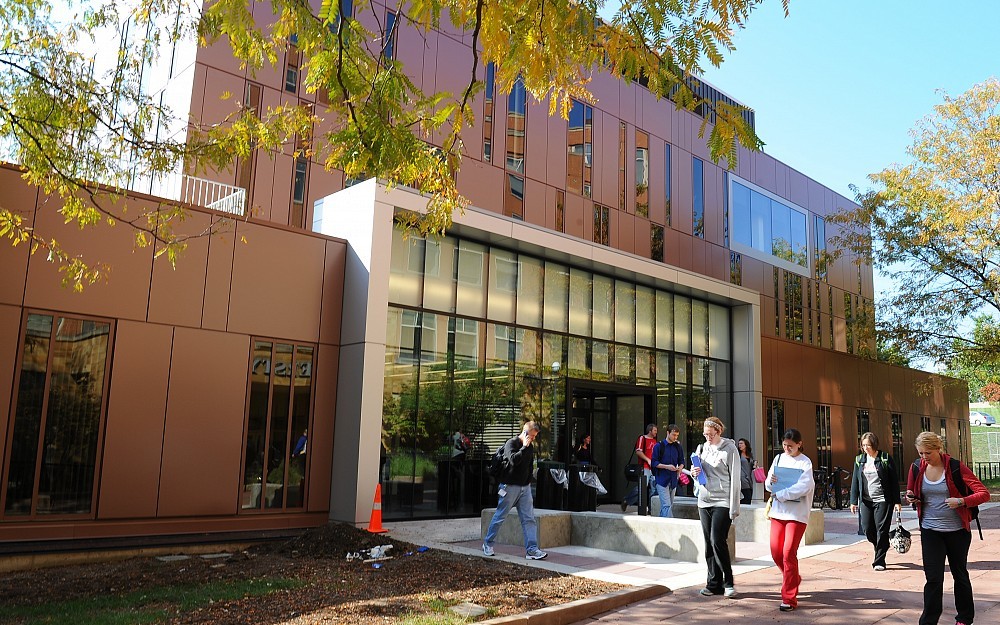
Procter Hall, home to the College of Nursing

Cincinnati Childrens Hospital Medical Center
Tags
Related Stories
UC radiation oncologist speaks with Local 12 news about clinical trial for head and neck cancer treatment
August 10, 2026

Dr. Sara Medek, a UC radiation oncology professor, speaks with Local 12 news about a new clinical trial aimed at reducing radiation in certain areas while still treating cancer effectively but with fewer painful side effects.
Cancer Center director charts future based on collaboration, AI
August 10, 2026

David Gius, MD, PhD, was featured in a Cincinnati Business Courier article and The Cancer Letter’s “The Directors" podcast discussing his priorities and goals as he recently took the helm as director of the University of Cincinnati Cancer Center.
UC graduates cross finish line at commencement
August 7, 2026
The University of Cincinnati recognized 2,125 graduates in two ceremonies at summer commencement Friday on campus at Fifth Third Arena.