Team Studies Role of Gene, Its Mechanisms in Breast Cancer Tumor Growth

During a membership event April 29, the Cincinnati Cancer Center awarded over $200,000 in pilot grants to members and basic scientists who are collaborating to find out more about various cancers with hopes of generating more data and additional funding.
Two teams received Mentee-Mentor Partnership Awards to encourage CCC members, especially young investigators, in cancer research.
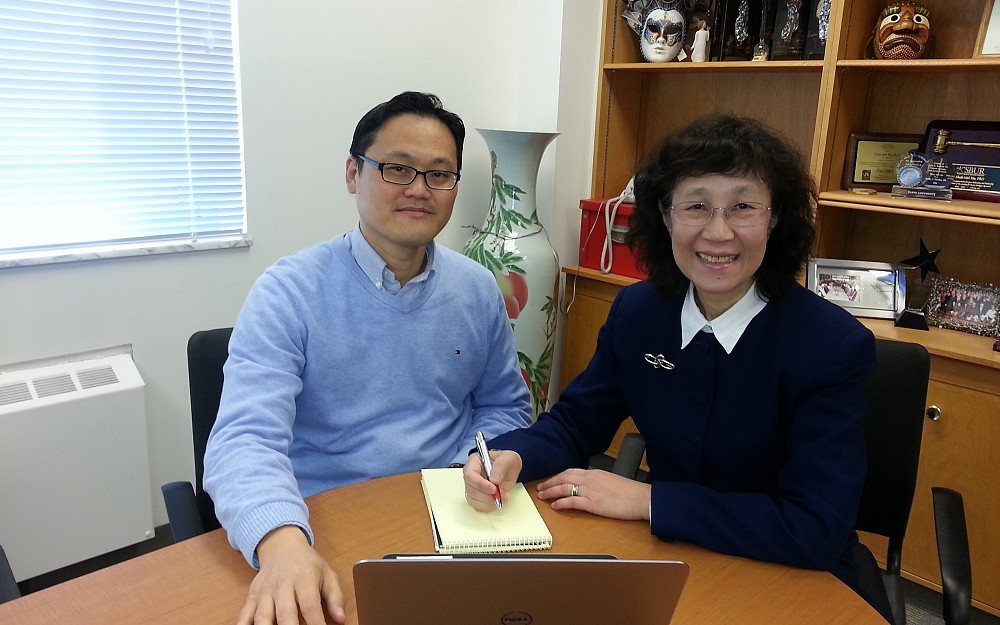
Principal investigator KyoungHyun Kim, PhD, member of the Cincinnati Cancer Center, an assistant professor in the department of environmental health at the UC College of Medicine and member of the UC Cancer Institute, came to UC from the Texas A&M Health Science Center in Houston only a year ago, but in that time hes already made strides that could help with the treatment of recurring breast cancer.
Under the mentorship of Shuk-Mei Ho, PhD, director of the CCC and Jacob G. Schmidlapp Chair of Environmental Health and professor at the UC College of Medicine, Kim is using the $19,640 CCC pilot grant to study the role of the gene ZBTB4 and the mechanisms that control this gene for slowing tumor growth in breast cancer.
"Initial onset of breast cancer is treated with hormone therapy or chemotherapy, but after a relapse, there arent many options for treatment, as the cancer has mutated and evolved into something we cannot target, he says. "The cancer cells become more aggressive and resistant to treatment.
"Prior analysis of around 27,000 genes has shown that when ZBTB4 is present at high levels in breast cancer patients, outcomes are better without recurrence; however, we dont know the mechanism in ZBTB4 which triggers this reaction, and we dont know what genes it targets to cause this tumor-suppressing effect.
"In this study, we want to find which oncogenes are suppressed by ZBTB4 and how we can target this gene to increase its effects and become a treatment for aggressive cancer.
Kim says Ho adds her expertise in epigenetics (changes in gene activity not caused by DNA) and DNA methylation, which blocks or suppresses the expression of harmful stretches of DNA that have entered the host genetic material.
"She is an established investigator and leader who can not only help further my science but also can help to teach me the way to manage and run a lab, he says.
"A mentor needs to see the potential of the mentee and help him or her realize that potential as well as introducing the mentee to a new network of collaboration, says Dr. Ho.
"Im pleased to be a member of the Cincinnati Cancer Center and to have this important funding to further my work and to enhance our overall research environment, Kim says.
The University of Cincinnati, Cincinnati Childrens Hospital Medical Center and UC Health have created the Cincinnati Cancer Centera joint effort designed to leverage the strengths of all three organizations in order to provide the best possible cancer diagnostics, research, treatment, and care for individuals in the Tristate region and the nation. To learn more, visit cincinnaticancercenter.org.
Related Stories
UC radiation oncologist speaks with Local 12 news about clinical trial for head and neck cancer treatment
August 10, 2026

Dr. Sara Medek, a UC radiation oncology professor, speaks with Local 12 news about a new clinical trial aimed at reducing radiation in certain areas while still treating cancer effectively but with fewer painful side effects.
Cancer Center director charts future based on collaboration, AI
August 10, 2026

David Gius, MD, PhD, was featured in a Cincinnati Business Courier article and The Cancer Letter’s “The Directors" podcast discussing his priorities and goals as he recently took the helm as director of the University of Cincinnati Cancer Center.
UC graduates cross finish line at commencement
August 7, 2026
The University of Cincinnati recognized 2,125 graduates in two ceremonies at summer commencement Friday on campus at Fifth Third Arena.