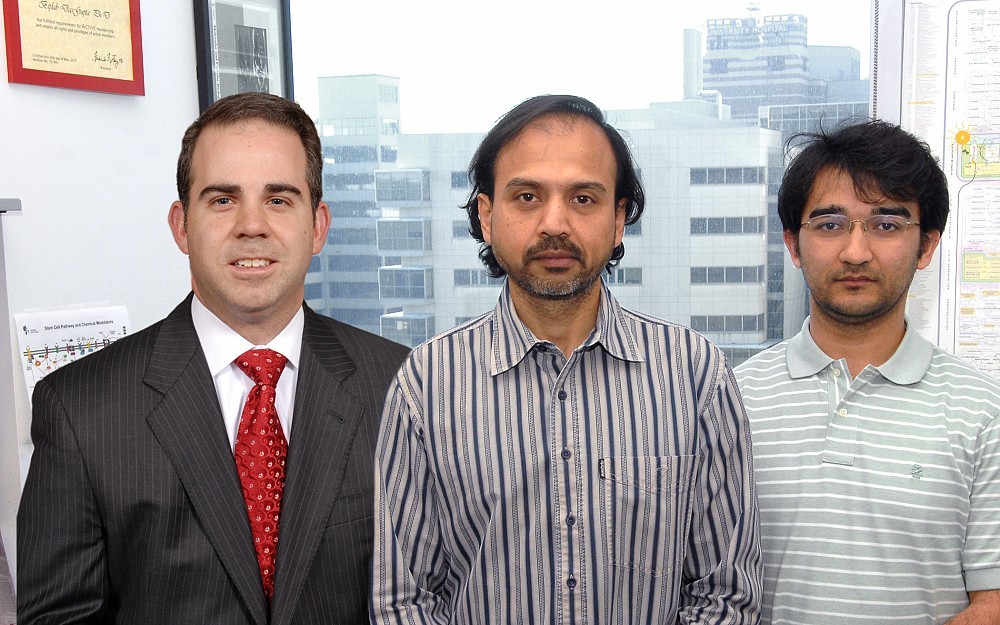
Metabolic Reprogramming in Brain Tumor Cells Could Be Potential Target

During a membership event April 29, the Cincinnati Cancer Center awarded over $200,000 in pilot grants to members and basic scientists who are collaborating to find out more about various cancers with hopes of generating more data and additional funding.
Three teams received Affinity Group Awards to encourage multidisciplinary research efforts and link CCC programs.
Cancer doesn't just happen.
It takes a lot for a normal cell to become cancerous.
"Rogue cells are usually instantly detected and our body does a pretty good job of getting rid of them, says CCC member Biplab Dasgupta, PhD, assistant professor in the department of pediatrics at the UC College of Medicine and a member of the Cancer and Blood Diseases Institute at Cincinnati Childrens Hospital Medical Center. "The saga usually begins with a mutation or any other biochemical change in the chromosome of a normal cell that somehow manages to stay on, allowing other genetic or biochemical changes to occur. These cells alter their metabolism in order to grow and spread and are hungry for specific types of food. Unfortunately, the dietary habits of humans are much to blame for the growth and spread of these rogue cells.
"It is a combination of several unfortunate events that leads to the establishment and spread of cancersometimes it takes decades.
Dasguptas lab is studying some of these initial events in cancer formation.
Now, with a $60,000 CCC affinity grant, he, along with CCC investigators Christopher McPherson, MD, assistant professor in the department of neurosurgery and a member of the UC Neuroscience and UC Cancer institutes, and Kakajan Komurov, PhD, assistant professor in the department of pediatrics and member of the Cancer and Blood Disease Institute at Cincinnati Childrens, is specifically studying metabolic reprogramming in brain tumor cells and how that can be targeted to inhibit tumor growth.
"In preliminary studies, we found that, compared to normal brain cells, patient-derived brain cancer cells express significantly more amounts of a protein called AMP kinase, he says. "This protein is very important for metabolic programming of cancer cells. We want to see if blocking the function of the protein in the tumor cells blocks tumor formation in animal models, and if it does, whether a chemical inhibitor can be used as a potential treatment for brain cancer.
He says the Cancer Genome Atlas provides a lot of data about mutations associated with various types of cancer.
"There are driver mutations and passenger mutations associated with certain genes, Dasgupta explains. "The driver mutations' roles are mostly known; however, very little is known about the role of the passenger mutations. When a driver gene gets deleted, other genes (passengers) around it also get deleted, many of which remain unnoticed and understudied because of the dominant role of the driver gene. We are examining when a driver gene gets deleted, whether it takes one or more important passenger genes with it and if this makes some brain tumors vulnerable to certain drugs.
Besides helping to treat brain tumors, he adds that this data could also help with the treatment of other tumors.
"This grant is a tremendous help, as we do not have money allocated for novel projects like this, Dasgupta says. "Without this money, we probably wouldnt be able to do this kind of research that is so important for generating data that could potentially lead to more funding from the National Institutes of Health. We are very grateful.
The University of Cincinnati, Cincinnati Childrens Hospital Medical Center and UC Health have created the Cincinnati Cancer Centera joint effort designed to leverage the strengths of all three organizations in order to provide the best possible cancer diagnostics, research, treatment, and care for individuals in the Tristate region and the nation. To learn more, visit cincinnaticancercenter.org.
Related Stories
UC radiation oncologist speaks with Local 12 news about clinical trial for head and neck cancer treatment
August 10, 2026

Dr. Sara Medek, a UC radiation oncology professor, speaks with Local 12 news about a new clinical trial aimed at reducing radiation in certain areas while still treating cancer effectively but with fewer painful side effects.
Cancer Center director charts future based on collaboration, AI
August 10, 2026

David Gius, MD, PhD, was featured in a Cincinnati Business Courier article and The Cancer Letter’s “The Directors" podcast discussing his priorities and goals as he recently took the helm as director of the University of Cincinnati Cancer Center.
UC graduates cross finish line at commencement
August 7, 2026
The University of Cincinnati recognized 2,125 graduates in two ceremonies at summer commencement Friday on campus at Fifth Third Arena.