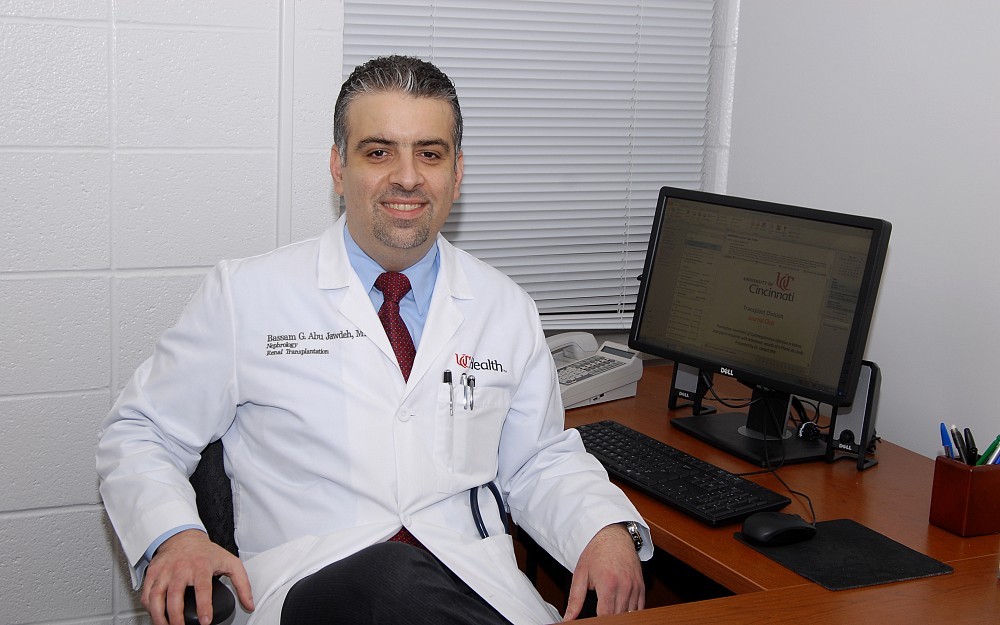
Focus on Research with Bassam Abu Jawdeh, MD

Focus On highlights faculty, staff, students and researchers at the UC Academic Health Center. To suggest someone to be featured, please email uchealthnews@uc.edu.
Bassam G. Abu Jawdeh, MD, is an assistant professor of clinical medicine in the division of nephrology and hypertension in the UC Department of Internal Medicine.
After attending medical school at the American University of Beirut and completing both his residency and fellowship at Case Western Reserve University, Abu Jawdeh completed a kidney transplant fellowship at Johns Hopkins University.
He arrived at UC in September 2011 and soon after started research partnerships in his subspecialty of transplant nephrology. His recently published review of desensitization protocols was highlighted by the American Society of Transplantation newsletter.
What motivates you to study this topic?
"More than a third of the kidney transplant candidates in this country are sensitized to human leukocyte antigens. This is a patient population with a great deal of circulating antibodies, which makes it very hard to find them a suitable matching kidney. You either have to desensitize them or work around their status to get them to transplantation, with a kidney exchange program, for example.
"If you dont find them a kidney, they are going to stay on dialysis, and thats associated with high mortality. The literature is very consistent on this: Patients who get a kidney transplant live longer than dialysis patients, as much as 20 years longer.
How did you start this review of desensitization protocols?
"My interest in humoral responses to transplanted kidneys started when I was a transplant nephrology fellow. When I arrived at UC, I started working with E. Steve Woodle, MD and Rita Alloway, PharmD, who are running a very busy clinical research program in transplantation in general and desensitization in particular. I thought that writing a comprehensive review will be the best way to learn about all the desensitization literature in a systematic way.
What did you find with the review?
"I reviewed all the previous methods that were used for desensitization in the last 10 to 15 years to allow for transplantation in highly-sensitized patients. These strategies mainly included combinations of plasmapheresis, immunoadsorption, and IVIG. Unfortunately, these efforts are still associated with poor kidney graft outcomes and a high incidence of antibody-mediated rejection.
"In the review, I also included UCs desensitization protocols, which utilized bortezomib, a drug typically used for a cancer of the plasma cells. Recent research on bortezomib used in combination with other desensitization modalities has been promising. Its still early to say its the best method, but the results seem good.
What are your next steps?
"Im interested in conducting clinical trials to investigate strategies to help prevent patients who require blood product transfusions from becoming sensitized. Im also interested in investigating complement-split product proteins as potential biomarkers for better characterizing antibody-mediated rejection.
"Moreover, and with the help of our nephrology fellows, I am now completing a retrospective study looking at contrast-induced nephropathy in transplant recipients and plan on initiating a study on hypertension in living kidney donors.
Tags
Related Stories
UC radiation oncologist speaks with Local 12 news about clinical trial for head and neck cancer treatment
August 10, 2026

Dr. Sara Medek, a UC radiation oncology professor, speaks with Local 12 news about a new clinical trial aimed at reducing radiation in certain areas while still treating cancer effectively but with fewer painful side effects.
Cancer Center director charts future based on collaboration, AI
August 10, 2026

David Gius, MD, PhD, was featured in a Cincinnati Business Courier article and The Cancer Letter’s “The Directors" podcast discussing his priorities and goals as he recently took the helm as director of the University of Cincinnati Cancer Center.
Bidirectional link between oral, kidney health calls for patient education, access
August 4, 2026

Despite growing awareness of the connection between oral health and chronic health conditions, patient awareness and access to dental care remain limited, according to University of Cincinnati experts who recently spoke with Healio | Nephrology News & Issues.