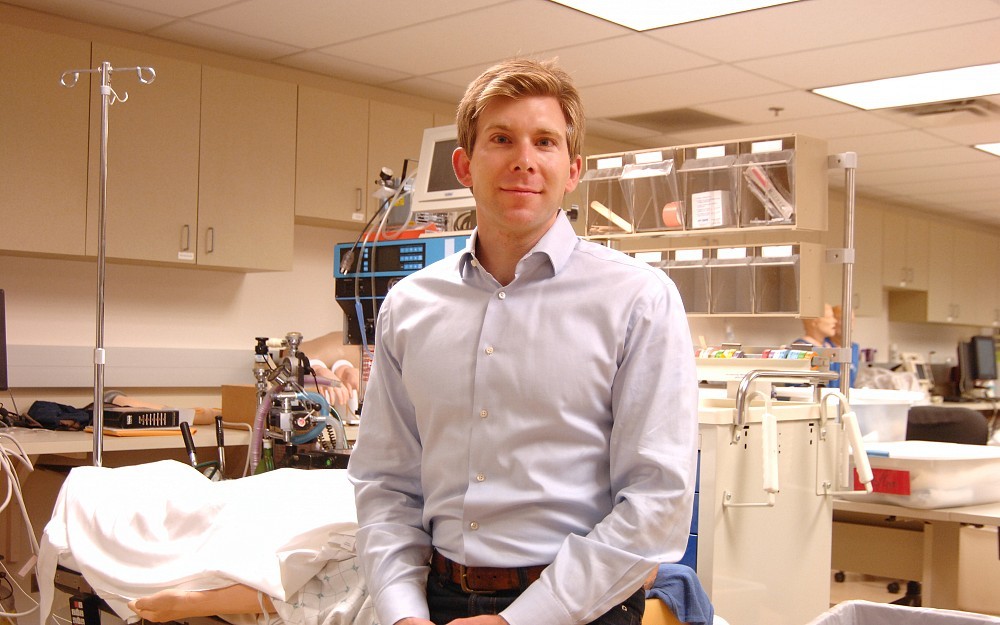
Focus on Students with Ryan Gamlin

Focus On highlights faculty, staff, students and researchers at the UC Academic Health Center. To suggest someone to be featured, please email uchealthnews@uc.edu.
Ryan Gamlin, 34, is among the new crop of incoming medical students in the College of Medicine. He and his wife, Jenna, and their 4-month-old son, Soren, moved to Cincinnati from San Francisco in July. They call Hyde Park home.
You have been in Cincinnati for little more than month. How are things going?
Very well. Any place is different when compared to San Francisco, but Cincinnati is in the midst of a renaissance. I dont think theres ever been a better time to be here. Our neighborhood, Hyde Park, has a lot of what we value in terms of walkability and community, and as far as favorite restaurants, weve come to love a place right around the corner from us; it's a combination Argentine-Italian place (Alfios Buon Cibo).
Tell us about yourself
I was born in Lexington, Kentucky, though I lived there for a grand total of something like eight daysmy dad was finishing a graduate degreeI grew up in a few places around Chicago. After High School I joined the Chicago-Oxford migration as many do and moved to Miami University, where I studied economics. After graduating I was recruited into a large managed care company, and my entire professional career since then was spent in various facets of the health care economy. Ive consulted for and worked within managed care companies, helped doctors to start facilities, worked with providers to help them understand process and workflow, and have been involved in medical technology startups in financing and business development capacities.
When did you decide you wanted to go to medical school?
It ends up sounding trite and cliché, but it was because of an emergency, or rather a series of emergencies. I have climbed and skied all around the world and I've seen people get hurt in places where it is unequivocally a really bad idea to be hurt. It only took me a time or two of standing there going, "I think we should do this or do that to realize that I needed some medical training. So ultimately it was this avocationthe outdoorsthat made me go out and enroll in an EMT (emergency medical technician) class. I found that I really enjoyed it and I decided as interesting as it was, I wanted to know more. I found a course that allowed me to train as a paramedic on the weekends, loved it, and it was about halfway through that training that I enrolled in a post baccalaureate program to complete the typical pre-medical courses that Id avoided so completely as an undergraduate.
What did your wife think of this decision to do go medical school?
First, I married really well. My wife married one guy and ended up getting another; it was literally a month after our wedding that I began thinking I wanted to leave the business of medicine and pursue the clinical side of healthcare as a doctor. My wife has always stood with me, and Im grateful for that every day.
What kind of doctor do you want to be?
To put it simply: A good one. I can't think of any other field where you get to try before you buy. The beauty of medical school is it forces you to start as a generalist and gives you exposure to specialties, and my goal is to take full advantage of the opportunity to experience the depth and breadth of specialties while I can.
What do you do for fun?
I have always been an endurance athlete, though as I get older I sometimes cant believe I used to be able to do the things that I did. Now I focus more on running and climbing when Im able, and still love to spend time in the worlds great mountain ranges whenever I can. My other passion is music, and Im fortunate to have played and recorded with both great friends and some exceptionally talented professionals.
Related Stories
UC radiation oncologist speaks with Local 12 news about clinical trial for head and neck cancer treatment
August 10, 2026

Dr. Sara Medek, a UC radiation oncology professor, speaks with Local 12 news about a new clinical trial aimed at reducing radiation in certain areas while still treating cancer effectively but with fewer painful side effects.
Cancer Center director charts future based on collaboration, AI
August 10, 2026

David Gius, MD, PhD, was featured in a Cincinnati Business Courier article and The Cancer Letter’s “The Directors" podcast discussing his priorities and goals as he recently took the helm as director of the University of Cincinnati Cancer Center.
UC graduates cross finish line at commencement
August 7, 2026
The University of Cincinnati recognized 2,125 graduates in two ceremonies at summer commencement Friday on campus at Fifth Third Arena.