Two New Papers Shed Light on Stem Cell Mobilization

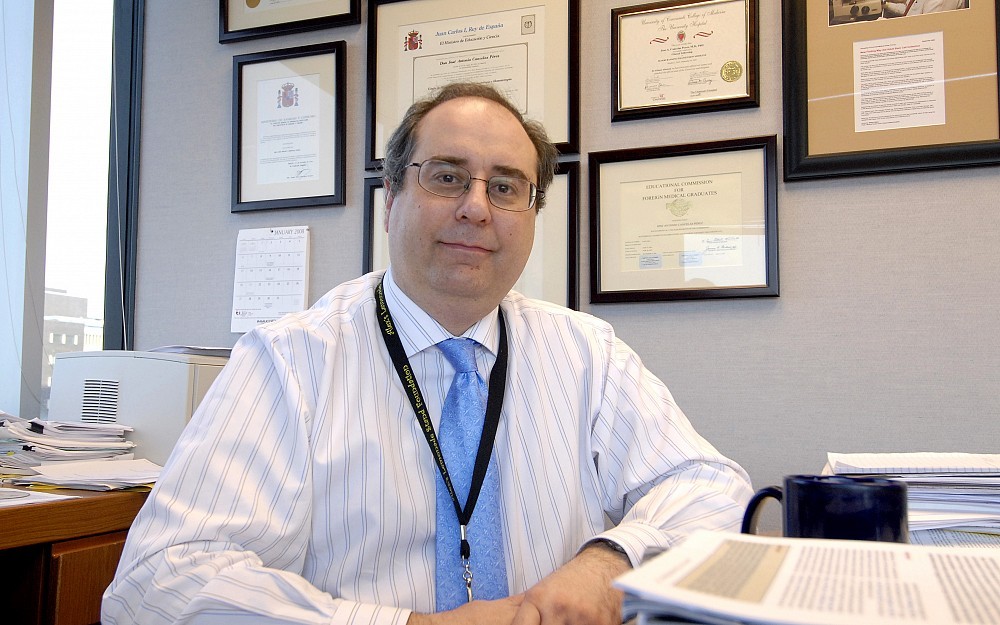
For three decades, Jose Cancelas, MD, PhD, has been on a quest to understand stem cell mobilizationsimply put, how stem cells are released in the bone marrow to the peripheral blood before they can be collected for transplant.
"My expertise is in trying to induce stem cell mobilization in people, says Cancelas, a professor of pediatrics at the UC College of Medicine and deputy director at Hoxworth Blood Center. "Patients with cancer and blood diseases require stem cell transplantation as salvage of toxical radiochemotherapy. So if we can understand how the stem cell mobilization process works, well be in a better position to reliably predict situations in which stem cells willor will notbe mobilized.
"This is a major issue, because millions of people are affected, Cancelas adds, noting that stem cell transplants are used to treat people whose stem cells have been damaged by disease or the treatment of a disease, or as a way to have the donor's immune system fight a blood disorder such as leukemia.
With the recent publication of articles in two scholarly journals, Nature Communications and Cell Reports, Cancelas believes that his group has made significant progress in this quest. Cancelas was corresponding author for both articles.
"We believe these two papers provide new concepts for understanding stem cell traffic and mobilization, says Cancelas.
In the Nature Communications article, Cancelas and colleagues at UC, Cincinnati Childrens Hospital Medical Center and Vanderbilt University School of Medicine examined a phenomenon that finds patients in organ failure of vascular origin with increased circulating hematopoietic stem and progenitor cells (i.e., blood-forming stem cells that can take on the role of any blood cell in the body).
"This phenomenon may represent a stress response contributing to vascular damage repair, says Cancelas. "So the question becomes, how can we learn from these patients?
Using mouse models of vascular disease and vascular disease associated sickle cell disease, Cancelas and his colleagues determined that acute and chronic elevated levels of a peptide hormone called angiotensin II resulted in an increased pool of circulatory hematopoietic stem and progenitor cells. With anti-angiotensin therapy in sickle cell disease (medication, for instance), the pool of circulatory hematopoietic stem and progenitor cells was decreased in mice and humans. (This publication resulted from collaboration with groups at Cincinnati Childrens led by Punam Malik, MD, co-corresponding author, and Yi Zheng, PhD, both of whom are UC pediatrics professors.)
"These results indicate a new role for angiotensin in hematopoietic stem and progenitor cell trafficking under pathological conditions, and define the hematopoietic consequences of anti-angiotensin therapy in vascular disease and sickle cell disease, says Cancelas.
"Every year, millions of patients receive anti-angiotensin therapies due to the harmful effects associated with chronic hyperangiotensinemia in cardiac, renal or liver failure, he adds. "Our study shows that this anti-angiotensin therapy modulates the levels of circulating stem cells and progenitors.
In the Cell Reports article, Cancelas and colleagues at UC, Cincinnati Childrens, Sanford-Burnham Institute in San Diego and Washington University at St. Louis examined the role of a key regulatory protein called p62 in osteoblasts, the cells that form the bones, in stem cell traffic and mobilization.
When this protein is lost in osteoblasts, mice develop a process similar to osteoporosis in humans, Cancelas says. Osteoporosis is the loss of bone mass that happens during aging in many patients. As a consequence, the bone-forming cells cannot degrade inflammatory signals coming from other neighboring cells called macrophages. Macrophages are important in chronic inflammatory processes such as rheumatoid arthritis.
As a consequence, the deficient osteoblasts secrete inflammatory signals that impair the retention of stem cells in the bone marrow, the organ responsible for forming blood, and allow their escape to the circulation.
"This paper displays for the first time the crosstalk signaling pathway that controls the relationships of macrophages (white blood cells that ingest foreign materials and thus are key players in the immune response) on the retention of stem cells in the bone marrow dependent on microphages, Cancelas says.
Patients with inflammatory diseases, Cancelas points out, often have osteopenia, or lower-than-normal bone density. The studys findings provide possible insight into that phenomenon and may explain why patients with chronic inflammatory diseases have a higher count of stem cells in circulation, he says.
Related Stories
UC radiation oncologist speaks with Local 12 news about clinical trial for head and neck cancer treatment
August 10, 2026

Dr. Sara Medek, a UC radiation oncology professor, speaks with Local 12 news about a new clinical trial aimed at reducing radiation in certain areas while still treating cancer effectively but with fewer painful side effects.
Cancer Center director charts future based on collaboration, AI
August 10, 2026

David Gius, MD, PhD, was featured in a Cincinnati Business Courier article and The Cancer Letter’s “The Directors" podcast discussing his priorities and goals as he recently took the helm as director of the University of Cincinnati Cancer Center.
UC graduates cross finish line at commencement
August 7, 2026
The University of Cincinnati recognized 2,125 graduates in two ceremonies at summer commencement Friday on campus at Fifth Third Arena.