Environmental Health Researcher Awarded National Eye Institute Grant

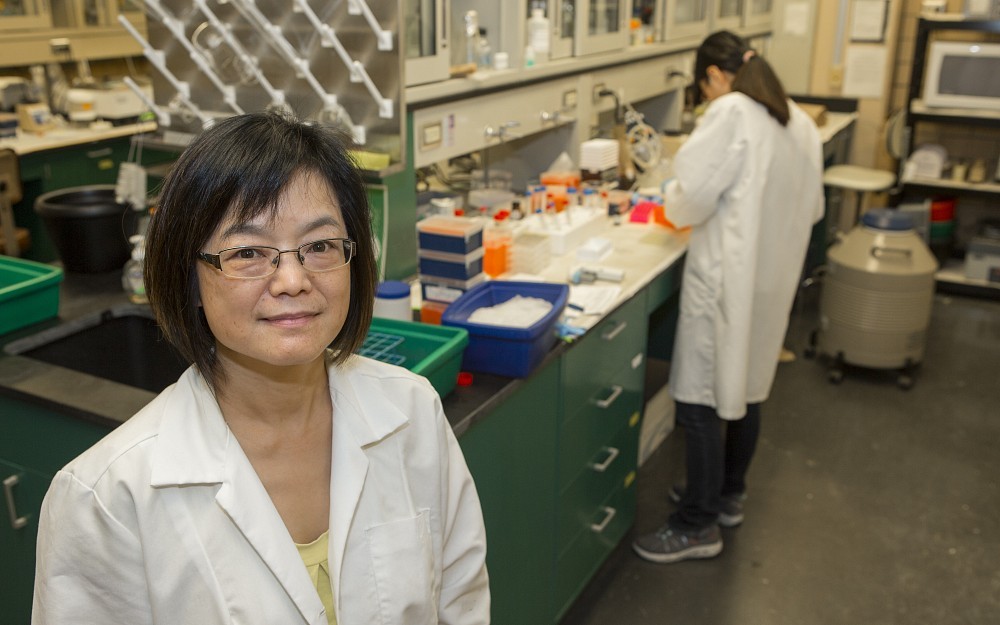
Ying Xia, PhD, an associate professor in the Department of Environmental Health, has received a five-year competitive grant from the National Eye Institute to continue her research into congenital eye disorders.
The grant, $395,729 for the first year, will fund research designed to identify defects in the MAP3K1-EGFR axis that lead to developmental eye disorders in mice. Xia is the principal investigator; co-investigators are Winston Kao, PhD, professor of ophthalmology, and Alvaro Puga, PhD, professor of environmental health.
MAP3K1 is an intracellular protein enzyme that has previously been shown by Xia and her colleagues to be essential for eye development. Specifically, her research shows, having MAP3K1 heterozygosity (different alleles of a particular gene) can render the eyelid closure program more vulnerable to perturbation by genetic and environmental insults.
"We are hypothesizing that MAP3K1 allelic lesion is a genetic risk that predisposes the development programs to eyelid defect and congenital eye anomalies, Xia says.
Xia and her colleagues propose two objectives:
They will investigate the genetic contributions to defective eyelid development by using genetically modified mice. Then, in collaboration with Jing-Huei Lee, PhD, scientific director of UCs Center for Imaging Research, they will examine, using 3D imaging, the eye abnormalities in the mutants to uncover novel structural and functional information.
They will investigate whether in utero exposure to dioxin-like compounds results in defective eyelid closure and whether the defect is associated with inactivation of the MAP3K1-EGFR axis.
"This work is part of our ongoing effort to understand and explain the genesis of congenital eye abnormalities, says Xia, who last year received a $237,000 grant from the National Institutes for Healths National Institute of Environmental Health Sciences to study the maternal environmental influences on eyelid development.
Xia is an affiliate member of the UC Center for Environmental Genetics, which is funded by NIEHS and housed in the environmental health department under the direction of Shuk-mei Ho, PhD, Jacob G. Schmidlapp Professor and Chair of Environmental Health.
Tags
Related Stories
UC radiation oncologist speaks with Local 12 news about clinical trial for head and neck cancer treatment
August 10, 2026

Dr. Sara Medek, a UC radiation oncology professor, speaks with Local 12 news about a new clinical trial aimed at reducing radiation in certain areas while still treating cancer effectively but with fewer painful side effects.
Cancer Center director charts future based on collaboration, AI
August 10, 2026

David Gius, MD, PhD, was featured in a Cincinnati Business Courier article and The Cancer Letter’s “The Directors" podcast discussing his priorities and goals as he recently took the helm as director of the University of Cincinnati Cancer Center.
Bidirectional link between oral, kidney health calls for patient education, access
August 4, 2026

Despite growing awareness of the connection between oral health and chronic health conditions, patient awareness and access to dental care remain limited, according to University of Cincinnati experts who recently spoke with Healio | Nephrology News & Issues.