Unique Expertise at UC Leads Patient to Diagnosis, Better Quality of Life

In September 2013, Dan Schmidtz, 65, a Fairfield Township resident, began experiencing shortness of breath which progressively got worse.
A trip to the emergency department revealed that he had fluid in the sac around his heart, which was drained, and then he was sent home.
However, the problems didnt stop there.
"I was hospitalized four or five times after that initial hospitalization for fluid in the sacs around my lungs, he says. "Physicians at the hospital I was going to at the time thought I had a virus or undiagnosed pneumonia. I went to the Cleveland Clinic for a second opinion, but they thought it had to do with a heart condition. I was also told I had pleurisy (inflammation of the lining of the lungs and chest). Physicians even suggested a procedure where they would insert powder in the lung sac to prohibit the collection of fluids, which I was later told could have made my situation much worse.
"I knew these diagnoses and suggested treatments werent right, and I was getting frustrated and discouraged.
A friend of Schmidtzs wife Karen suggested UC, and in January 2014, thats where he went.
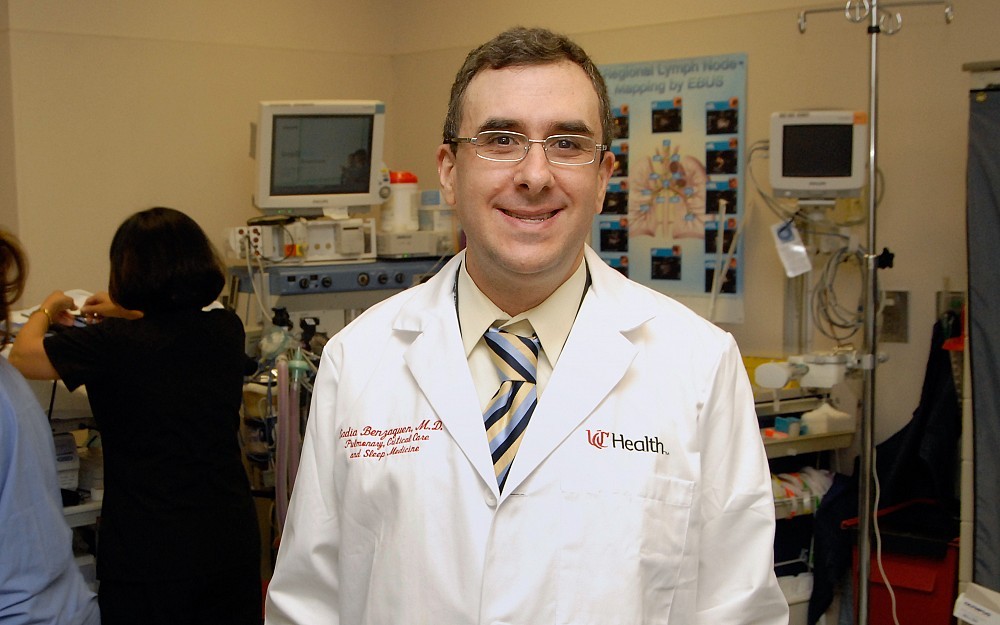
"I was admitted with fluid on my left lung again the day I came in, he says, vividly recalling the day he met Sadia Benzaquen, MD, assistant professor at the UC College of Medicine and UC Health interventional pulmonologist. "There were three doctors in the room, and one of them began reading my lung pressures out loud. Dr. Benzaquen began charting these numbers on a graph, and I wondered what in the world he was doing, but at the end of it all, he looked at me and said, I know what you have. You have trapped lung.
"I asked the other physician, Who is that guy? I wanted to give him a hug.
Interventional pulmonology focuses on the use of advanced diagnostic and therapeutic techniques to treat patients with lung cancer, pleural disease and other advanced airway disorders. Benzaquen is currently the only highly trained and board-certified interventional pulmonologist in the area, and UC is the home to this specialized program.
Trapped lung, also known as unexpandable/unexpanded lung, is a term used where a fibrous membrane develops around the lung sac and hinders it from re-expanding once fluid is removed.
Schmidtz says Sandra Starnes, MD, John B. Flege, Jr. Chair in Cardiothoracic Surgery and chief of cardiothoracic surgery and UC Health thoracic surgeon, performed the procedure to remove the membrane, known as a "peel, in March 2014. While the procedure is quite invasive, involving thoracotomy, an incision into the pleural space of the chest, and spreading of the ribs, it seems to have worked, and Schmidtz says he hasnt experienced shortness of breath since the procedure.
"Its been quite a recovery process, but I have been getting progressively better as time marches on. Now, I can do things I havent been able to do in a long time, like go to the gym or walk or even just go shopping, he says, adding that he has a large family with which he enjoys spending time.
"I had such a supportive team working together for me at UC, between the lung experts and my cardiologists, I couldnt ask for better. Dr. (Tehmina) Naz, my cardiologist, told me when I first got to UC that she wouldnt give up, and sheas well as the rest of the teamnever did. The follow-up experience with UC has been great ... encouraging, supportive and caring.
"I want others to know about the expertise available right here in Cincinnati. They told me what other experts couldnt, and my life has improved because of it.

Dan Schmitz thanks a UC team for making a correct diagnosis and improving his life.

Sandra Starnes, MD, is chief of the thoracic surgery division for the UC College of Medicine Department of Surgery.
Related Stories
Cancer Center plays key role in lab research, clinical trials for new pancreatic cancer drug
September 1, 2026

WLWT and WCPO highlighted the contributions of University of Cincinnati Cancer Center researchers that helped lead to the recent FDA approval of daraxonrasib, a new treatment for pancreatic cancer.
Cancer Center physician receives $150,000 New Investigator Research Grant to study treatment-resistant leukemia
September 1, 2026
The University of Cincinnati Cancer Center’s Sarah Skuli, MD, PhD, received a two‑year, $150,000 Leukemia Research Foundation New Investigator Grant to study TP53‑mutated leukemia, a treatment‑resistant subtype with very poor outcomes.
Heavy social media use linked to depression
August 31, 2026

U.S. News and World Report, Yahoo! News, MSN, USA Today and other national media highlight a new study by the University of Cincinnati and Northwestern University that found a correlation between heavy social media use and depression in adults.