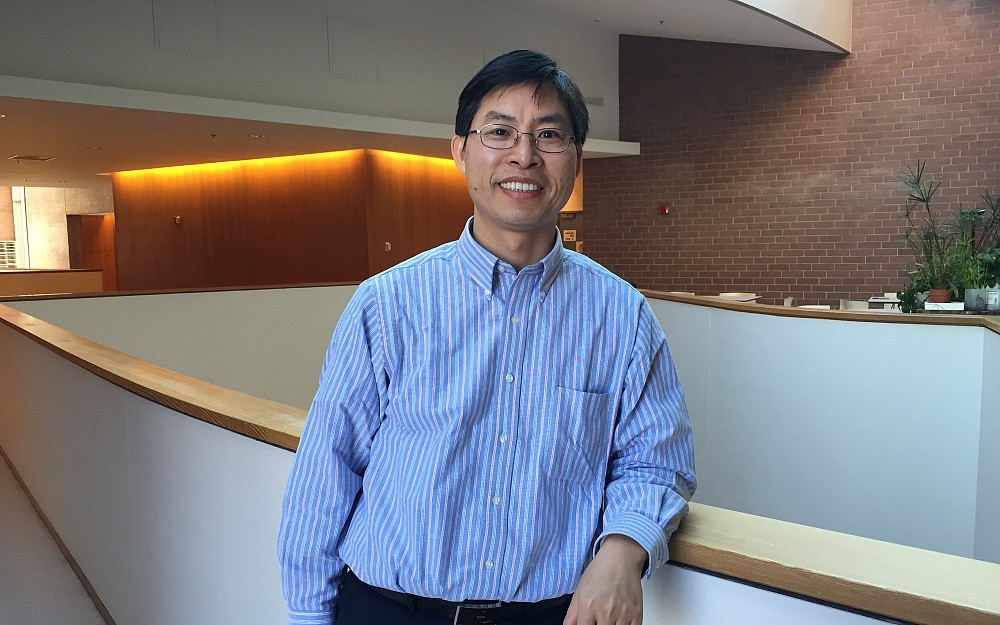
Focus On Faculty With Jianjun Chen, PhD

As part of the provosts cluster hiring initiative, Jianjun Chen, PhD, an associate professor in the Department of Cancer Biology and member of the UC Cancer Institute, joined the UC faculty in January. Chen received his undergraduate degree in genetics from Sichuan University, Chengdu, China, in 1994. In June 1999, he completed his PhD degree from Shanghai Institute of Biochemistry, Chinese Academy of Sciences, Shanghai, with a major in biochemistry and molecular biology and then became a postdoctoral fellow at the University of Chicagos department of medicine in the renowned lab of Janet Rowley, MD. Chen remained at the University of Chicago for more than 15 years, where he rose through the ranks, eventually being named an assistant professor in the department of medicine.
Why did you choose UC?
"There are several reasons that made me choose UC. Through my communications with Dr. Jun-Lin Guan, the chair of the Department of Cancer Biology, I believed that the department, College of Medicine and UC would provide me a very supportive environment for my research and long-term career development. Colleagues in this department and across the campus are very friendly, and they exhibit a strong interest to collaborate with me, which will provide me with new opportunities to expand and advance my research. Additionally, there is a very strong research team surrounding hematopoietic malignancies (forms of cancer that begin in the cells of blood-forming tissue) at Cincinnati Children's Hospital Medical Center, and many of the team members are already my friends and collaborators. Thus, my moving to UC will further enhance our collaboration. Also, Cincinnati is a nice city with warmer weather than Chicago.
Explain a bit about your research focus and why you chose to study it.
"My focus is to conduct basic cancer research in order to better understand the pathological mechanisms underlying the start and progression of and drug response to acute leukemia, a severe type of blood cancer. Im also focusing on conducting translational research in order to develop more effective therapeutic strategies to treat patients with leukemia. Despite the impressive progression made in the treatment of leukemia during past decades, a large proportion of leukemia patients, especially those with acute myeloid leukemia, still cannot survive more than five years. Thus, it is urgent to develop novel therapeutic strategies with high efficacy and specificity with minimal side effects to treat this fatal form of leukemia.
What is your hope to accomplish in this new role and with your research in coming years?
"As a cancer research scientist, I believe that the advancement of basic cancer research will bring novel insights into the pathology of diseases and may result in new approaches for the treatment of diseases. My career goal is to further advance our understanding of cancer biology, acute leukemia in particular, and to translate my discoveries from basic research into clinical application through collaboration with clinical colleagues. The cancer-associated protein-coding and non-coding genes identified from my research have the potential to serve as biomarkers for early diagnosis, as targets for new drug design and cancer therapy, and as indicators for treatment responsiveness and prognosis. Therefore, translational research will gradually become dominant in my lab research in coming years.
"As a new member of this research community, I expect to establish a strong tie and collaboration with other investigators in UC and Childrens. Especially, I hope to develop a strong research program on cancer epigenetics, a new frontier of cancer research that focuses on epigenetic regulations in cancer biology, which involves modification of DNA, proteins, or RNA, resulting in changes to the function and/or regulation mode of these molecules without altering their main sequences.

Jianjun Chen, PhD
Related Stories
On-site training in Speech & Hearing Clinic sets UC’s programs apart
August 27, 2026
At the University of Cincinnati’s Speech & Hearing Clinic, Doctor of Audiology and Speech-Language Pathology graduate students gain real-world experience while providing free speech and hearing services to the community.
Designing with cancer patients' needs in focus
August 27, 2026
Kristina Shin is designing garments that prioritize the comfort, function and confidence of breast cancer patients, addressing a need often overlooked by traditional fashion.
UC, NKU renew longstanding partnership supporting Army ROTC cadets
August 26, 2026
The University of Cincinnati Army ROTC and Northern Kentucky University (NKU) have renewed a longstanding partnership that supports students preparing to become Army officers and leaders in their communities. The universities formalized the renewed agreement during a signing event Aug. 11 at NKU.