UC Studies Safe Patient Handling to Reduce Health Care Provider Injuries

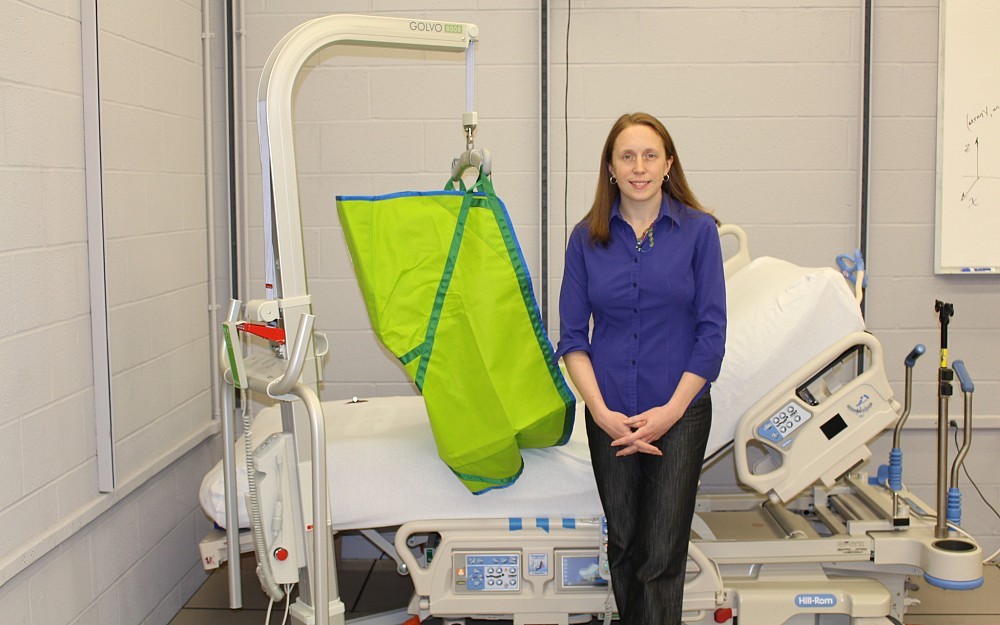
A $250,000 state grant will fund University of Cincinnati-led research to examine whether the combination of education along with the use of lift assist equipment in long-term care facilities can reduce injuries to care providers.
The study, financially backed by the Ohio Occupational Safety and Health Research Program, a division of the Ohio Bureau of Workers' Compensation, will compare the effectiveness of lifting assist equipment with and without a comprehensive training program.
"We propose that for a safe patient handling program to be effective it has to be comprehensive. It cant just be training or equipment based. You have to have all the pieces fit together, says the studys principal investigator, Susan Kotowski, PhD, an assistant professor at the University of Cincinnatis College of Allied Health Sciences and director of the Gait and Movement Analysis Lab there.
According to Kotowski, whose research focus is biomechanics of the lower back, patient handling tasks are largely responsible for the prevalent and costly musculoskeletal injuries to care providers in long-term care facilities. The greatest numbers of injuries, she says, are low back injuries which occur during "transfers. Patient transfers are classified as moving a patient in and out of bed, moving the patient from the bed to a wheelchair or even repositioning or turning the patient in bed.
The implementation of safe patient handling equipment shows promise to reduce injury, but there are barriers such as lack of training, lack of buy-in by staff, and lack of overall culture change that preclude widespread use of lift equipment in long-term care facilities.
"Patient handling injuries sideline the provider causing turnover in the institutions, which reduces their ability to provide the highest quality of care. There are also the broad financial implications of time off, medical bills and compensation, Kotowski says.
There are efforts underway to support the use of lift equipment by the Ohio Bureau of Workers Compensation. The bureau has a safety program that offers 3-1 matching funds for safe patient handling equipment.
According to state records, there are more than 1,000 long-term care facilities serving more than 80,000 residents in Ohio, and as the number of elderly continues to grow so will the number of care providers.
The study will be the first of its kind to fully develop and assess the value of a comprehensive handling program specifically designed for long-term care and will take place at 50 long-term care facilities in Ohio.
Other investigators on the study include Kermit Davis, PhD, an associate professor at the UC College of Medicines Department of Environmental Health, and Mike Fray, PhD, of Loughborough University in the United Kingdom.
Related Stories
UC radiation oncologist speaks with Local 12 news about clinical trial for head and neck cancer treatment
August 10, 2026

Dr. Sara Medek, a UC radiation oncology professor, speaks with Local 12 news about a new clinical trial aimed at reducing radiation in certain areas while still treating cancer effectively but with fewer painful side effects.
Cancer Center director charts future based on collaboration, AI
August 10, 2026

David Gius, MD, PhD, was featured in a Cincinnati Business Courier article and The Cancer Letter’s “The Directors" podcast discussing his priorities and goals as he recently took the helm as director of the University of Cincinnati Cancer Center.
UC graduates cross finish line at commencement
August 7, 2026
The University of Cincinnati recognized 2,125 graduates in two ceremonies at summer commencement Friday on campus at Fifth Third Arena.