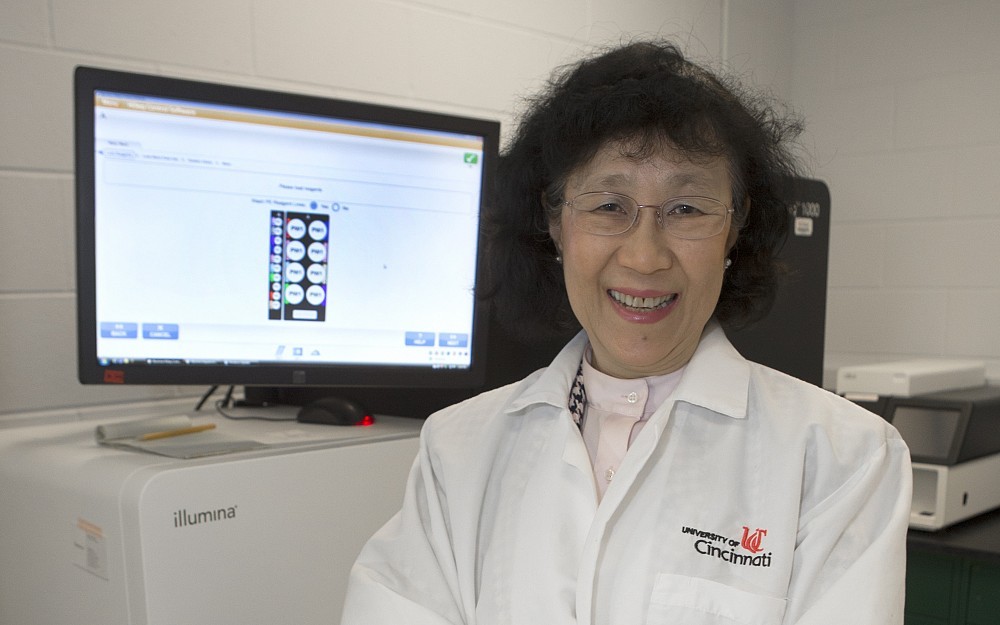
2015 George Rieveschl Jr. Award for Distinguished Scientific Research

Shuk-mei Ho, PhD, joined UC in 2005 as Joseph P. Schmidlapp Professor and Chairperson of the Department of Environmental Health. She has won over $33 million in grants from the NIH as a principal investigator.
She directs the Center for Environmental Genetics, funded by the National Institute of Environmental Health Sciences (NIEHS); the Genomics, Epigenomics and Sequencing Facility Core; and the Cincinnati Cancer Center, a consortium formed among UC, UC Health and Cincinnati Childrens Hospital Medical Center. She also holds the Hayden Family Endowed Chair for Cancer Research and serves as associate dean for basic research at the College of Medicine.
Ho is internationally recognized for her expertise in the role of hormones and endocrine disruptors on disease development and tumor formation in the prostate, ovaries, endometrium and breast.
Ho is a scientific pioneer whose discoveries have identified the way the world around us affects our health and are leading to new ways to combat disease. In 2006, research by Hos team provided the first evidence that early-life exposure to endocrine disruptors, such as bisphenol A (BPA), reprogram specific gene networks to elevate risk of disease later in life. This work led to regulatory policy changes for BPA usage in Europe and certain states in the U.S.
In the same year, Hos team discovered possible new disease biomarkers and therapeutic targets for cancer, cardiovascular disease and neurodisorders derived from estrogen receptor ESR2. It is now a fast-moving field in pharmaceutic industry.
She was also a forerunner in the development of the new field of epigenetic epidemiology which emerged around 2008. This field uses epigenomic information stored in cells to predict disease susceptibility, drug and toxicant exposure and health outcomes including those related to cancer, asthma, neurobehavioral health and reproduction.
Her work has been continuously funded by the National Institutes of Health for three decades, and in addition to the important work conducted in her lab, she is a teacher and a mentor to junior faculty and students who see inspiration in her successes as a researcher and educator.
"I strongly believe that Dr. Hos research is highly innovative and at the leading edge, showing impactful translational significance in the near- and long-term horizons, said Linda Birnbaum, PhD, director for the NIEHS and National Toxicology Program, in her nomination letter.
In 2007, Ho was recognized by the Ohio Senate for her accomplishments in reporting BPA exposure in the womb may increase prostate cancer risk and was the second woman to receive the Women in Urology Award from the Society for Basic Urologic Research and the Society of Women in Urology for her lifetime research in prostate cancer.
Related Stories
UC radiation oncologist speaks with Local 12 news about clinical trial for head and neck cancer treatment
August 10, 2026

Dr. Sara Medek, a UC radiation oncology professor, speaks with Local 12 news about a new clinical trial aimed at reducing radiation in certain areas while still treating cancer effectively but with fewer painful side effects.
Cancer Center director charts future based on collaboration, AI
August 10, 2026

David Gius, MD, PhD, was featured in a Cincinnati Business Courier article and The Cancer Letter’s “The Directors" podcast discussing his priorities and goals as he recently took the helm as director of the University of Cincinnati Cancer Center.
UC graduates cross finish line at commencement
August 7, 2026
The University of Cincinnati recognized 2,125 graduates in two ceremonies at summer commencement Friday on campus at Fifth Third Arena.