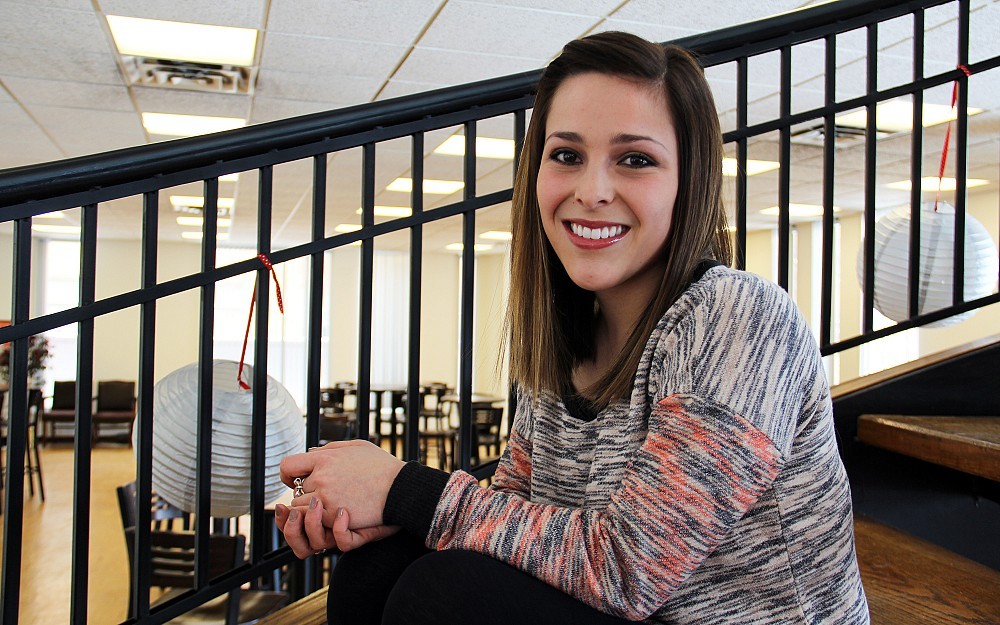
Nursing Student Not Easily Defeated on Way to Diploma

Using unfortunate, unexpected events as excuses to accept defeat is an easy task for most people. But for Brooke Dungan, a fourth-year nursing student at the University of Cincinnati (UC) College of Nursing, no obstacle can slow her down.
In December 2013, Dungan suffered a broken neck and head laceration after a drunken taxi driver crashed into a median on a bridge in Cleveland while she was riding as a passenger.
Dungan broke her C2-C3 vertebrae the area that controls the bodys breathing and respiration. After having a two-and-a-half inch screw inserted in her neck, remaining in the hospital for three days and spending three months in hard and soft neck braces, Dungan was back to her normal routine.
However, the accident occurred prior to the start of the spring semester of her third year in UCs nursing program and she was not physically or mentally able to continue with the semester. As it was necessary for her to remain in Cleveland to recover, Dungan took two online classes to prevent from falling too far behind in coursework.
"We never plan for something like that to happen, says Deborah Gray, College of Nursing assistant director of undergraduate programs and academic adviser to Dungan.
During her three-month recovery and absence from school, Dungan received academic support from Gray. Prior to the accident, Dungan and Gray had never met in person and did not maintain consistent contact. However, Dungan says she would not be where she is today if Gray hadnt helped her devise a plan to maintain her academic standings.
"I would not have been able to get back and be on my feet right now and be where I am if it wasnt for [Gray], Dungan says. "I didnt have to do anything. She set up my classes, she talked to my professors, she added and dropped classes and totally bent over backward for me.
Gray says it was Dungans will power to overcome extreme mental and physical challenges and her commitment to the recovery plan that enabled her to remain on track to graduate from the nursing program in four years.
"There were decisions Brooke had to make to let her body heal properly and stay on track, which included attending a summer semester with a group of students outside her own cohort, Gray says. "I commend our administration on working with Brookes situation to allow her to transition outside her cohort in order to stay on track.
Dungan says she and Gray now have a closer relationship and contact each other often.
"She definitely had a huge impact on me being successful in coming back, Dungan says.
In May 2014, Dungan moved back to Cincinnati to complete her pediatric clinical rotation and labor and delivery clinical rotation as a full-time student enrolled in the colleges accelerated nursing program.
Completing the summer semester positioned Dungan back on the track to graduate with her bachelors degree in nursing in May 2015.
Originally from Elyria, a city located about 20 miles west of Cleveland, Dungan says the nursing direct admittance program was the selling factor in her decision to come to UC.
Dungans greatest passion lies in caring for children, which was cultivated at a young age when her parents adopted a boy and a girl both 11.5 years younger than Dungan. It was this experience that inspired Dungan to want to obtain a pediatric position within the field of nursing.
This passion for children also influences Dungans volunteer work. She spends two hours once a week holding and calming babies born early or with medical problems at Good Samaritan Hospital in its Neonatal Intensive Care Unit (NICU.) This volunteer "cuddler position, which she started in January, serves as a stress relief in Dungans busy schedule, she says.
She further incorporates her passion and NICU volunteer experience into her academics. In the spring semester of 2015, Dungan paired with Joanne Schweitzer, MSN, RN, associate professor of clinical nursing, to complete an independent study course that focuses on the posttraumatic stress disorder mothers experience after their babies are released from the NICU. Dungan hopes to eventually publish an article in a nursing journal that discusses whether or not medical attention should be recommended for a mother whose baby spent time in the NICU and is now living at home with her baby.
Dungan has called Schweitzer her most respected professor.
"She welcomed me with open arms when I was put into the accelerated class and never made me feel behind or out of place, Dungan says. "Shes a mentor that I look up to and the absolute best teacher Ive ever had.
Schweitzer taught Dungans accelerated graduate pediatrics course in the summer semester of 2014 and said she and Dungan connected closely and quickly.
"She worked so hard, and her grades were excellent, but I mostly noted her clinical connection with all ages and stages of growth and development and varied diagnoses, Schweitzer says. "She is self-motivated and driven to be the best nurse she can be.
After experiencing her life-threatening setback, Dungan says she feels blessed to still be living and without any lasting medical side effects.
"I could have been paralyzed; I could have been on a ventilator; I really could have died, Dungan says. "I still have pain in my neck, and I still have mild setbacks, but overall Id say Im extremely blessed and lucky.
Ironically, Dungan was placed in a neurology clinical site rotation at University of Cincinnati Medical Center in the spring semester of 2015, just over a year after her accident. In this clinical rotation, Dungan helps patients with neurological disordersdisorders she could have potentially experienced from her accident.
Of the six clinical rotations Dungan will have completed by the time she graduates, her third clinical rotation experience at Cincinnati Childrens Hospital Medical Center was her favorite, she says.
"I fell in love with Cincinnati Childrens. Just walking in the doors, you dont feel like youre at a hospital, Dungan says. "Dealing with the kids is just so rewarding, and I take it to heart.
Although she is not certain as to which specific pediatric position she would like to acquire upon graduation, Dungan says she is open to her options and is researching nurse residency programs in childrens hospitals in Denver, where she plans to reside after graduation.
Dungan believes God has a plan for her, and she hopes that plan includes a future in nursing so that she can positively impact others lives.
"Everything does happen for a reason, and I dont know what that one was, but God does have a plan for me, Dungan says. "I hope I can make a huge impact on peoples lives, because I think Im still around here for a reason.
Tags
Related Stories
UC radiation oncologist speaks with Local 12 news about clinical trial for head and neck cancer treatment
August 10, 2026

Dr. Sara Medek, a UC radiation oncology professor, speaks with Local 12 news about a new clinical trial aimed at reducing radiation in certain areas while still treating cancer effectively but with fewer painful side effects.
Cancer Center director charts future based on collaboration, AI
August 10, 2026

David Gius, MD, PhD, was featured in a Cincinnati Business Courier article and The Cancer Letter’s “The Directors" podcast discussing his priorities and goals as he recently took the helm as director of the University of Cincinnati Cancer Center.
UC graduates cross finish line at commencement
August 7, 2026
The University of Cincinnati recognized 2,125 graduates in two ceremonies at summer commencement Friday on campus at Fifth Third Arena.