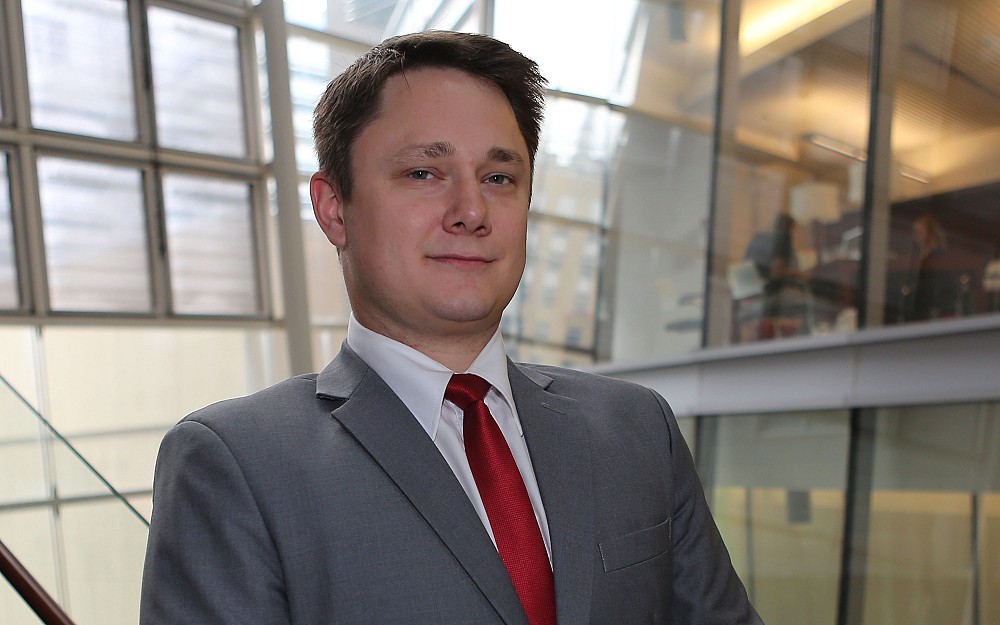
Andrew Warner, a Green Beret, was a world away serving the United States military in Iraq and Afghanistan when he encountered word of UC. He met Jay Johannigman, MD, director of the UC Division of Trauma and Critical Care.
"Dr. Jay Johaningman was a surgeon I had connected with during one of my deployments and he said Cincinnati was a great medical school, said Warner. "He said, I really think you should consider it and I really started to talk with him during my first year of college.
After his deployment ended, Warner eventually completed a bachelors in chemistry at UC and began shadowing physicians in UC Medical Centers trauma unit.
"I think I did over 200 hours before I started medical school, said Warner. "I really liked the program and instructors. I also had the advantage of my wife (she was his girlfriend at the time) finishing pharmacy school in Cincinnati so I could stay here.
Warner, 32, had faced many challenges as a Green Beret and was accustomed to difficult conditions that were often not just physically demanding but mentally draining. He learned Arabica category 3 language as complex and difficult as Mandarin Chinesewithin six months and operated in hostile scenarios witnessing service members being shot, stabbed, bitten or blow up by rocket-propelled grenades.
Yet, he still found a way to connect with local residents and realized that while their customs and culture were different, their humanity was as real as his own.
"We eat their food and drink their water, said Warner. "Sometimes we live on bases but we often live in small team houses. We rely on the national population to prevent us from getting hurt and you learn to respect the dynamics of those environments and how your relationship with them affects your life.
Memories of those experiences eventually took their toll showing in the midst of Warners first year of medical school. His struggle with post-traumatic stress disorder (PTSD) made the transition at UC a bit rocky so he took a year off for medical leave to regroup.
"I realized I had to take care of myself before I could took care of patients, said Warner. "PTSD is something you live with but you are not defined by it. I am open with groups and I talk with people about PTSD...I dont think a lot of doctors like to talk about their faults, the things that make them human.
But Warner shared his experiences with post-traumatic stress disorder by presenting sessions about it to his fellow medical students.
"When I talk about PTSD to students, I speak with them about how you can talk to a patient who might be guarded because they have lost that trust or they have these reactionary symptoms, said Warner.
"I like to talk about how PTSD affects families, he said. "My wife was at this last meeting I had here and she ended up talking too. The best management for PTSD is having families know what goes on and offer ways to mitigate high-anxiety environments.
"Admittedly, I think if I had just driven through med schooland I think I could have and not taken that medical leave and not taken care of myselfI think it definitely would have affected me
leaving the profession, or leaving my relationship or leaving society and becoming something not normal, said Warner. "I recognized my feelings werent normal and I needed to take care of them.
Fortunately, one thing Warner wasnt so good at was quitting. After medical school, he will take a year to do research at Cincinnati Childrens Hospital Medical Center before seeking a residency program. It will give him more time with his wife and their five-month old daughter, Blakely Mae, and allow him to determine which program best suits him.
"I think the non-linear journey is the most rewarding journey sometimes, said Warner.